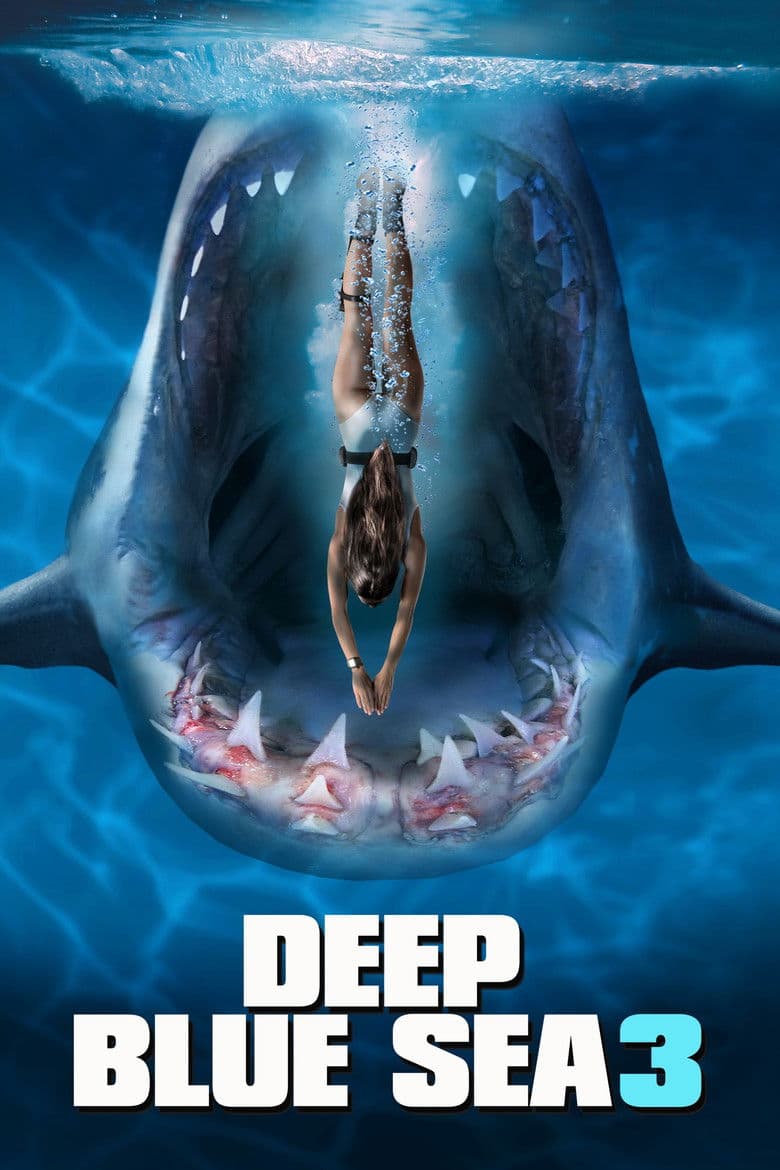
Dr. Emma Collins leads a small team of marine scientists on Little Happy, a sinking island near Mozambique. The team studies how rising seas and warmer water affect great white sharks that return there to breed. Emma’s ex-boyfriend Richard arrives with a private research crew to capture three genetically changed bull sharks. The film turns the island, its flooded village, and its sinking buildings into a tense trap filled with shark attacks, explosions, and rough action.
The film places climate change at the center of Emma’s work and says that carbon pollution warms the ocean, raises sea levels, and harms wildlife. Emma is a highly skilled female scientist who also leads dives, fights armed men, and saves the people around her. Nandi, a local African woman, joins Emma in the final fight, while the men around them often die, betray the group, or need rescue. The story also treats corporate science and private profit as threats to the ocean, but most of the movie remains a violent shark adventure.
Community feedback
Was our 36% Woke rating accurate?
Breakdown
These are the editorial factors and ratings behind our score for Deep Blue Sea 3.
Woke representation / casting
Emma leads the research team and the action scenes as a highly skilled female scientist. The team also includes Black scientist Eugene, Japanese student Miya, and African locals Nandi and Bahari. Nandi helps Emma in the final fight, while the mixed team is visibly diverse. The setting explains the local African characters, so this is a mild representation signal rather than a central identity message.
22%
Woke political dialogue
Emma opens the film by explaining that carbon emissions warm the sea, raise water levels, reduce food, and cause species loss. Emma says that danger to sharks also threatens people, so the film treats climate change as a direct human warning. Richard later says that climate change will make the world smaller and make some people rich. The film repeats the climate topic during the shark plot, but it does not build a wider party or election message.
33%
Identity-driven story themes
Emma is the movie’s central hero, and her science work and personal choices drive the survival plot. Emma answers a man’s offer to bring in a strong male helper by saying that her degree does not make her helpless. Emma leads dives, disables the mine, fights the mercenaries, and kills the last bull shark. Nandi joins Emma in defeating Lucas, while several male characters die or fail to control the crisis. These repeated choices give the film a clear female empowerment message, although the story is still mainly a shark thriller.
39%
Western institutional / cultural critique
Not present. The company’s unsafe shark research is a standard science-thriller villain plot. The film does not make a wider activist attack on Western culture, men, families, religion, or social rules.
0%
Woke character or canon changes
Not relevant. The movie carries forward the genetically altered sharks from Deep Blue Sea 2, but it does not make a woke or identity-driven change to an established character, canon, or real event.
0%
Anti-woke backlash and complaints
Small X accounts called the movie woke garbage or a climate-change PSA with feminist undertones. One Rotten Tomatoes audience review called the film a finger-wagging sermon and attacked its girlboss lead. A Blu-ray forum user mocked the environmentalist premise. The reaction was scattered, and the available evidence shows no organized boycott or review-bombing.
18%
Creator track record context
The supplied creator notes give the director, writers, and producers no documented activist or DEI profile. Casting director Ko Iwagami has a representation-focused mission around Asian casting, while the other casting notes show little related activity. Tania Raymonde’s title interviews describe Emma as a strong scientist and connect the role to climate change and female strength. The wider creator record gives only limited support for a woke reading.
8%
Production

Movie · 2016
Picking up immediately after the events in Resident Evil: Retribution, Alice is the only survivor of what was meant to be humanity's final stand against the undead.

Movie · 2025
Special Forces commandos on a mission are abducted mid-operation by a mysterious spacecraft. Upon waking aboard, they find themselves prey to a relentless alien race in a fight…

Movie · 2021
Once the booming home of pharmaceutical giant Umbrella Corporation, Raccoon City is now a dying Midwestern town.

Movie · 2024
In the near future, on a decimated Earth, Paul and his twin sons face terror at night when ferocious creatures awaken.

Movie · 2016
When a massive, gilled monster emerges from the deep and tears through the city, the government scrambles to save its citizens.

Movie · 2016
Set in a near future, technology-reliant society that pits man against killing machines. Against this backdrop an elite army unit is helicoptered to a remote, off-the-grid island…
Movie · 2025
During the Vietnam War, a recon unit ventures to an isolated jungle valley to uncover the fate of a missing platoon.

Movie · 2017
A story of broken humanity following the invasion of a technologically superior alien species. Bleak, harrowing, and unrelenting, the humans must find enough courage to go on…
