Movie review
September 26, 2017 · 16 min · PG-13 · Sci-Fi · Animation · Thriller
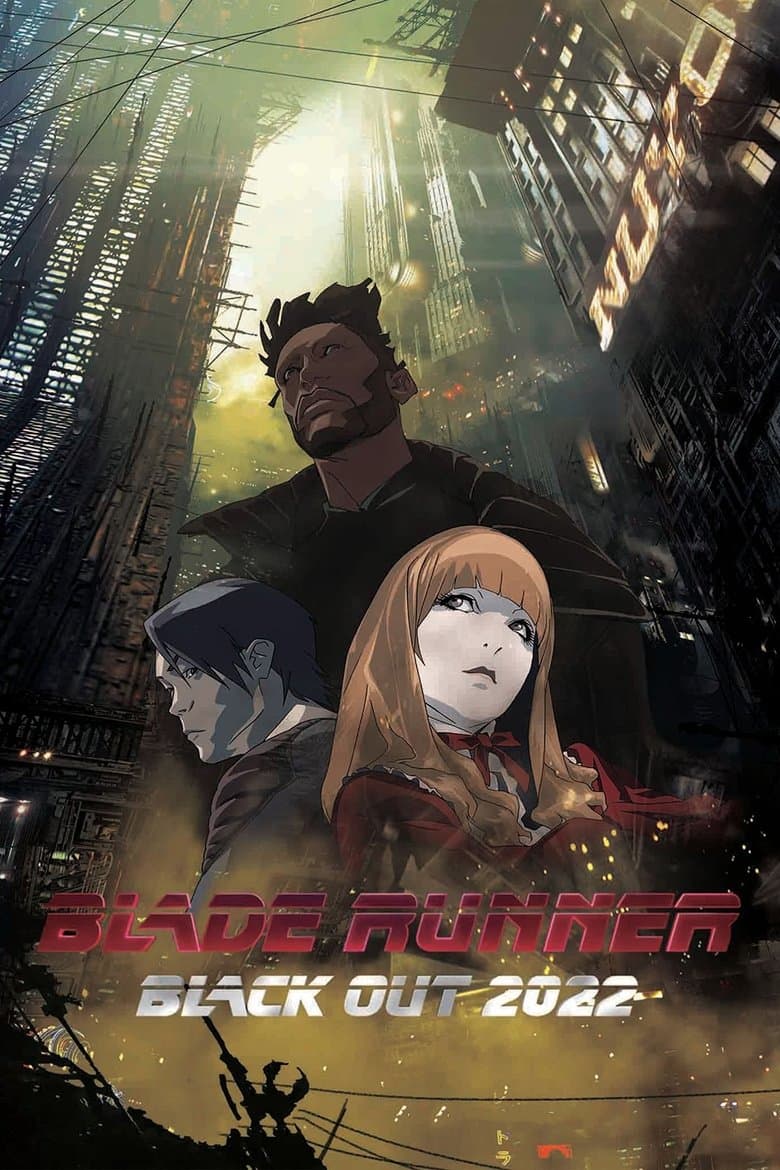
Blade Runner: Black Out 2022 follows Iggy, a Nexus-8 replicant and former soldier, in Los Angeles in May 2022. Humans hunt the new replicants because a public database lists who they are. Iggy joins Trixie and Ren in a plan to destroy the database by crashing a nuclear test missile over the city and attacking the Tyrell Corporation’s servers. The short has a dark, violent, fast-moving tone, with neon streets, gunfire, flying cars, and a bleak ending.
The film gives its main conflict an identity-driven shape by showing replicants as a marked group that is called nonhuman and hunted by ordinary people. Iggy says both sides of a war were only replicants used as toy soldiers, and he says the rebels fight for the right to live. Trixie and Iggy erase the records so they can pass as human, while Ren helps them because he cares for Trixie. The story treats the rebels as brave victims and Tyrell’s system as cruel, although it uses science-fiction rights language rather than direct modern race, gender, or DEI politics. The message is important to the whole plot, but the story stays focused on replicant freedom, violence, and survival rather than a wider culture-war debate.
Community feedback
Was our 38% Woke rating accurate?
Breakdown
These are the editorial factors and ratings behind our score for Blade Runner: Black Out 2022.
Woke representation / casting
The short places black and Asian characters among its main visible roles. Trixie is a prominent female replicant who takes part in the raid and gets a major fight scene. Los Angeles can support a mixed cast, and the film does not present the casting as a diversity campaign.
18%
Woke political dialogue
Human attackers call replicants nonhuman and demand that they be hanged. Iggy says both sides of a war were only replicants used as toy soldiers. Iggy says the rebel group fights for the right to live, and the group erases its records to become almost human. The short repeats this freedom message, but it does not mention race, gender, DEI, or current politics.
35%
Identity-driven story themes
The story treats replicants as a marked group whose names are stored so humans can hunt them. Iggy and Trixie join a freedom movement that risks a citywide blackout to remove that mark. The film presents their fight for life and freedom as the heart of the plot. The theme is a strong group-rights message, but it stays inside the fictional human-versus-replicant conflict and does not name modern race, gender, or queer politics.
35%
Western institutional / cultural critique
Tyrell keeps a database that helps humans find and kill replicants. The military treats replicants as disposable soldiers, and the corporation uses them as products. The film therefore criticizes a powerful company and human supremacy. It does not turn that criticism into a direct attack on present-day capitalism, patriarchy, Christianity, or Western family life.
26%
Woke character or canon changes
Not relevant. The short adds Iggy, Trixie, and Ren to the timeline. It does not change the race, gender, sexuality, or hero role of an established character.
0%
Anti-woke backlash and complaints
Not present. The separate X pass found no anti-woke reaction. Checked Reddit, Letterboxd, and news coverage discuss length, animation, story, and canon fit rather than woke or DEI messaging.
0%
Creator track record context
Cached context gives Shinichiro Watanabe a 49/100 score for support of mixed global casts and social-issue stories. Cached context gives Broderick Johnson 26/100 for Democratic policy and opportunity work. Cached context gives Koichi Watanabe 0/100, with no clear activist or DEI record. This creates moderate creator track record context, while the short itself is not sold as a diversity project.
29%
Production
Movie · 2022
The Red Ribbon Army, an evil organization that was once destroyed by Goku in the past, has been reformed by a group of people who have created new and mightier Androids, Gamma 1…
Movie · 2017
This in-world short film takes place in the year 2036 and revolves around Jared Leto’s character, Niander Wallace.
Movie · 2026
Two dandelion balls are the only survivors of a series of nuclear explosions that are destroying the Earth. At the end of their odyssey, they will find a new soil for the survival…
Movie · 2016
Robin is sent by Batman to work with the Teen Titans after his volatile behavior botches up a Justice League mission.

Movie · 2017
Jimmy is a committed child psychologist who uses his own playbook, but when he is brought in to work with Ellie, he is completely unprepared for his subject—a 9-year-old…
Movie · 2024
Ella Blake, a stop-motion animator struggling to control her demons after the loss of her overbearing mother, embarks upon the creation of a film that becomes the battleground for…
Movie · 2024
An elite trio of astronauts aboard a years-long, possibly compromised mission to Saturn's moon, Titan, gears up for a highly dangerous slingshot manoeuvre that will either…
Movie · 2018
Batman, along with many of his allies and adversaries, finds himself transported to feudal Japan by Gorilla Grodd's time displacement machine.
