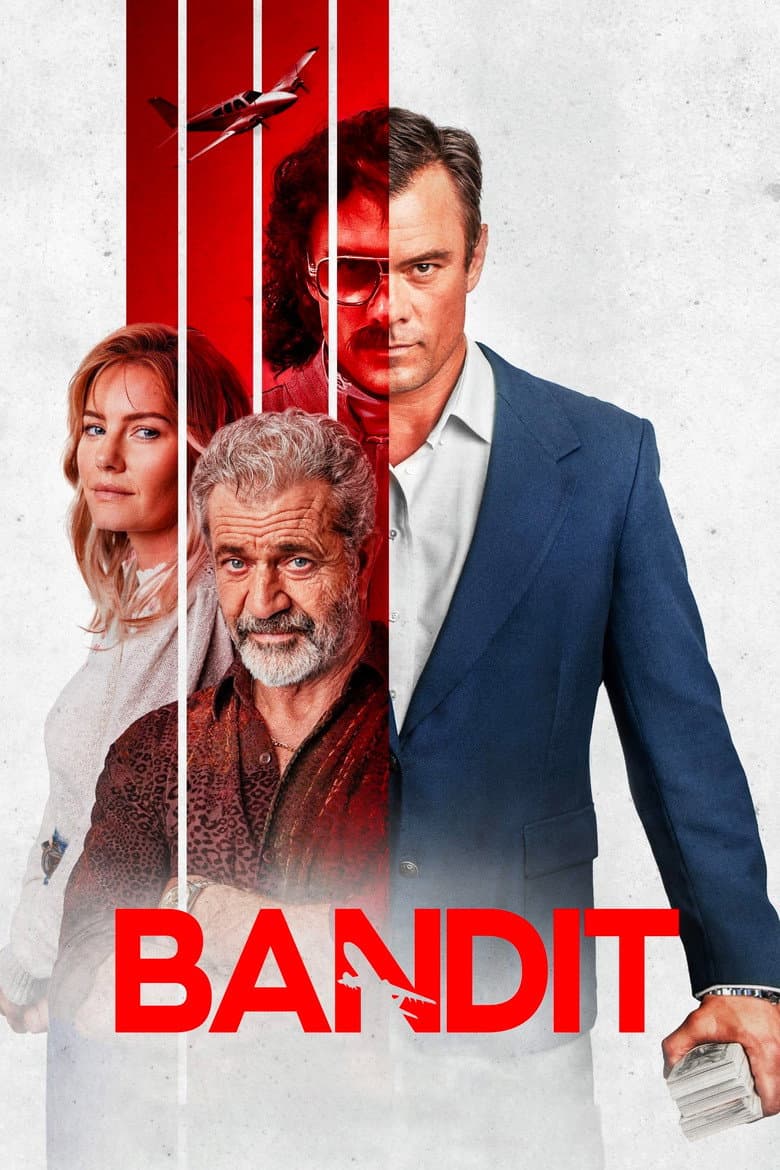
Bandit follows Gilbert Galvan Jr, a career criminal who escapes a Michigan prison and crosses into Canada in the 1980s. He takes the name Robert Whiteman and tries to build a new life with Andrea, a kind social worker. When regular work cannot support that life, he begins robbing banks and jewelry stores across the country. A determined police officer and Gilbert’s own lies slowly close the net around him.
The film presents Gilbert as a charming, clever, and restless thief who enjoys both the money and the danger. His friendship with Tommy Kay gives him a criminal partner who feels like family. His romance with Andrea creates the main personal cost because she believes he has an honest job while he keeps flying away to rob more places. The tone stays light and playful during many crimes, but the story still shows that his greed, lies, and need for excitement destroy the safe life he wants.
Community feedback
Was our 3% Woke rating accurate?
Breakdown
These are the editorial factors and ratings behind our score for Bandit.
Woke representation / casting
Not present. The main cast follows the real story’s adult characters and period setting. The film does not present diversity or identity as a message.
0%
Woke political dialogue
Not present. The dialogue focuses on robberies, money, family, police work, and the risk of a double life. It does not promote modern identity politics or activist politics.
0%
Identity-driven story themes
Not present. The story is about a criminal’s secret life, not race, sex, gender, or sexual identity. Its main themes are risk, money, love, family, and lying.
0%
Western institutional / cultural critique
Not present. The police hunt Gilbert because he is a bank robber. The film does not attack family life, religion, traditional relationships, or Western institutions through modern activist ideas.
0%
Woke character or canon changes
Not relevant. The film uses a real criminal and changes some names and events for drama. Those changes are not presented as identity or DEI messaging.
0%
Anti-woke backlash and complaints
Not present. Public discussion focused on the cast, the film’s low-budget look, Mel Gibson’s reputation, and mixed views of the movie. No notable complaint said the film pushed DEI, identity politics, or activist ideas.
0%
Creator track record context
The director and writers are mainly linked to crime, action, true-crime, and commercial work. Jordan Yale Levine has a queer-centered production credit. Keli Price has made a documentary about equality in sports, while Ryan Donnell Smith has backed some impact projects. These links give the title a weak creator-context signal.
15%
Production
Movie · 2019
A charismatic New York City jeweler always on the lookout for the next big score makes a series of high-stakes bets that could lead to the windfall of a lifetime.
Movie · 2024
While awaiting the next fuel truck at a middle-of-nowhere Arizona rest stop, a traveling young knife salesman is thrust into a high-stakes hostage situation by the arrival of two…
Movie · 2019
In 1934, Frank Hamer and Manny Gault, two former Texas Rangers, are commissioned to put an end to the wave of vicious crimes perpetrated by Bonnie Parker and Clyde Barrow, a…
Movie · 2021
When the aging Meyer Lansky is investigated one last time by the Feds who suspect he has stashed away millions of dollars over half a century, the retired gangster spins a…
Movie · 2017
A traumatized veteran, unafraid of violence, tracks down missing girls for a living. When a job spins out of control, his nightmares begin to overtake him, and a conspiracy is…
Movie · 2016
In the fourth installment of the fighting franchise, Boyka is shooting for the big leagues when an accidental death in the ring makes him question everything he stands for.
Movie · 2019
After a mass shooting at a police funeral, reclusive ex-cop Gannon finds himself unwittingly forced out of retirement when he realizes that the killer belongs to the same militia…

Movie · 2019
A young agent is tasked with investigating a tangled web of corruption and fraud in New York.
