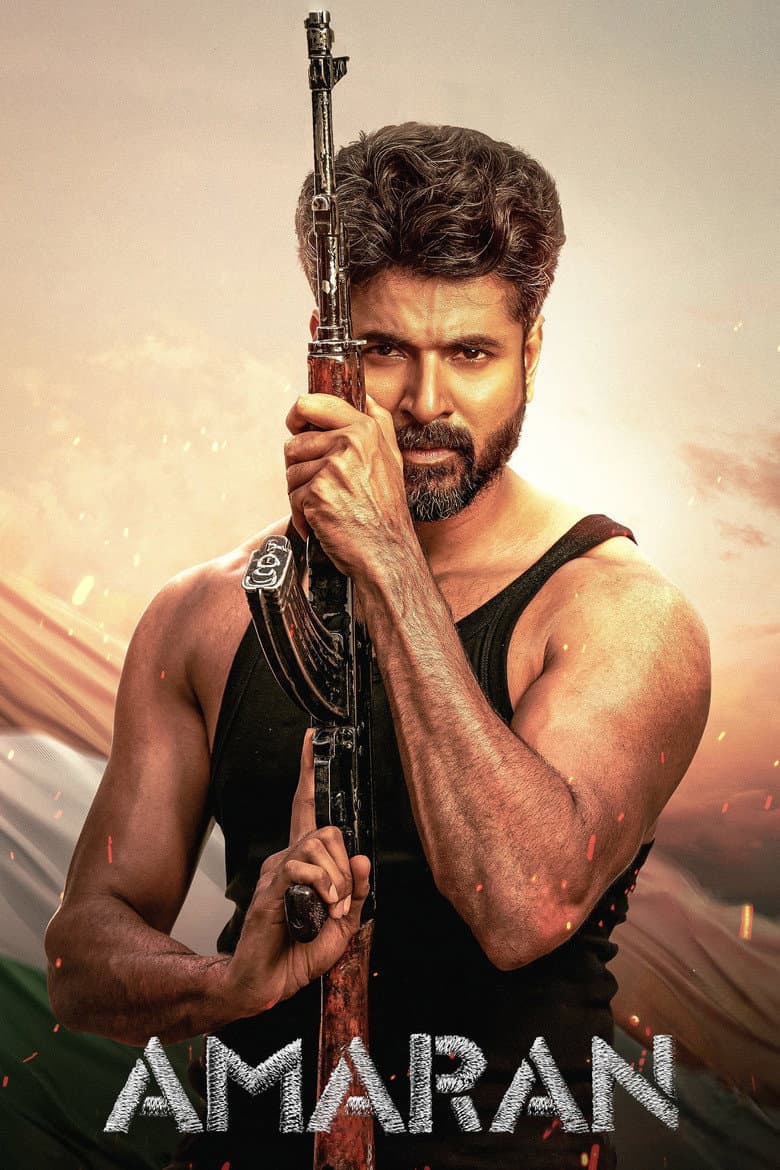
Amaran follows Major Mukund Varadarajan, a Tamil Indian Army officer who serves in Kashmir. He meets Indhu Rebecca Varghese in college, and their love grows while his family and her Christian family worry about their different religions and regions. Mukund joins the army, leads soldiers during dangerous missions in Shopian, and tries to protect civilians as well as his team. Indhu raises their daughter through long separations before Mukund dies in battle, and the film ends with her receiving his Ashoka Chakra. The tone moves from warm romance and family humor to tense action and deep grief.
The film gives Indhu the voice that tells Mukund’s life, so the story spends much of its time on love, marriage, waiting, and loss. Their Hindu-Christian marriage is a major story thread, and Indhu pushes back against family pressure before the couple marries. The film presents their choice as a personal love story rather than a broad political campaign. The film shows Mukund as a Hindu but does not name his reported Brahmin caste, while Indhu’s Christian identity is clear. The Kashmir sections praise army duty and show militants, young men pulled into violence, and civilians caught in danger.
Community feedback
Was our 33% Woke rating accurate?
Breakdown
These are the editorial factors and ratings behind our score for Amaran.
Woke representation / casting
Not present. The leads match the real people, with Sivakarthikeyan as Tamil Hindu Mukund and Sai Pallavi as Malayali Christian Indhu. The army group fits an Indian military setting, and the film does not frame the casting as a diversity message.
0%
Woke political dialogue
Not present. The political lines concern Kashmir, militants, elections, and army duty. The film has no confirmed modern DEI, gender, or activist speech.
0%
Identity-driven story themes
The film makes Mukund and Indhu’s Hindu-Christian marriage a major part of the first half. Indhu pushes back against family pressure and the couple marries across religious and regional lines. The film presents their choice as a personal love story rather than a broad political campaign. The story also gives Indhu the main voice and emotional viewpoint.
27%
Western institutional / cultural critique
Not present. The movie does not attack Western institutions, capitalism, patriarchy, Christianity, or traditional family life. Its conflict stays with militants, army duty, and grief.
0%
Woke character or canon changes
The film shows Mukund as a Hindu Tamilian but leaves out his reported Brahmin or Iyengar caste. That is an audience-visible change to the identity of a real historical figure. The omission is not a large plot point, and the director said Mukund’s family wanted him shown mainly as Indian and Tamil. The choice still became a public identity dispute.
27%
Anti-woke backlash and complaints
Some right-leaning viewers and commentators said the film hid Mukund’s Brahmin identity while showing Indhu’s Christian identity. The complaint spread on X and was reported by India Today, The Indian Express, and The Economic Times, while actor Kasthuri raised it at a public rally. A boycott call appeared, but no large organized campaign or review-bomb is documented. The director said Mukund’s family asked for Indian and Tamil identities, so the charge remained disputed.
45%
Creator track record context
Producer Kamal Haasan has a long public record tied to secularism, atheism, and criticism of caste. The director and main writers are mainly linked to mainstream stories and military or security work. The other listed producers have no clear activist or DEI public record. This gives the film some creator-context signal, but not a strong team-wide pattern.
24%
Production
Movie · 2025
After a family tragedy, kung fu prodigy Li Fong is uprooted from his home in Beijing and forced to move to New York City with his mother.

Movie · 2023
The ultimate wish-fulfillment tale of a teenage Gran Turismo player whose gaming skills won him a series of Nissan competitions to become an actual professional racecar driver.
Movie · 2016
Clavius, a powerful Roman military tribune, and his aide, Lucius, are tasked with solving the mystery of what happened to Jesus in the weeks following the crucifixion, in order to…
Movie · 2016
A falsely accused nobleman survives years of slavery to take vengeance on his best friend who betrayed him.
Movie · 2018
After losing the love of his life to a cruel Philistine prince, a young Hebrew with Supernatural strength defends his people, sacrificing everything to avenge his love, his…
Movie · 2024
A colossal-sized omnibus film bringing together the last two episodes of Attack on Titan in the franchise's first-ever theatrical experience.
Movie · 2016
A story of lost love, young love, a legendary sword and one last opportunity at redemption.

Movie · 2016
As two evil sisters prepare to conquer the land, two renegades—Eric the Huntsman, who aided Snow White in defeating Ravenna in Snowwhite and the Huntsman, and his forbidden lover…
