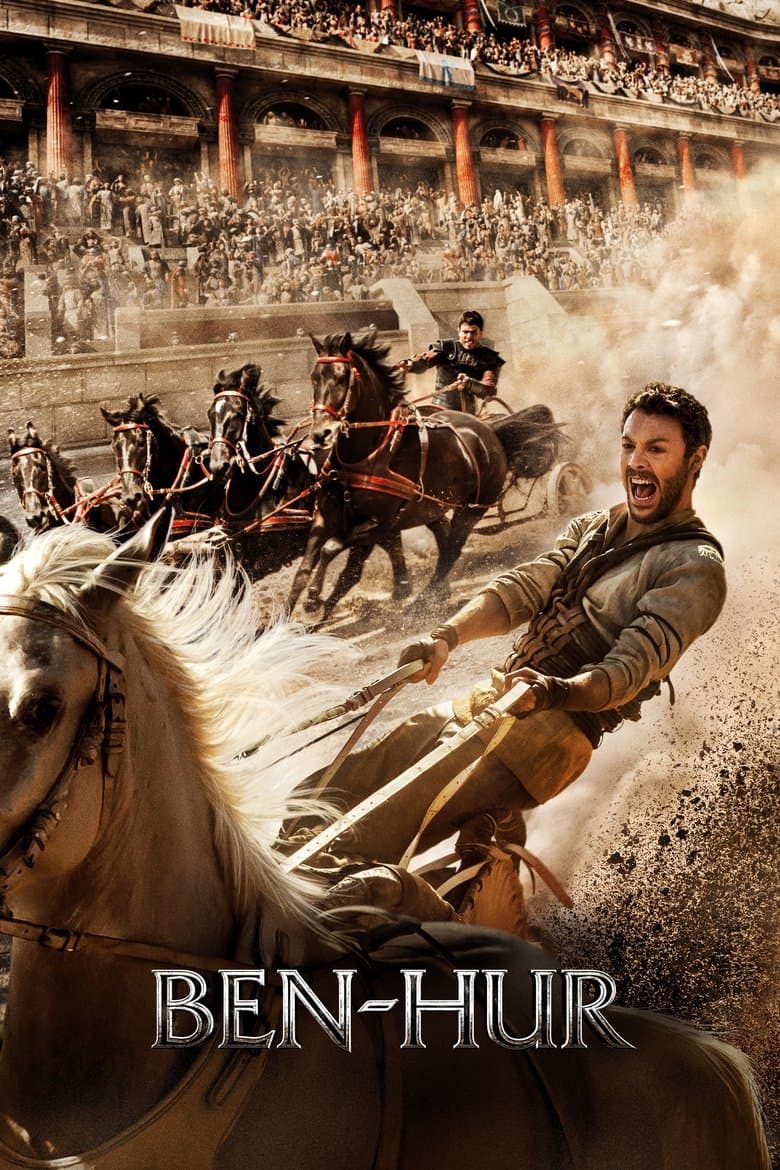
Ben-Hur (2016) is a remake of the Lew Wallace novel following Jewish prince Judah Ben-Hur, who is betrayed by his Roman friend Messala, sold into slavery, rises as a charioteer, and ultimately chooses forgiveness after encounters with Jesus. The narrative centers on personal revenge versus redemption and the power of Christian faith. Audience-visible elements include the prominent recasting of Sheik Ilderim as a powerful Nubian played by black actor Morgan Freeman in an explicitly multicultural ensemble choice and the expansion of Esther into a stronger, more independent, charity-focused follower of Jesus who actively challenges the protagonist’s path.
Community feedback
Was our 22% Woke rating accurate?
Breakdown
These are the editorial factors and ratings behind our score for Ben-Hur.
Woke representation / casting
Prominent supporting role of Sheik Ilderim recast as powerful Nubian with black star Morgan Freeman, publicly framed as multicultural redress for past casting practices; Esther expanded into a stronger, more assertive independent female character.
25%
Woke political dialogue
Biblical teachings on forgiveness, rejecting hatred, and reconciliation delivered through Jesus; director notes timeless relevance of Roman power dynamics without modern activist slogans or identity terminology.
10%
Identity-driven story themes
Personal betrayal, slavery, revenge, and Christian redemption arc with historical Jew-Roman conflict as backdrop; mild elevation of female agency in Esther but not centered on group identity or social-justice messaging.
8%
Western institutional / cultural critique
Roman Empire shown as brutal and divisive occupier contrasted with Christian mercy (standard to source material); director’s “Roman Empire today” framing adds mild contemporary resonance but avoids specific critiques of patriarchy, capitalism, or Western institutions.
8%
Woke character or canon changes
Script revisions expand Esther’s independence, reimagine Ilderim as Nubian with dominant presence, and humanize Jesus; these are noticeable adaptations without race/gender swaps of leads or ideological canon rewrites.
10%
Anti-woke backlash and complaints
Complete absence of backlash claiming the title pushes woke, DEI, activist dialogue, or propaganda; all major criticism stayed on visual execution and comparison to the 1959 classic.
5%
Creator track record context
John Ridley’s prior work includes race-focused historical drama (12 Years a Slave), but faith-based producers Burnett and Downey anchor the project in traditional Christian messaging with no activist positioning from the director.
12%
Production

Movie · 2023
The ultimate wish-fulfillment tale of a teenage Gran Turismo player whose gaming skills won him a series of Nissan competitions to become an actual professional racecar driver.
Movie · 2025
After a family tragedy, kung fu prodigy Li Fong is uprooted from his home in Beijing and forced to move to New York City with his mother.
Movie · 2016
Clavius, a powerful Roman military tribune, and his aide, Lucius, are tasked with solving the mystery of what happened to Jesus in the weeks following the crucifixion, in order to…
Movie · 2018
After losing the love of his life to a cruel Philistine prince, a young Hebrew with Supernatural strength defends his people, sacrificing everything to avenge his love, his…
Movie · 2016
A story of lost love, young love, a legendary sword and one last opportunity at redemption.
Movie · 2019
When a hulking monster arrives on Earth and begins a mindless rampage, the Justice League is quickly called in to stop it.
Movie · 2017
Having died unexpectedly, firefighter Ja-hong is taken to the afterlife by 3 afterlife guardians. Only when he passes 7 trials over 49 days and proves he was innocent in human…
Movie · 2017
Manji, a highly skilled samurai, becomes cursed with immortality after a legendary battle. Haunted by the brutal murder of his sister, Manji knows that only fighting evil will…
