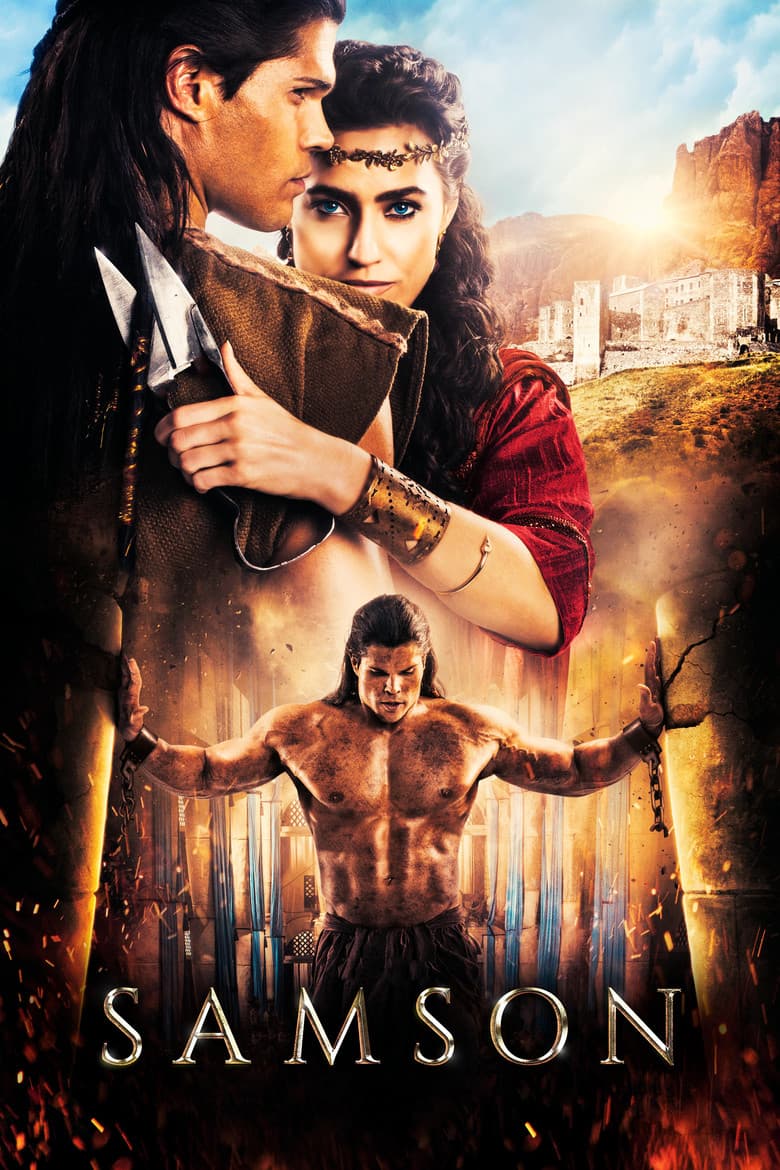
Samson is a young Hebrew man who has been chosen by God to help free his people from Philistine rule. He has supernatural strength, but his pride, anger, and desire for love lead him into danger. Prince Rallah uses Samson’s feelings for Taren and later Delilah to find his weakness and break his power. The film mixes sword fights, romance, betrayal, prayer, and a final act of sacrifice in an ancient biblical setting.
The story treats faith in God as the answer to fear, pride, and defeat. Samson learns that physical strength cannot replace obedience, self-control, and trust in God. The film changes parts of the Bible story by adding a larger Philistine royal family and by making Samson more like a clean heroic action lead. Those changes support a simple message about sin, forgiveness, and redemption.
Community feedback
Was our 4% Woke rating accurate?
Breakdown
These are the editorial factors and ratings behind our score for Samson.
Woke representation / casting
The film casts Taylor James, Billy Zane, Jackson Rathbone, Caitlin Leahy, Rutger Hauer, and Lindsay Wagner as major ancient Hebrew and Philistine characters. The leading cast is largely Anglo, Dutch, and South African even though the story takes place in the Middle East. This creates a visible setting and casting mismatch across the main roles. The movie does not frame that choice as a modern diversity campaign.
5%
Woke political dialogue
Not present. King Balek calls pagan gods tools of control, but the film uses that line to show his corruption and contrast false gods with the God of Israel. The story has no current identity, gender, DEI, or activist speech.
0%
Identity-driven story themes
Not present. The film focuses on faith, pride, love, betrayal, and repentance. It does not build its plot around race, gender, sexuality, or modern identity politics.
0%
Western institutional / cultural critique
Not present. The conflict centers on ancient Philistine rule over the Hebrews. The movie does not turn that setting into a modern attack on Western institutions, family life, or traditional gender roles.
0%
Woke character or canon changes
Not relevant. The film adds characters and changes parts of the biblical story for drama. Those changes do not push a race, gender, sexuality, or DEI message.
0%
Anti-woke backlash and complaints
Not present. The separate X research found no anti-woke complaints about the film. Web coverage centered on its quality, budget, and Bible accuracy instead of claims that it pushed DEI or identity politics.
0%
Creator track record context
Bruce Macdonald has made social-impact shorts about human trafficking, forced labor, and exploitation. Vlokkie Gordon has expressed support for diverse local and global film teams. The other cached creator profiles center on Christian stories, family values, and faith-based entertainment. The available context does not show a sustained DEI or identity-politics pattern tied to this film.
4%
Production

Movie · 2023
The ultimate wish-fulfillment tale of a teenage Gran Turismo player whose gaming skills won him a series of Nissan competitions to become an actual professional racecar driver.
Movie · 2025
After a family tragedy, kung fu prodigy Li Fong is uprooted from his home in Beijing and forced to move to New York City with his mother.
Movie · 2016
A story of lost love, young love, a legendary sword and one last opportunity at redemption.
Movie · 2016
Clavius, a powerful Roman military tribune, and his aide, Lucius, are tasked with solving the mystery of what happened to Jesus in the weeks following the crucifixion, in order to…
Movie · 2017
Manji, a highly skilled samurai, becomes cursed with immortality after a legendary battle. Haunted by the brutal murder of his sister, Manji knows that only fighting evil will…
Movie · 2024
A colossal-sized omnibus film bringing together the last two episodes of Attack on Titan in the franchise's first-ever theatrical experience.
Movie · 2019
When a hulking monster arrives on Earth and begins a mindless rampage, the Justice League is quickly called in to stop it.
Movie · 2018
When a stadium is seized by a group of heavily armed criminals during a major sporting event, an ex-soldier must use all his military skills to save both the daughter of a fallen…
