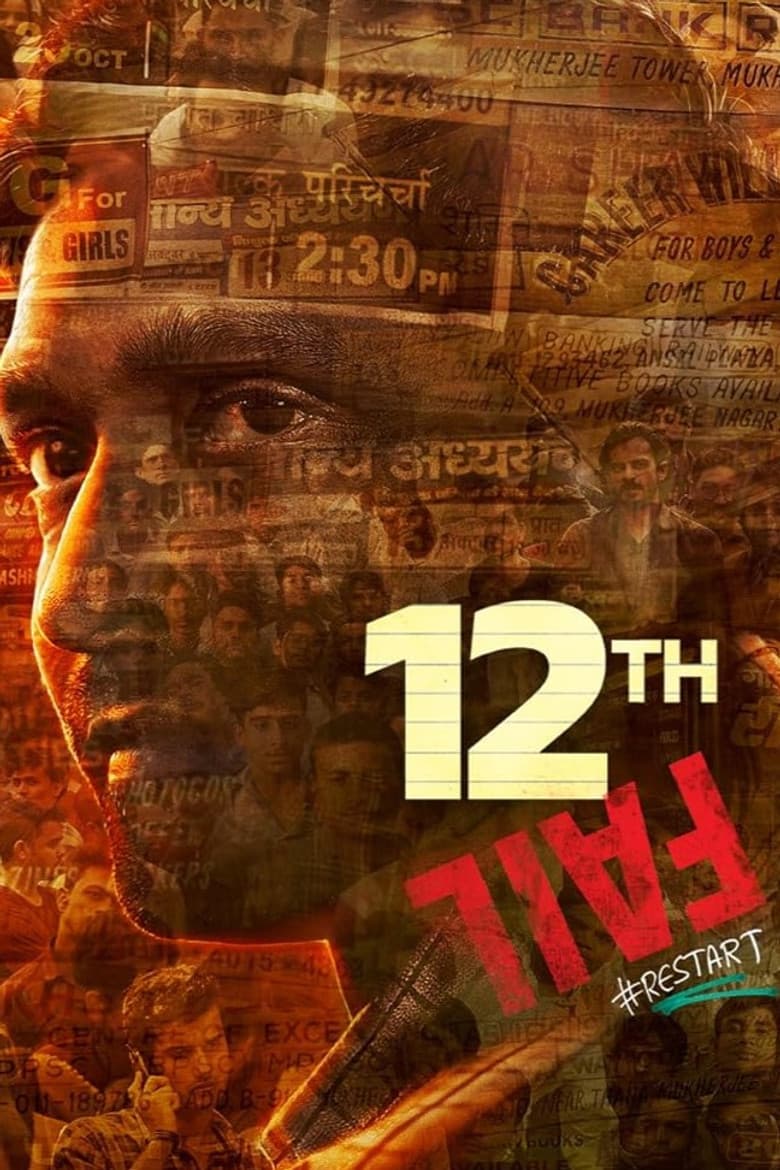
Manoj Kumar Sharma grows up in a poor farming family in the Chambal region of Madhya Pradesh, where local police and leaders use fear and bribes. After he fails his 12th grade exam because he refuses to cheat, he travels to Gwalior and Delhi to prepare for the UPSC exam and become a police officer. He works as a cleaner and mill worker while friends, teachers, and strangers help him keep studying. The film uses a warm, serious, and sometimes funny tone as Manoj faces failure, hunger, loneliness, and repeated new starts.
Manoj’s story centers on honesty, hard work, education, friendship, family duty, and the belief that failure does not end a person’s life. The film also shows caste and class through Gauri, a student from a backward caste who gets more exam attempts but later helps others after he fails, and through the gap between Hindi and English students. Shraddha, a fellow candidate, leaves medical work after seeing a dowry death treated as an accident and chooses public service so she can protect women from abuse. These identity and social issues matter in several scenes, but the main story remains Manoj’s personal climb from poverty to the IPS, supported by love and community.
Community feedback
Was our 31% Woke rating accurate?
Breakdown
These are the editorial factors and ratings behind our score for 12th Fail.
Woke representation / casting
Not present. The film uses Indian actors for Indian characters in a real Indian setting. The prominent female candidate and backward-caste student fit the story world and are not presented as an unusual diversity statement.
0%
Woke political dialogue
Manoj says that people in power keep power and use poor, uneducated voters through religion and caste. He quotes Ambedkar’s call to educate, agitate, and organize. Other scenes show English-medium students getting an advantage over Hindi-medium students. The ideas appear in a major interview scene and a few study scenes, but they do not control the whole film.
30%
Identity-driven story themes
The film gives a meaningful side story to caste and gender injustice. Gauri says he is from a backward caste, has six attempts, fails, and then helps other students. Shraddha leaves medical work after seeing a dowry death recorded as an accident and seeks government power to protect women. These themes recur around the main exam story, but Manoj’s poverty, honesty, and persistence remain the center.
34%
Western institutional / cultural critique
Not present. The film attacks corruption, bribery, exam pressure, and local power in India. It does not target Western institutions or promote an anti-Western cultural message.
0%
Woke character or canon changes
Not relevant. The film adapts a nonfiction account of real people and makes ordinary drama changes. It does not swap the race, gender, sexuality, or identity of a known person or established character.
0%
Anti-woke backlash and complaints
Not present. X research found no anti-woke complaint volume, and the one viewer who called Chopra woke blamed an earlier film and got no pickup. Right-leaning praise that the film kept its real identities and avoided a political rewrite is approval, not backlash. No sustained anti-woke campaign appeared in the wider coverage.
0%
Creator track record context
Chopra’s past films show interest in poverty, education, corruption, conflict, and social harm, but they do not show a steady modern identity-politics campaign. Pathak and the listed producers have no strong activist or DEI record in the available profiles. Chhabra has widened access for newcomers and people outside film families, which is a representation-related work pattern. This gives the title mild creator track record context, not a strong ideological signal.
30%
Production

Movie · 2024
Inspired by the incredible true story of a hairdresser who single-handedly rallies an entire community to help a widowed father save the life of his critically ill young daughter.

Movie · 2023
Hirayama is content with his life as a toilet cleaner in Tokyo. Outside of his structured routine, he cherishes music on cassette tapes, books, and taking photos of trees.
Movie · 2023
British stockbroker Nicholas Winton visits Czechoslovakia in the 1930s and forms plans to assist in the rescue of Jewish children before the onset of World War II, in an operation…

Movie · 2018
A father and daughter live a perfect but mysterious existence in Forest Park, a beautiful nature reserve near Portland, Oregon, rarely making contact with the world.
Movie · 2016
Based on the life story of Mahendra Singh Dhoni, and his journey to being the world cup winning captain of the Indian cricket team.

Movie · 2019
A look at the Apollo 11 mission to land on the moon led by commander Neil Armstrong and pilot Buzz Aldrin.

Movie · 2021
The enthralling, against-all-odds story that transfixed the world in 2018: the daring rescue of twelve boys and their coach from deep inside a flooded cave in Northern Thailand.
Movie · 2018
Dan, a 21-year-old carefree boy is always surrounded by a bunch of friends and fellow hotel interns who feed off each other's everyday moments, their ups and downs.
