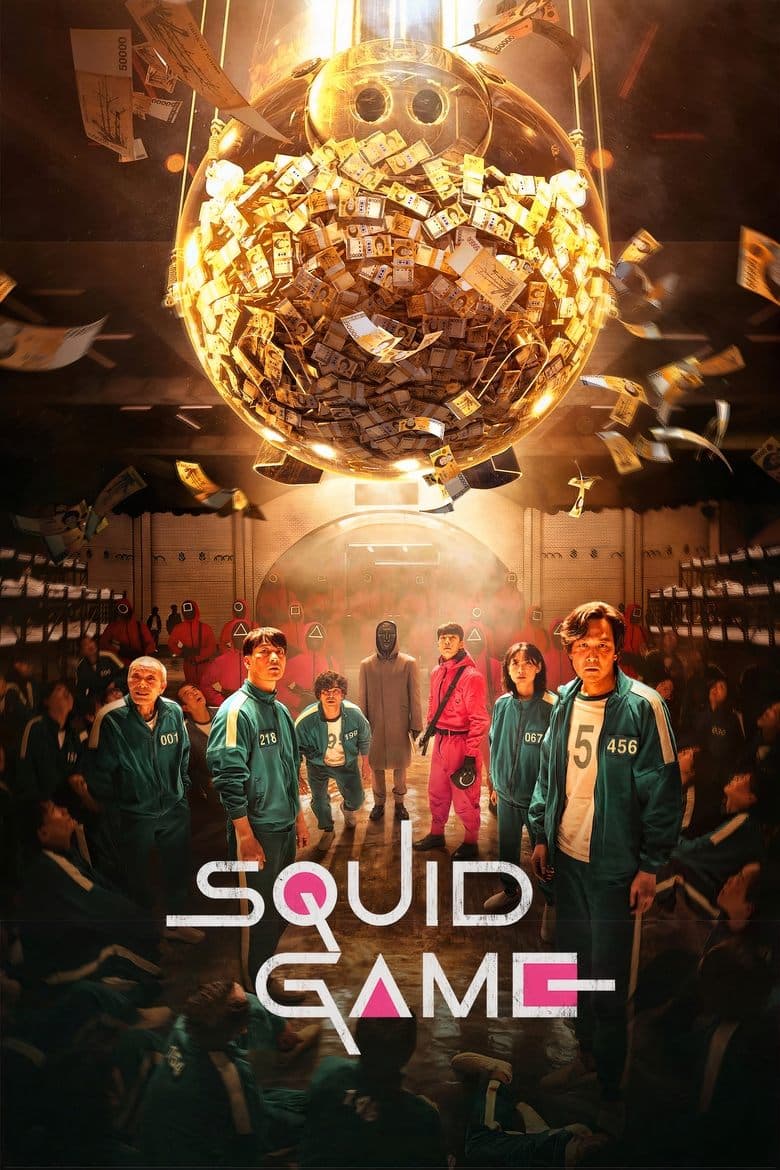
Started September 17, 2021 · Ended · Based on 3 seasons, 22 episodes through June 27, 2025 · TV-MA · Korean
Seong Gi-hun is a broke South Korean gambler who joins a secret contest after debt leaves him desperate. Four hundred fifty-six players face children's games where losing means death and the last survivor wins a huge cash prize. Gi-hun first tries to survive, then uses his winnings to fight the people who run the contest. Across three seasons, the story stays violent, grim, and sometimes darkly funny as it asks whether people can keep their kindness when money controls their lives.
The show gives major roles to a Pakistani migrant worker, a North Korean defector, a pregnant player, a female guard, and Hyun-ju, a transgender woman and former Special Forces soldier. Hyun-ju becomes a brave leader in Seasons 2 and 3, helps deliver Jun-hee's baby, and dies while trying to save the group. The later seasons also repeat debates about voting, greed, debt, and whether a group can protect its weakest members. These identity and social-justice themes matter, but the main story remains a deadly contest and a wider attack on wealth, exploitation, and human selfishness.
Community feedback
Was our 68% Woke rating accurate?
Breakdown
These are the editorial factors and ratings behind our score for Squid Game.
Woke representation / casting
Most players are Korean, which fits the South Korean setting. The show also gives major roles to a Pakistani migrant worker, a North Korean defector, a pregnant player, and a transgender woman. Hyun-ju becomes a skilled former Special Forces soldier, a team leader, and one of the main heroes in Seasons 2 and 3. The transgender role was also discussed as a representation choice, although the show used a male actor who is not transgender.
48%
Woke political dialogue
Players repeatedly argue over whether to stop the games or keep risking their lives for money. The voting scenes frame majority rule, public shaming, and political division as central problems in Seasons 2 and 3. Hyun-ju explains her rejection by family and the cost of her transition, while other players learn to accept her. Gi-hun and the Front Man also speak about greed, human worth, and the harm done by powerful systems.
45%
Identity-driven story themes
Season 1 centers on debt, class pressure, and the way rich spectators turn poor people into entertainment. Seasons 2 and 3 add a trans woman's struggle for acceptance, a pregnant player's survival, and a newborn baby treated as a sign of hope. Hyun-ju and other women protect weaker players and lead important fights. The series still spends most of its time on games, betrayal, and survival.
53%
Western institutional / cultural critique
Squid Game treats debt and the contest as products of a system that rewards the rich and traps ordinary people. The organizers and VIPs turn poverty into a business and a show, while the later seasons connect money pressure to voting and democracy. Season 3 makes this system-level criticism more direct by linking greed to the choices forced on ordinary people. The show does not target Christianity or ordinary family life, so this factor rests mainly on its repeated anti-capitalist and democracy critique.
54%
Woke character or canon changes
Not relevant. The series is an original story with no established characters or source canon that it changes.
0%
Anti-woke backlash and complaints
Some social posts and video reviews call Hyun-ju a woke, DEI, or trans-agenda addition. Those complaints focus on the choice to include a prominent trans heroine and on her heroic treatment. Larger news coverage mostly reports criticism from viewers who wanted a trans actor, which is not anti-woke backlash. The overall reaction is mixed and the anti-woke side appears limited to online audiences.
15%
Creator track record context
Hwang Dong-hyuk has a cached creator score of 71/100 for social criticism, class conflict, LGBTQ support, and political activism. The show matches that pattern through its repeated attacks on greed, debt, and unequal power and through Hyun-ju's role. Producer Kim Ji-yeon has a cached score of 0/100 and no clear activist record. Hwang is the main creative voice, so the overall context is high but not dominant.
65%
Production

TV Show · 2020
A tight-knit group of teens unearths a long-buried secret, setting off a chain of illicit events that takes them on an adventure they'll never forget.

TV Show · 2025
In the early Meiji era, Shujiro, once known as an undefeated samurai, decides to participate in a deadly survival game to save his family and villagers.

TV Show · 2022
When a small plane crashes in the middle of the Canadian wilderness, a lone survivor must battle the elements — and her personal demons — to stay alive.

TV Show · 2025
Before The Terminal List, Navy SEAL Ben Edwards finds himself entangled in the black operations side of the CIA.

TV Show · 2018
When CIA analyst Jack Ryan stumbles upon a suspicious series of bank transfers his search for answers pulls him from the safety of his desk job and catapults him into a deadly…

TV Show · 2022
Dan Chase absconded from the CIA decades ago and now lives off the grid. When an assassin arrives and tries to take Chase out, the old operative learns that to ensure his future…

TV Show · 2022
An MI6 deputy's bright future takes a sharp turn after a reunion with a Russian spy forces him to question his entire life.

TV Show · 2026
The mayor of a New England town resolves to turn it into the next tourist hot spot, despite local warnings that it's cursed.
