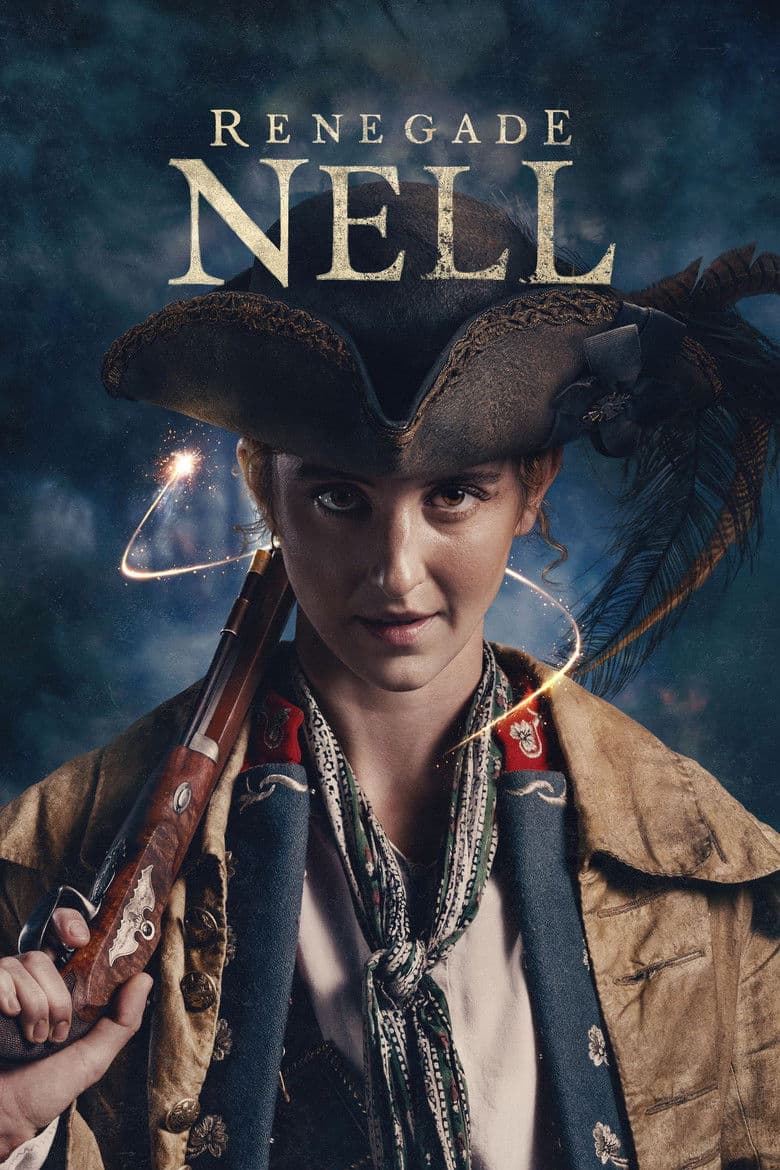
Started March 29, 2024 · Canceled · Based on 1 season, 8 episodes through March 29, 2024 · TV-14
Renegade Nell follows Nell Jackson, a working class woman in England in 1705. After a local lord is murdered and Nell is blamed, she runs with her two sisters and a servant named Rasselas. A magical sprite gives Nell great strength, and she becomes a highway robber while she fights a secret plan against Queen Anne. The show mixes sword fights, jokes, family danger, dark magic, and a bright fairy tale mood.
The clearest woke elements are the repeated message that women are held back by male rules and can lead, fight, and choose their own path. Nell wears men's clothes because people respect men more, while Sofia cannot inherit her family's power because she is a woman. The story also gives a black servant taken from Benin a major role and includes a short same-sex kiss when Polly kisses Nell. These ideas recur through the season, but the show presents them as part of a fast fantasy adventure rather than as long political speeches.
Community feedback
Was our 54% Woke rating accurate?
Breakdown
These are the editorial factors and ratings behind our score for Renegade Nell.
Woke representation / casting
The show gives major roles to a black earl, a black servant taken from Benin, and a South Asian noblewoman in 1705 England. Rasselas's origin explains his identity, but the story gives no clear reason for a Black English earl or Polly's place in the upper class. The pattern goes beyond a typical English period cast, especially among named supporting characters. The fantasy setting softens the historical mismatch, but the choices still look like a clear audience-visible diversity signal.
38%
Woke political dialogue
Nell and Billy say they are meant to stand up to people who profit from misery and pain. Nell says the truth must beat the news sheets' lies, and the show praises freeing poor prisoners. These ideas appear in several episodes, but the words stay short and tied to the adventure rather than to modern party politics.
24%
Identity-driven story themes
The show repeatedly presents women fighting limits set by men. Nell uses male clothes because men get more respect, while Sofia cannot inherit her family's power because she is a woman. Roxy wants to choose her own love, and George's reading and courage are treated as signs of a better future. Polly's crush on Nell adds a brief same-sex moment, while Rasselas's lost name adds a racial and colonial identity thread. These ideas are woven into the season, but the show presents them through a comic fantasy adventure.
48%
Western institutional / cultural critique
The show repeatedly treats inherited power, courts, prisons, landlords, and newspapers as systems that protect the rich. Nell breaks prisoners out after seeing poor children held in bad conditions, and the news plot shows powerful owners spreading lies. The story also shows Sofia shut out of a male power group because she is a woman. The targets are mostly corrupt people in a fantasy version of 1705, so the critique is strong but not a direct attack on modern Western culture.
30%
Woke character or canon changes
Not relevant. The show is an original fantasy story, not a remake of an established character or canon. Queen Anne appears as a real ruler, but the show does not change her identity or use her as a modern identity message.
0%
Anti-woke backlash and complaints
A few small X accounts called the show woke, box-ticking, or Disney agenda content. Some objected to the mixed-race aristocracy in 1705 and called it forced or out of place, while a few user reviews made similar complaints. The separate X pass found low reach and no coordinated boycott, review-bombing drive, or large right-leaning campaign. The backlash is real but fringe.
15%
Creator track record context
Sally Wainwright's cached creator score is 64, based on her repeated focus on women's stories and queer women. Georgia Christou is cached at 62 for diverse and female-led stories, and Johanna Devereaux is cached at 75 for Disney DEI strategy. Emme Hoy is cached at 0, while several directors and producers have low or moderate scores. The combined context is strong but mixed, and it matches the show's female-led story and queer subplot.
56%
Production
TV Show · 2024
In a world plagued by creatures known as Kaiju, Kafka Hibino aspired to enlist in The Defense Force. He makes a promise to enlist with his childhood friend, Mina Ashiro.
TV Show · 2023
A girl with extraordinary psychic abilities joins two gifted teen boys at a small ghost-hunting agency to fight the many deadly spirits haunting London.
TV Show · 2021
Legendary bounty hunter Boba Fett and mercenary Fennec Shand must navigate the galaxy’s underworld when they return to the sands of Tatooine to stake their claim on the territory…
TV Show · 2024
They say whatever doesn’t kill you makes you stronger, but that’s not the case for the world’s weakest hunter Sung Jinwoo.
TV Show · 2026
A century before the events of Game of Thrones, two unlikely heroes wandered Westeros: a young, naive but courageous knight, Ser Duncan the Tall, and his diminutive squire, Egg.
TV Show · 2017
Daredevil, Jessica Jones, Luke Cage and Iron Fist join forces to take on common enemies as a sinister conspiracy threatens New York City.
TV Show · 2021
After encounters with a dragon and a princess on her own mission, a Dragon Knight becomes embroiled in events larger than he could have ever imagined.
TV Show · 2022
After losing his home to a powerful enemy, a hot-tempered fighter trains under his zealous grandfather while awaiting his chance for revenge.
