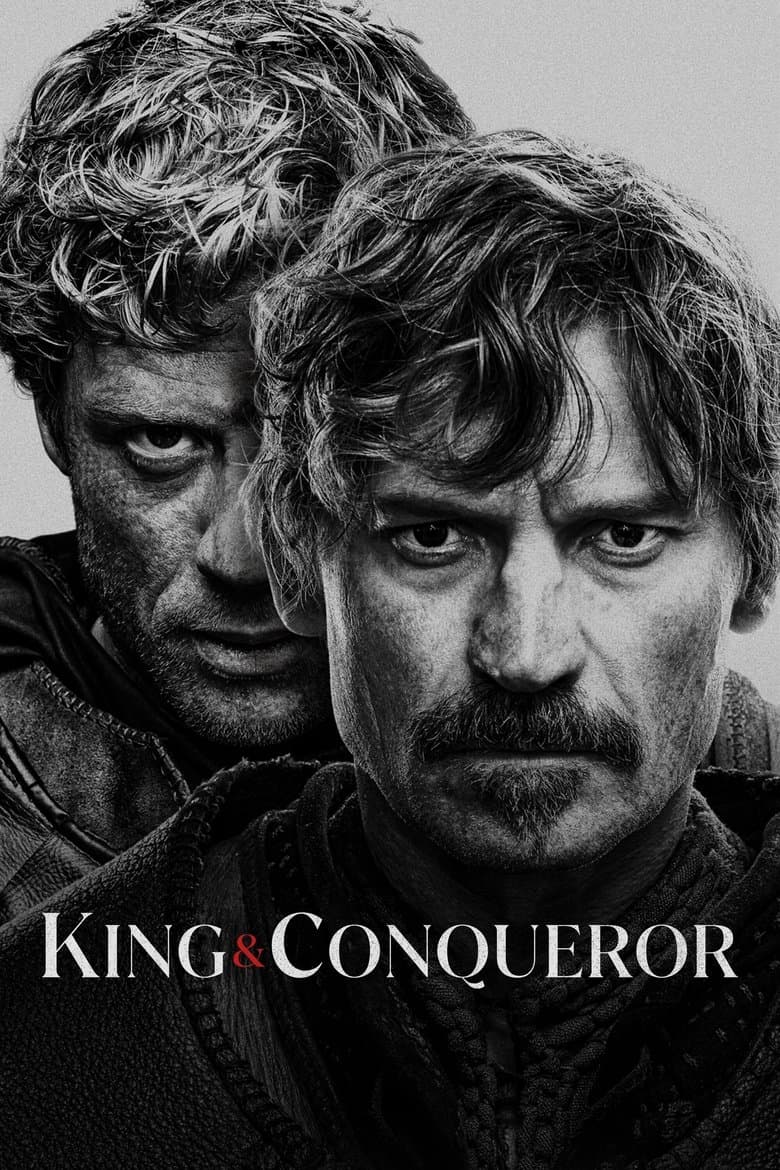
Started August 24, 2025 · Ended · Based on 1 season, 8 episodes through October 5, 2025 · TV-MA
King & Conqueror follows Harold Godwinson and William of Normandy before the Battle of Hastings in 1066. The two men begin as allies, but family plots, broken promises, and their hunger for the English crown turn them into enemies. Harold fights to protect Wessex, his wife Edith, and his children, while William gathers Norman support and a fleet. The show is a dark and violent period drama about power, loyalty, marriage, and the cost of war.
The series gives repeated attention to women who shape the struggle, including Edith, Matilda, Emma, Gunhild, and Margaret. These women plan alliances, manage power, warn the men, and try to protect their families, while the men often ignore their advice. The story also gives black actors two named Anglo-Saxon power roles, including the real Earl Morcar and the fictional Thane Thomas. The show does not make modern identity politics its main conflict, but viewers will notice its focus on women making decisions and its casting choices.
Community feedback
Was our 75% Woke rating accurate?
Breakdown
These are the editorial factors and ratings behind our score for King & Conqueror.
Woke representation / casting
The show gives two named Anglo-Saxon power roles to black actors. Elander Moore plays the real Earl Morcar, and Jason Forbes plays the fictional Thane Thomas. Both characters take part in court and war decisions, so the choices are more visible than background casting. For an 11th-century English court, this is a clear identity mismatch.
51%
Woke political dialogue
Edith says that women are cast aside and that men’s eyes are fickle. Gunhild says that none of the men were given a task like hers when she must secure the royal family’s future. Gunhild also challenges Emma and claims her own power as queen. These gender-role lines appear across several episodes but do not become the main political subject.
38%
Identity-driven story themes
Women repeatedly shape the main power struggle instead of serving only as support for the men. Edith investigates danger, bargains with rivals, protects children, and guides Harold’s choices. Matilda helps plan William’s rise and later takes control of Normandy while he is away. Emma, Gunhild, and Margaret also use marriage, money, and court power to defend their families.
47%
Western institutional / cultural critique
Edith says that women are pushed aside by the world around them. Gunhild rejects the men’s control over her duties and choices. The show also presents royal custom and religious claims as tools used by powerful people to control others. The criticism stays inside the medieval power struggle instead of becoming a broad attack on modern Western institutions.
23%
Woke character or canon changes
Morcar, a real Anglo-Saxon nobleman, is played by a black actor, changing the audience-visible identity of a known historical figure. The fictional Thane Thomas does not count as a canon change because the character was created for the show. The series changes many dates, deaths, and relationships, but those are ordinary history changes rather than identity changes. The Morcar change is important, but it affects one supporting role.
45%
Anti-woke backlash and complaints
Historians and commentators objected before release to black actors playing Anglo-Saxon nobles. Critics called the casting color-blind, historically wrong, or too woke. Social reviews later called the choices race swaps and diversity casting. Other viewers defended modern language or enjoyed the drama, so the backlash was strong but mixed rather than universal.
70%
Creator track record context
Michael Robert Johnson and the writers have mainly made commercial genre and historical dramas, with no clear activist record. James Norton has a stronger liberal and inclusion-focused record and helped produce the show. Lindsey Martin’s work often supports diverse and cross-cultural productions, while Richard Halliwell’s record includes the queer-centered Queer as Folk. The other key creators are mostly known for craft, history, or general social causes.
33%
Production
TV Show · 2022
Navy SEAL Commander James Reece turns to vengeance as he investigates the mysterious forces behind the murder of his entire platoon.

TV Show · 2025
In the early Meiji era, Shujiro, once known as an undefeated samurai, decides to participate in a deadly survival game to save his family and villagers.
TV Show · 2022
An MI6 deputy's bright future takes a sharp turn after a reunion with a Russian spy forces him to question his entire life.
TV Show · 2018
When CIA analyst Jack Ryan stumbles upon a suspicious series of bank transfers his search for answers pulls him from the safety of his desk job and catapults him into a deadly…
TV Show · 2022
Dan Chase absconded from the CIA decades ago and now lives off the grid. When an assassin arrives and tries to take Chase out, the old operative learns that to ensure his future…

TV Show · 2025
Before The Terminal List, Navy SEAL Ben Edwards finds himself entangled in the black operations side of the CIA.
TV Show · 2019
An antiquities expert teams up with an art thief to catch a terrorist who funds his attacks using stolen artifacts.

TV Show · 2020
A tight-knit group of teens unearths a long-buried secret, setting off a chain of illicit events that takes them on an adventure they'll never forget.
