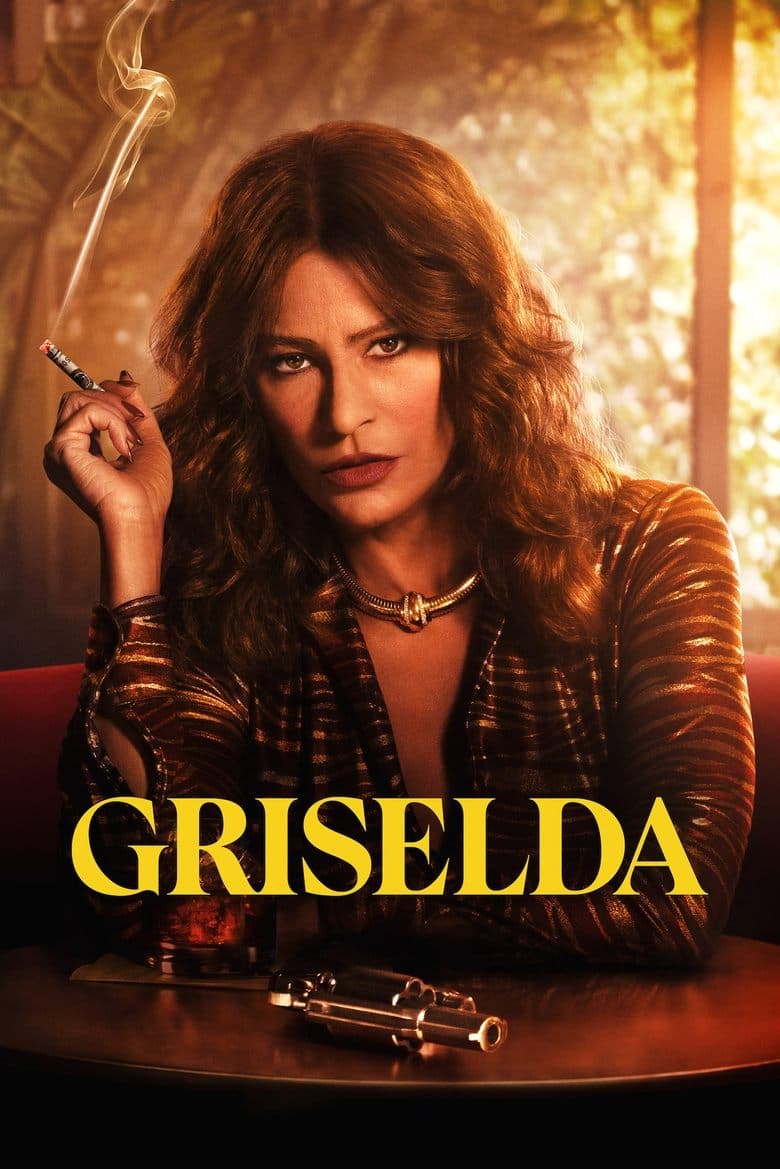
Started January 25, 2024 · Ended · Based on 1 season, 6 episodes through January 25, 2024 · TV-MA
Griselda is a six-episode crime drama about Griselda Blanco, a Colombian mother who leaves Medellín for Miami with her sons. She starts with little money and builds a cocaine business by using women to move drugs and by making deals with men who control the trade. Her success brings wealth and power, but it also brings murder, fear, family damage, and a long fall. The show feels stylish, tense, violent, and sometimes darkly funny.
The series makes Griselda’s fight for power as a woman in a male-run crime world a central part of its story. Men dismiss, use, threaten, or betray her, while she answers by becoming a stronger boss and bringing other women into the business. June Hawkins, a sharp female police analyst, mirrors Griselda as another woman pushing through a male workplace. Griselda is also shown in intimate, suggestive moments with women, and the story asks viewers to understand her pain and ambition even while showing her cruelty. These ideas recur across the six episodes, but the show remains mainly a violent rise-and-fall crime story rather than a direct political message.
Community feedback
Was our 52% Woke rating accurate?
Breakdown
These are the editorial factors and ratings behind our score for Griselda.
Woke representation / casting
The show places two highly capable women at the center of the conflict. Griselda is a real Colombian woman, and June Hawkins is a Latina police analyst, so the main identity choices fit the setting and source story. Promotional coverage still stresses the unusual sight of women leading both the drug trade and the police case. That creates a small representation signal, but the cast does not look like a broad diversity program.
15%
Woke political dialogue
The series repeatedly has women talk about being dismissed, used, or judged by men. Griselda is reduced to a housewife or a whore, and June faces doubts from male police coworkers. These lines help explain why both women push for control and recur across the season. The show does not build a wider modern political speech about DEI, elections, or public policy.
27%
Identity-driven story themes
Female power is one of the show’s main story ideas. Griselda turns men’s contempt into a reason to build her own empire, and the show often presents her as a mother, survivor, and business builder before showing the full cost of her crimes. June serves as a second capable woman who fights the same male workplace from the other side of the law. A brief same-sex scene and suggestive moments confirm Griselda’s attraction to women, but queer identity is not the main plot. The series makes this gender and identity framing important without becoming a direct activist drama.
48%
Western institutional / cultural critique
The drug trade and the police unit are both shown as male spaces where women are doubted or controlled. Griselda’s husbands and rivals treat her as property or a lesser partner, while June’s male coworkers overlook her ideas. The show uses these patterns to explain the women’s anger and ambition. It criticizes macho behavior and old gender roles, but it does not attack Western culture, Christianity, or capitalism as a whole.
33%
Woke character or canon changes
The series turns a real murderer into a more sympathetic female underdog who is pushed by abuse, poverty, and men’s contempt. It gives her a repeated rise-against-the-men arc and changes parts of the real story to support that frame. The series presents her as a mother and business builder before it shows the full cost of her crimes. This is an identity-based reframe of a real figure, but it remains a fictionalized crime adaptation rather than a complete rewrite.
32%
Anti-woke backlash and complaints
A few small X accounts called the show a girlboss or pro-feminist rewrite that softens Griselda and sidelines men. One called it feminist fantasy, and another called it a Narcos woke mess. The posts had little or no engagement, and no boycott or review-bombing effort appeared. The anti-woke reaction is fringe rather than a broad culture-war fight.
15%
Creator track record context
The main creators and the director have low stored woke scores and are known mainly for crime dramas. Vergara and Balaguer have mild Latino and multicultural representation work, while Pappas has some women-centered credits. The stored summaries show no strong activist or identity-driven record for the team. This gives the title a mild creator-context signal, not a strong one.
22%
Production
TV Show · 2021
A world-famous comedian desperately searches for a way out after a night in Philadelphia with his brother threatens to sabotage more than his success.
TV Show · 2021
In a small Michigan town where the business of incarceration is the only thriving industry, the McClusky family are the power brokers between the police, criminals, inmates…
TV Show · 2025
Two lifelong friends in Philadelphia pose as DEA agents to rob small-time drug dealers. It's a perfect grift—until they choose the wrong mark and become targets of a massive…

TV Show · 2017
A financial adviser drags his family from Chicago to the Missouri Ozarks, where he must launder $500 million in five years to appease a drug boss.
TV Show · 2020
New Orleans judge Michael Desiato is forced to confront his own deepest convictions when his son is involved in a hit and run that embroils an organized crime family.
TV Show · 2017
Covert operative Tom Keen joins forces with Susan "Scottie" Hargrave, the brilliant and cunning chief of a covert mercenary organization that solves problems that are too…
TV Show · 2022
A psychotherapist finds himself held prisoner by a serial killer with an unusual request: curb his homicidal urges.
TV Show · 2021
The remarkable story of how murderer Charles Sobhraj was captured. As the chief suspect in unsolved murders of young Western travellers across India, Thailand and Nepal’s ‘Hippie…
