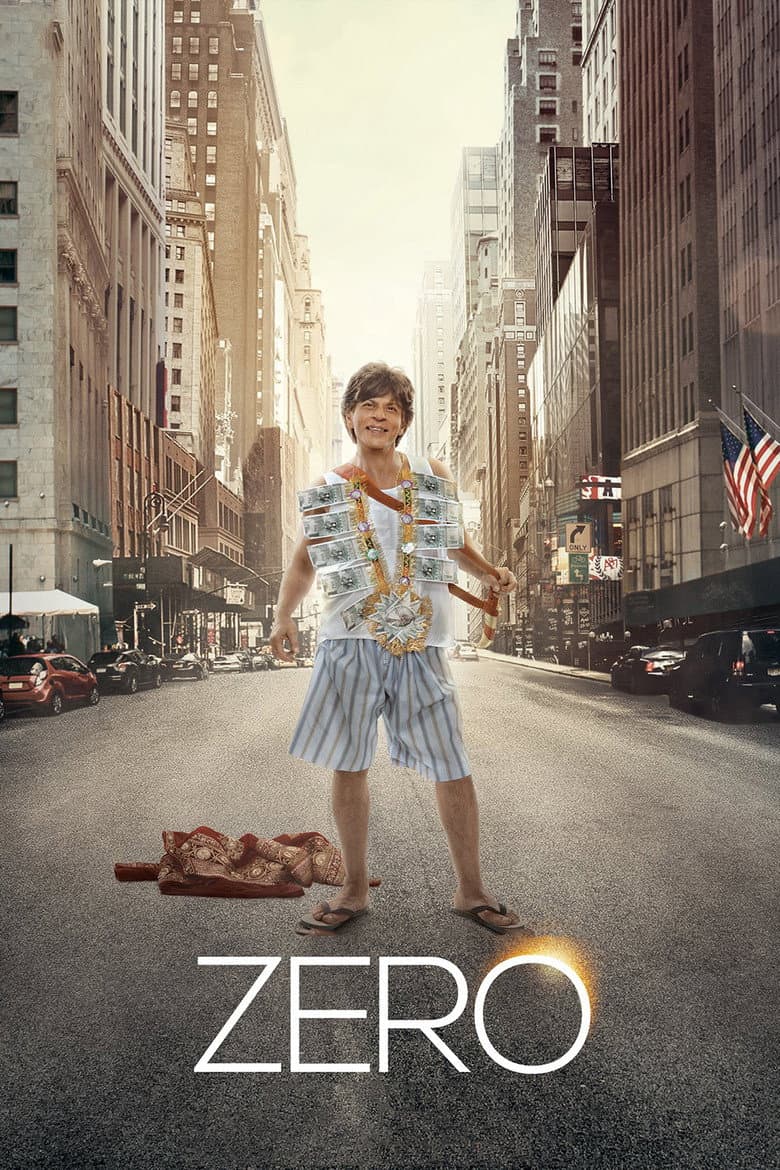
Zero follows Bauua Singh, a short man from Meerut who wants marriage, fame, and a life that feels bigger than his body. He meets Aafia, a wheelchair user with cerebral palsy who works as a space scientist, and the two fall in love. Bauua leaves her for Babita, a famous actress dealing with drinking and a broken heart, after he gets a chance to join her world. The story moves from family homes and Bollywood parties to New York and a wild mission to Mars, so the tone shifts between jokes, romance, sadness, and fantasy.
The film makes disability a central part of its romance and its message about equality. Bauua and Aafia are treated as people who can desire, argue, marry, work, and make big choices instead of people who need pity. Aafia is shown as a very skilled scientist, becomes pregnant, and races to say goodbye before Bauua leaves for space. The story also places a pushy and selfish male hero beside women who shape his growth, although the film still returns to his journey and often uses disability for jokes and spectacle.
Community feedback
Was our 59% Woke rating accurate?
Breakdown
These are the editorial factors and ratings behind our score for Zero.
Woke representation / casting
The film places three people with visible disabilities in major roles. Bauua has dwarfism, Aafia has cerebral palsy, and Guddu has night blindness. Aafia is a wheelchair-using space scientist, and Bauua later joins a Mars mission. The director and cast presented these unusual choices as a story about equality and life without pity. Able-bodied stars play the disabled characters, which adds a clear representation signal.
50%
Woke political dialogue
A short New York exchange says people may see Muslims as visitors who come to plant bombs. Another joke asks whether Muslims get visas. The scene points to present-day religious bias. The film does not return to this issue or build a larger political argument.
25%
Identity-driven story themes
Disability shapes the main romance, the marriage conflict, and the final Mars mission. Aafia is shown as a very skilled scientist who works, wants love, becomes pregnant, and makes her own choice about a planned marriage. Bauua and Aafia are told to meet as equals instead of treating each other with pity. The film also turns their bodies into comic material, so its message is mixed rather than fully serious.
62%
Western institutional / cultural critique
A short New York sequence has the characters joke that people suspect Muslims of coming to plant bombs. The line points to anti-Muslim suspicion in a Western setting. The film does not make that issue a larger conflict or attack Western society as a whole.
15%
Woke character or canon changes
Not relevant. Zero is an original fictional story. It does not change an established character, source story, or historical figure.
0%
Anti-woke backlash and complaints
Not present. The supplied X pass found no anti-woke complaints. Mainstream reports covered quality, disability portrayal, access, and a Sikh-symbol dispute instead. One Rotten Tomatoes user called the Muslim visa joke “woke nonsense,” but the comment had no wider pickup.
0%
Creator track record context
Aanand L. Rai has repeatedly made mainstream films about class, gender expectations, disability, and LGBTQ relationships. Himanshu Sharma often writes women with strong wants and unusual paths. Gauri Khan is mainly an entertainment producer, while Ashish Tandel and Shashikant Sinha have no clear public activist record. This gives a moderate creator track record signal, but not a strongly partisan one.
48%
Production

Movie · 2017
After the early death of his wife, a mourning father moves with his teenage son across the country for a private school teaching job.
Movie · 2016
Mia, an aspiring actress, serves lattes to movie stars in between auditions and Sebastian, a jazz musician, scrapes by playing cocktail party gigs in dingy bars, but as success…
Movie · 2025
When her mother sends her on a quest to complete a teenage bucket list, a young woman uncovers family secrets, finds romance — and rediscovers herself.

Movie · 2024
After discovering their significant others are siblings, two resentful exes must spend Christmas under one roof — while hiding their romantic history.

Movie · 2021
Troubled teen Will Hawkins has a run-in with the law that puts him at an important crossroad: go to juvenile detention or attend a Christian summer camp.

Movie · 2016
The unconventional love story of an aspiring actress, her ambitious driver, and their eccentric boss, the legendary billionaire Howard Hughes.

Movie · 2022
Divorced couple Georgia and David find themselves on a shared mission: they team up and travel to Bali to stop their daughter Lily from making the same mistake they once made 25…

Movie · 2017
When a hapless but dedicated talent manager signs his first client who actually has talent, his career finally starts to take off.
