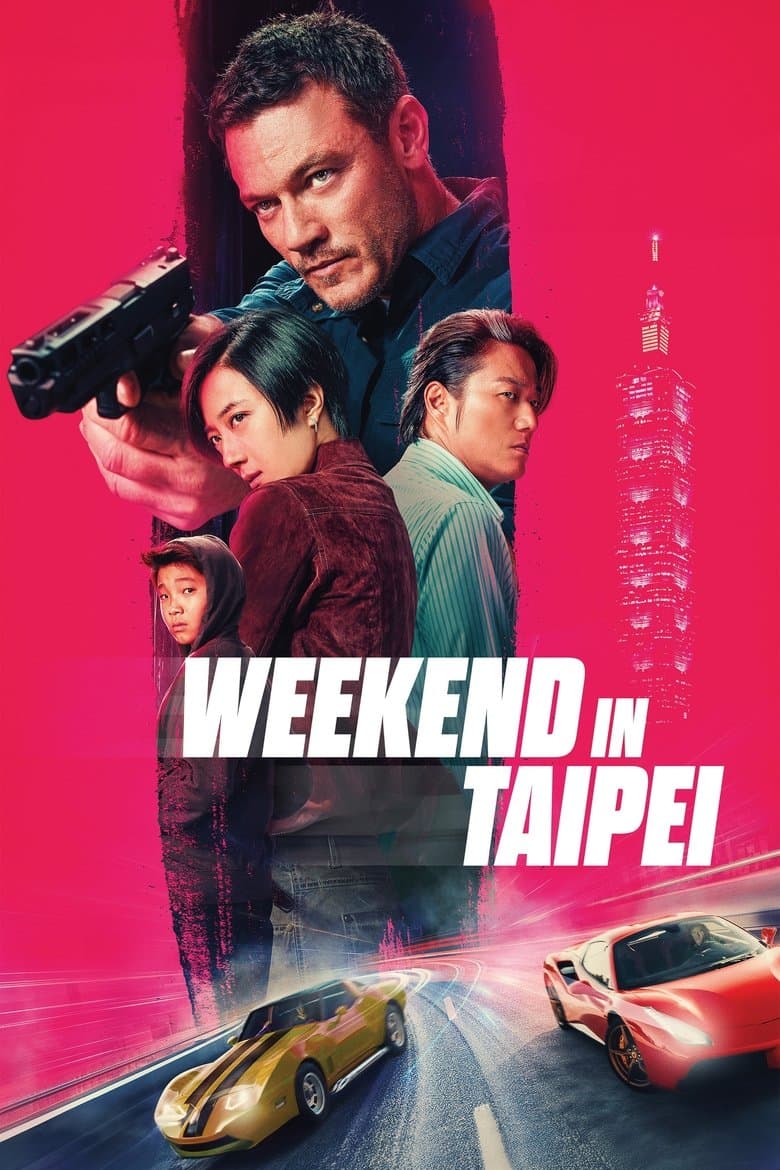
Weekend in Taipei follows John Lawlor, a DEA agent who returns to Taipei to chase a drug ledger after an undercover case falls apart. He finds Joey, the woman he loved while working under cover, and learns that she is raising their son Raymond. Joey is married to crime boss Kwang, who wants the ledger back and will hurt anyone who stands in his way. The story mixes gun battles, car chases, family tension, old romance, and broad humor in a fast but simple action style.
The film gives Joey a major action role as a skilled driver, mechanic, and fighter, while John remains the main hero who defeats the cartel. Raymond briefly acts as an environmental activist because he wants to expose dolphin deaths and pollution linked to Kwang's business. The story also shows Joey escaping a forced marriage and rebuilding her family after years of hurt. These ideas shape the family and chase plot, but the movie treats them as light background to crime, romance, and action rather than as a sustained political message.
Community feedback
Was our 11% Woke rating accurate?
Breakdown
These are the editorial factors and ratings behind our score for Weekend in Taipei.
Woke representation / casting
George Huang says he wanted a female transporter set in Asia. The film makes Joey a skilled Taiwanese driver, mechanic, and fighter in a leading role. Sung Kang says he wanted three-dimensional Asian representation in Hollywood. Joey's identity fits the Taipei setting, so the visible message is limited to a female action lead and a largely Asian cast.
18%
Woke political dialogue
Not present. The characters talk about drugs, crime, love, family, and pollution. They do not give recurring speeches about current identity politics or activist causes.
0%
Identity-driven story themes
Not present. Joey's difficult marriage and Raymond's concern about dolphins serve the crime and family plot. The film does not build these points into a recurring identity or social-justice message.
0%
Western institutional / cultural critique
Not present. The DEA, police, and criminal groups act as plot forces. The film does not make a wider case against Western culture, family life, religion, or traditional gender roles.
0%
Woke character or canon changes
Not relevant. The movie is an original story with no established franchise character, known canon, or real historical figure being changed.
0%
Anti-woke backlash and complaints
Not present. Searches found no major anti-woke campaign saying the film pushes DEI, identity politics, or left-wing messaging. The visible audience debate was mainly about the weak story, action, and the white American lead.
0%
Creator track record context
Luc Besson has some human-rights and student-support work, but his main films are commercial action and fantasy. George Huang has no strong public record of DEI advocacy in the supplied profile. Virginie Besson-Silla has a commercial producer profile without a representation-first campaign. The combined context is limited.
12%
Production
Movie · 2020
A hotel room shootout between two assassins kicks off a long night where bodies fall like dominoes, as we follow a chain of crooked cops, gangsters, hitmen, a femme Fatale and an…
Movie · 2016
The most dangerous former operative of the CIA is drawn out of hiding to uncover hidden truths about his past.
Movie · 2016
A suicidal artist goes into the desert, where he finds his doppelgänger, a homicidal drifter.
Movie · 2019
A battle for power ensues as warring gangters thrive to gain possession of a "black box" that can make them richer than they already are, and an undercover cop intervenes with the…
Movie · 2023
When a mysterious caller plants a bomb under his car seat, a bank executive begins a high-speed chase across the city to complete a specific series of tasks — all with his kids…
Movie · 2018
When a stadium is seized by a group of heavily armed criminals during a major sporting event, an ex-soldier must use all his military skills to save both the daughter of a fallen…
Movie · 2020
A couple flying on a small plane to attend a tropical island wedding must fight for their lives after their pilot suffers a heart attack.
Movie · 2018
Framed and on the run, a former FBI agent must save his family from a blazing fire in the world's tallest building.
