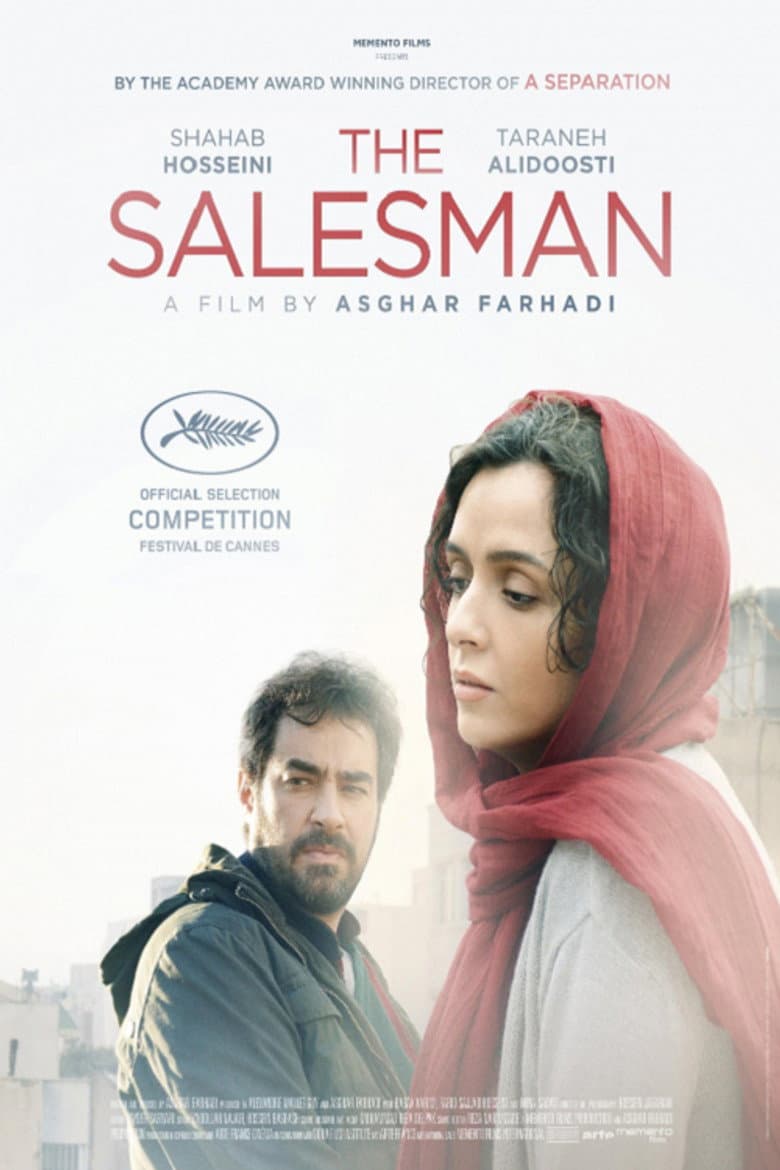
Emad is a schoolteacher and actor in Tehran, and Rana is his wife and stage partner. After building work forces them from their apartment, the couple moves into a flat left by a woman who had worked as a prostitute. A stranger enters while Rana is alone, and the attack leaves her hurt and deeply shaken. Rana wants to forget the event, but Emad starts searching for the man and turns the crisis into a private hunt for justice. The film has a quiet, tense tone that slowly becomes painful and threatening.
The film’s main woke element is its focus on sexual violence, male pride, and the way a husband’s need to control and protect his wife can overpower her wishes. Emad sees the assault as a blow to his manhood, while Rana faces the fear and shame in a more private way. The story repeatedly questions the old idea that a man must protect a woman’s honor through control and revenge. A classroom exchange also says that women in Iran are treated badly and should be warned about sexual assault. The film presents these issues through a morally mixed family drama, and it gives no simple activist speech or easy answer.
Community feedback
Was our 53% Woke rating accurate?
Breakdown
These are the editorial factors and ratings behind our score for The Salesman.
Woke representation / casting
Not present. The main cast is Iranian, which fits the Tehran setting. The film does not show a mixed cast chosen to make a diversity statement.
0%
Woke political dialogue
Emad tells his students that women are treated badly in Iran and should be warned about sexual assault. Emad also says Tehran should be torn down and rebuilt. Babak links earlier rebuilding to the Islamic Revolution. These lines give the story a small reform message. Most of the film shows its ideas through actions and silence instead of speeches.
30%
Identity-driven story themes
Rana’s sexual assault drives the whole story. Emad turns the attack into a test of his manhood and hunts the older man who hurt her. Rana asks to put the event behind her, but Emad ignores her wishes and chooses revenge. The film shows his pride and need for control as harmful to both of them. The story also gives the older man a human side, so it asks viewers to judge revenge as well as the assault.
50%
Western institutional / cultural critique
Emad’s male pride makes him ignore his wife’s wishes and take control of the response to her assault. The story treats the idea that a man must defend a woman’s honor as harmful. A short classroom exchange says women in Iran are badly treated. The story does not attack Western institutions, Christianity, or capitalism. This keeps the criticism local instead of making it a broad attack on Western culture.
38%
Woke character or canon changes
Not relevant. The film uses Arthur Miller’s Death of a Salesman as a play within the story, but the Iranian couple and their plot are original. The film does not change an established character’s identity or role.
0%
Anti-woke backlash and complaints
Iranian conservative critics said the film showed their country as dark and did not uphold traditional male honor. Some critics objected that the ending makes viewers feel sympathy for the older man and treats Emad’s revenge as wrong. These complaints appeared in Iranian papers, film reviews, and television debates around the release. The debate did not become a broad international anti-woke campaign, and the supplied X research found no anti-woke complaints.
24%
Creator track record context
Farhadi’s work often looks at gender inequality, family pressure, class tension, and social hypocrisy. His public record includes support for women’s rights and criticism of censorship and authoritarian rule. Script supervisor Parisa Gorgin has made women’s issues central to some of her own work, while producer Alexandre Mallet-Guy is mainly known for serious international cinema. This background points to a moderate creator track record, but the story remains more mixed than a direct activist message.
48%
Production
Movie · 2023
In 1988, American video game salesman Henk Rogers discovers the video game Tetris. When he sets out to bring the game to the world, he enters a dangerous web of lies and…
Movie · 2020
South Africa, 1978. Tim Jenkin and Stephen Lee, two white political activists from the African National Congress imprisoned by the apartheid regime, put a plan in motion to escape…

Movie · 2023
When her mother disappears while on vacation in Colombia with her new boyfriend, June’s search for answers is hindered by international red tape.

Movie · 2022
Based on the true nail-biting mission that captivated the world. Twelve boys and the coach of a Thai soccer team explore the Tham Luang cave when an unexpected rainstorm traps…
Movie · 2017
A former rodeo star, now a motel manager, meets a young man who is responsible for the violence that suddenly has seized his small town.

Movie · 2024
A ride-share turns into a high-stakes game of cat and mouse after it follows a car fitting the description of an AMBER Alert.
Movie · 2019
Los Angeles, 1969. TV star Rick Dalton, a struggling actor specializing in westerns, and stuntman Cliff Booth, his best friend, try to survive in a constantly changing movie…
Movie · 2024
While serving as a juror in a high profile murder trial, family man Justin Kemp finds himself struggling with a serious moral dilemma…one he could use to sway the jury verdict and…
