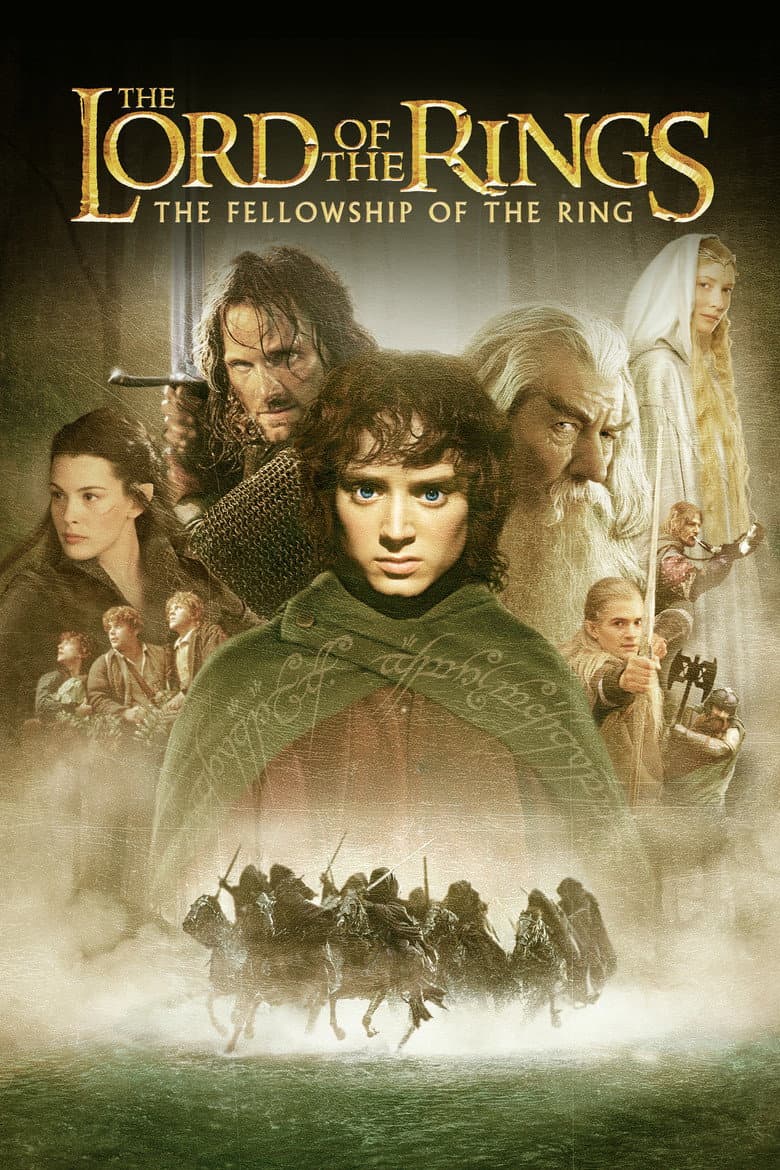
Movie review
December 18, 2001 · 179 min · PG-13 · Fantasy · Action · Adventure
Young hobbit Frodo inherits the One Ring and must leave the Shire so it does not fall to Sauron. With Sam, Merry, Pippin, Gandalf, Aragorn, Boromir, Legolas, and Gimli, he forms the Fellowship and sets out to destroy the Ring in Mordor. The film stresses friendship and loyalty, temptation and the corruption of power, and courage and self-sacrifice. It also defends a pastoral, free way of life against a dark tyrant and the industrial ruin of Isengard. These are classical epic and moral themes rather than modern identity politics.
Audience-visible woke content is mild and limited. Casting is overwhelmingly white and northern European in look, aligned with Tolkien’s Anglo-Nordic mythic setting, with no race-swap pattern and no quota-style ensemble. The main adaptation choice is Arwen taking a more active role than in the novel, most clearly by replacing Glorfindel as the elf who carries Frodo to the Ford of Bruinen and confronts the Nazgûl. Galadriel remains a powerful, book-rooted authority rather than a modern insert. The Fellowship itself is all male, as in the source material.
Community feedback
Was our 12% Woke rating accurate?
Breakdown
These are the editorial factors and ratings behind our score for The Lord of the Rings: The Fellowship of the Ring.
Woke representation / casting
The cast fits a European fantasy setting and shows no race or identity quota pattern. The only mild signal is giving Arwen a clearer heroic role so the early film is not almost entirely male. Galadriel’s power still comes from the source material.
12%
Woke political dialogue
Not present. No modern activist, DEI, systemic-oppression, or identity-politics dialogue. Speech is mythic, moral, and war or quest oriented.
0%
Identity-driven story themes
Not present. Core narrative is fellowship, temptation, sacrifice, and resisting tyrannical evil, not race, gender, or sexuality identity arcs. Environmental and anti-industrial beats are classical Tolkien pastoralism, not present-day activist framing.
0%
Western institutional / cultural critique
There is light traditional critique of industrial ruin and absolute power through Saruman and Sauron. The film does not attack Western institutions, Christianity, the family, or male heroism. Traditional virtues, kingship, and courage are affirmed instead.
0%
Woke character or canon changes
Arwen takes on Glorfindel’s rescue and heroics and becomes a more active female presence on screen. This is an adaptation choice for drama and a stronger female role, not a race swap or queer rewrite. Other cuts are ordinary adaptation work and are not scored here.
22%
Anti-woke backlash and complaints
Not present. No sustained anti-woke or anti-DEI backlash treats this film as pushing a woke agenda. Purist “Xena-Arwen” gripes were limited book-fidelity complaints. Modern anger about “too woke Middle-earth” is about later adaptations, especially The Rings of Power.
0%
Creator track record context
Cached profiles put Jackson, Walsh, Tolkien, Boyens, and the producer and casting group at low scores, roughly 0 to 23. The creative bench is not driven by identity politics. There is only a mild historical note that Boyens and Jackson expanded some female roles for drama and audience, not as a political project.
10%
Production

Movie · 2017
Four teenagers in detention discover an old video game console with a game they’ve never heard of. When they decide to play, they are immediately sucked into the jungle world of…
Movie · 2016
A common thief joins a mythical god on a quest through Egypt.
Movie · 2020
A portal transports Cpt. Artemis and an elite unit of soldiers to a strange world where powerful monsters rule with deadly ferocity.
Movie · 2016
Fearing the actions of a god-like Super Hero left unchecked, Gotham City’s own formidable, forceful vigilante takes on Metropolis’s most revered, modern-day savior, while the…
Movie · 2021
Washed-up MMA fighter Cole Young, unaware of his heritage, and hunted by Emperor Shang Tsung's best warrior, Sub-Zero, seeks out and trains with Earth's greatest champions as he…

Movie · 2022
A new adventure begins for Luffy and his crew when mysterious pop superstar Uta unveils her identity — and launches a misguided plan for world peace.
Movie · 2018
Lara Croft, the fiercely independent daughter of a missing adventurer, must push herself beyond her limits when she finds herself on the island where her father disappeared.
Movie · 2020
Earth is decimated after intergalactic tyrant Darkseid has devastated the Justice League in a poorly executed war by the DC Super Heroes.
