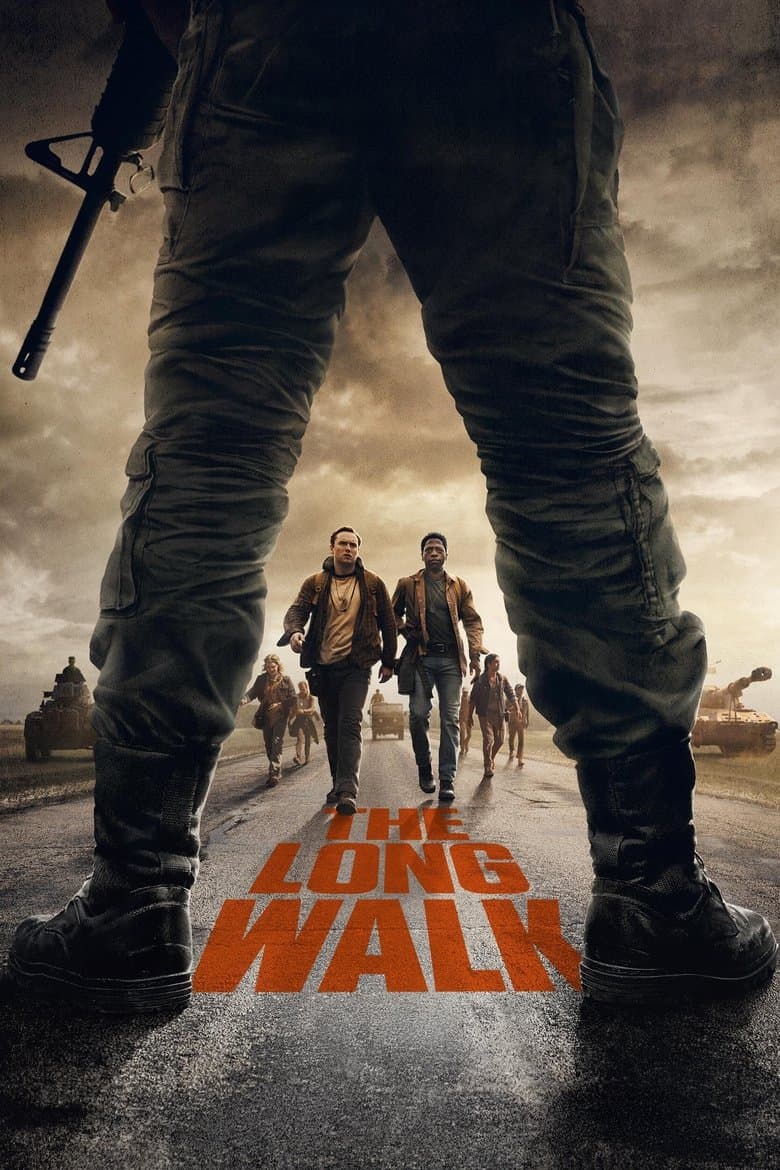
In a dystopian version of the 1970s, fifty teenage boys must compete in a deadly walking contest where slowing down means instant execution. The story follows Ray Garraty as he struggles to survive alongside his fellow walkers on a brutal journey. The film highlights strong queer romantic subtext between Ray and his friend Peter. This relationship is presented as a central love story that drives the plot and changes the ending of the original book.
Community feedback
Was our 77% Woke rating accurate?
Breakdown
These are the editorial factors and ratings behind our score for The Long Walk.
Woke representation / casting
The movie features a highly diverse group of boys in 1970s dystopian America, replacing the mostly white cast of the original novel. Black actors David Jonsson and Tut Nyuot play major roles, and Ben Wang is cast as Hank Olson. Trans actor Jordan Gonzalez plays Richard Harkness. This represents a noticeable pattern of identity-focused casting in prominent roles. Because this casting prominently includes LGBTQ+ representation, we add heavier scoring.
55%
Woke political dialogue
The script avoids major activist or political speeches. However, there is a quiet, deliberate scene where Peter McVries casually comes out as gay to Ray Garraty. This is quickly followed by hostile, homophobic insults from another competitor named Barkovitch.
5%
Production
Identity-driven story themes
The core of the film is the relationship between Ray and Peter, which queer media praised as a touching love story. They share highly intimate moments, and Ray openly says he loves Peter before sacrificing himself. This shifts the movie into a queer-centric romance. Additionally, the narrative critiques toxic masculinity among the contestants, linking their aggressive behaviors to the oppressive government. Due to these strong queer themes, we score this category aggressively.
68%
Western institutional / cultural critique
The film features a brutal totalitarian government led by the Major, played by Mark Hamill. Critics noted that the Major is portrayed as a Trumpian political figure, which invites modern anti-conservative comparisons. The story also critiques toxic masculinity and traditional male posturing as highly destructive. While anti-tyranny plots are common, the film pairs its critique of the state with modern social critiques of male behavior, creating a noticeable presence for viewers.
30%
Woke character or canon changes
The movie makes massive, identity-driven changes to Stephen King's original 1979 novel. Ray Garraty's girlfriend is completely removed to clear the way for a queer-coded romance with Peter McVries. More importantly, the entire ending is changed. In the book, Ray wins the walk in a traumatized state. In the movie, Ray sacrifices his own life so that Peter, his black and queer-coded friend, can win. This massive deviation swaps the winner to fit modern representation goals.
72%
Anti-woke backlash and complaints
There is light backlash from traditional book fans and anti-woke commentators. These complaints focus on the race-swapping of characters like McVries, the deletion of Garraty's girlfriend, and the forced queer romantic subtext. Some viewers also objected to the altered ending, viewing the protagonist's self-sacrifice as a forced political statement. This backlash remained relatively small and did not overshadow general discussions about the film's violence.
25%
Creator track record context
The primary creatives behind the film have a low-to-moderate woke track record. Director Francis Lawrence has a score of 19, and writer JT Mollner has a score of 15, as both tend to avoid activist filmmaking. Author Stephen King has a score of 31, reflecting his liberal online presence but standard fiction writing. The score is slightly elevated by producer Liana Montemayor, who has a score of 65 due to her active promotion of intersectional representation.
23%
Movie · 2022
For more than a decade, parents Andy and Vicky have been on the run, desperate to hide their daughter Charlie from a shadowy federal agency that wants to harness her unprecedented…
Movie · 2025
On the mysterious planet of Ash, Riya awakens to find her crew slaughtered. When a man named Brion arrives to rescue her, an ordeal of psychological and physical terror ensues…
Movie · 2020
A group of World War II American soldiers encounter a supernatural enemy as they occupy a French castle previously under Nazi control.
Movie · 2016
A corporate risk-management consultant must determine whether or not to terminate an artificial being's life that was made in a laboratory environment.
Movie · 2018
Held captive in a futuristic smart house, a woman hopes to escape by befriending the A.I. program that controls the house.
Movie · 2018
Set in the small town of Devil's Gate, North Dakota, the film examines the disappearance of a local woman and her young son.
Movie · 2024
Lost in a world reclaimed by nature and overrun by mysterious creatures, Ethan, a young man with amnesia navigates the dangerous landscape in search of his lost love Emma.
Movie · 2020
Two New Orleans paramedics' lives are ripped apart after encountering a series of horrific deaths linked to a designer drug with bizarre, otherworldly effects.
