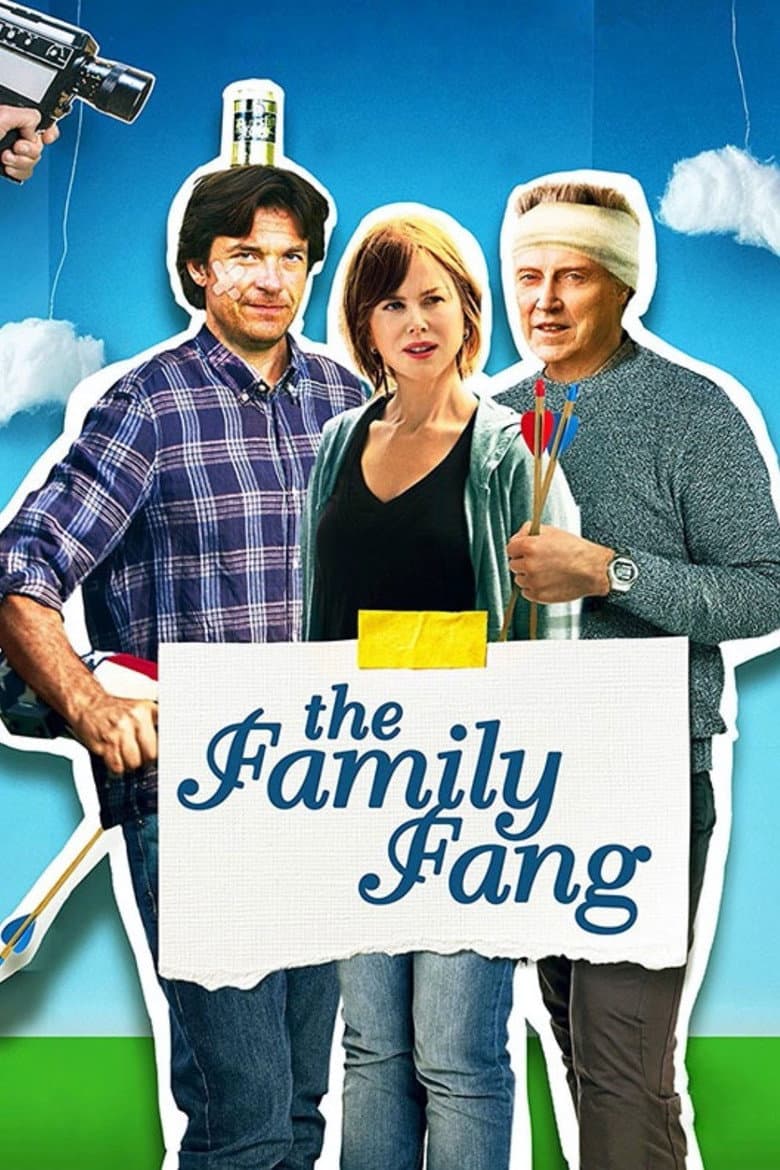
Annie Fang is an actress whose career is falling apart, and Baxter Fang is a writer who has lost his direction. The adult brother and sister return to the home where their parents raised them as part of strange public art stunts. Their parents, Caleb and Camille, then vanish and leave behind blood, old tapes, and questions about whether the disappearance is another trick. The movie moves between a tense mystery, dark jokes, and sad memories of a childhood that never felt normal.
Annie and Baxter search for the truth while they remember fake robberies, bad street music, staged deaths, and other acts that used them as children. The parents treat family life as material for art, so the siblings must decide whether love can survive years of selfish control. Annie faces drinking, a damaged acting career, and pressure to expose herself on a film set, while Baxter struggles with pain and unfinished writing. The story ends as the siblings learn what their parents planned and begin to build lives that are less controlled by the family.
Community feedback
Was our 5% Woke rating accurate?
Breakdown
These are the editorial factors and ratings behind our score for The Family Fang.
Woke representation / casting
Not present. The central family is white, while the supporting cast shows ordinary modern American variety. The film does not present casting as a diversity or identity statement.
0%
Woke political dialogue
Not present. The film has arguments about art, parenting, drinking, and career failure. It does not use spoken lines to push modern identity, DEI, or activist ideas.
0%
Identity-driven story themes
Not present. The film focuses on family damage, art, and personal identity after a strange childhood. It does not make race, sexuality, queer identity, or modern activist identity politics a major story theme.
0%
Western institutional / cultural critique
Not present. The film questions the parents’ performance art and neglect, but it does not attack modern Western institutions, family life, Christianity, or traditional gender roles.
0%
Woke character or canon changes
Not relevant. The movie adapts Kevin Wilson’s novel, but its changes concern plot details and do not change a character’s race, gender, sexuality, or hero role.
0%
Anti-woke backlash and complaints
Not present. News reports, audience pages, Reddit discussion, and the supplied X pass do not show anti-woke, DEI, identity-politics, or boycott complaints about the film. The visible reaction centers on its family drama, art pranks, acting, and ending.
0%
Creator track record context
The supplied creator scores are mostly low to mild, with Jason Bateman at 29, David Lindsay-Abaire at 35, and Kevin Wilson at 12. Nicole Kidman and several producers have some female-led or underrepresented-story patterns. Avy Kaufman has a stronger LGBTQ-focused credit history, but that pattern does not appear in this film’s story or casting. The background therefore gives mild context rather than a strong title signal.
24%
Production
Movie · 2016
In 1967, four undercover CIA agents were sent to NASA posing as a documentary film crew. What they discovered led to one of the biggest conspiracies in American history.
Movie · 2020
A once-celebrated kid detective, now 31, continues to solve the same trivial mysteries between hangovers and bouts of self-pity.
Movie · 2023
In this office satire, Orson, a straight-laced employee, retreats to a blissfully empty corner office to get away from his lackluster colleagues.

Movie · 2018
Max and Annie's weekly game night gets kicked up a notch when Max's brother Brooks arranges a murder mystery party -- complete with fake thugs and federal agents.
Movie · 2017
Dr. Steven Murphy is a renowned cardiovascular surgeon who presides over a spotless household with his wife and two children.
Movie · 2021
A truffle hunter who lives alone in the Oregon wilderness must visit Portland to find the mysterious person who stole his beloved foraging pig.
Movie · 2019
Agent Sai Srinivasa Athreya is a brilliant, underrated detective from Nellore who runs an agency called FBI which sees no business.
Movie · 2018
After suspecting that their police officer neighbor is a serial killer, a group of teenage friends spend their summer spying on him and gathering evidence, but as they get closer…
