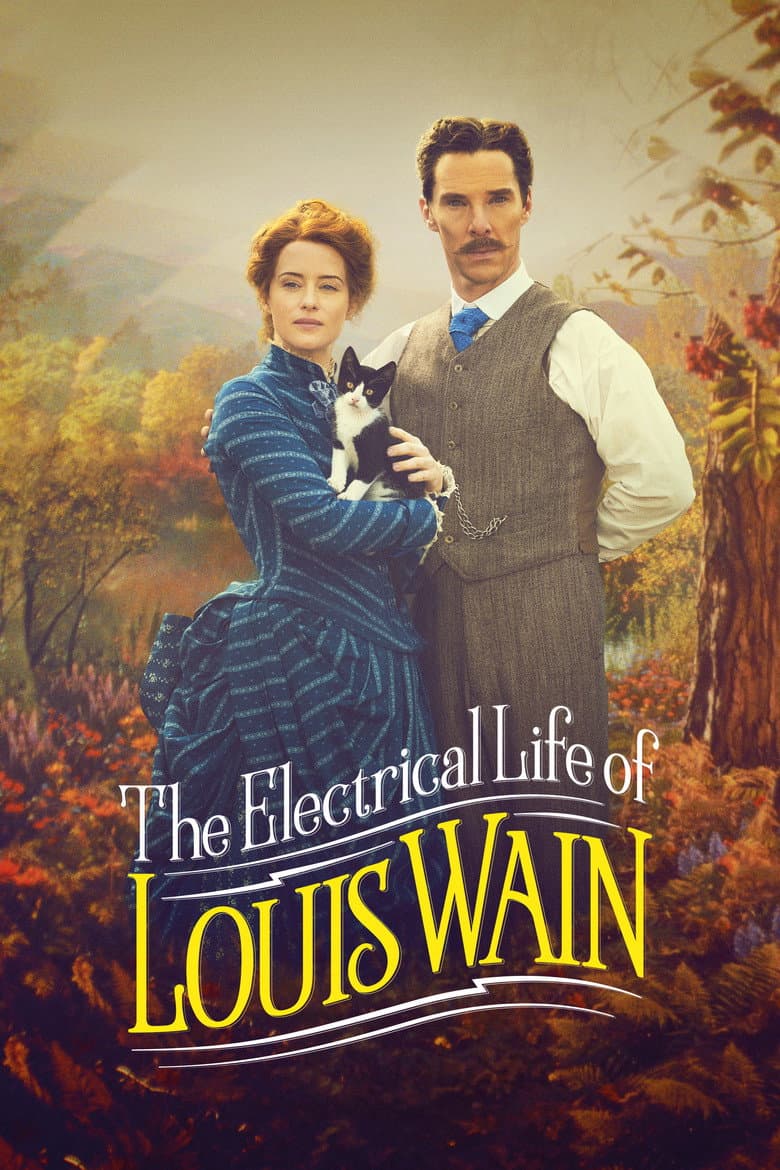
Louis Wain is a quirky British artist in the late 1800s who must support his mother and five sisters after his father dies. He falls in love with Emily, the family’s governess, even though people around them disapprove. After they marry and face illness and hard times, they take in a stray cat named Peter. Louis starts drawing playful cat pictures that make him famous and help change how people see cats. The story follows his art, his grief, his odd ideas about “electricity,” and his long struggle with mental illness, in a mix of warm comedy and sadness.
The film is mainly about love, cats, art, family duty, and mental health. A normal viewer mostly notices Louis’s strange mind, his romance with Emily, and his cat paintings—not modern activist lectures. There is light social pushback in the story when Louis and Emily marry across class and age lines, and when sister Caroline feels stuck because she is a woman expected to leave money matters to Louis. Supporting roles include some non-white actors in a Victorian/Edwardian setting (for example Adeel Akhtar as the man who later helps free Louis from a poor hospital), which some reviews called notably mixed for a period biopic. Those beats are real but secondary. Marketing and coverage sold charm, cats, and Cumberbatch—not identity politics. Anti-woke uproar about this title was thin and not a big news story.
Community feedback
Was our 38% Woke rating accurate?
Breakdown
These are the editorial factors and ratings behind our score for The Electrical Life of Louis Wain.
Woke representation / casting
Period biopic with white historical leads, but critics noted a clearly mixed supporting cast for Victorian/Edwardian Britain—Adeel Akhtar in a key helper role, Asim Chaudhry as illustrator Herbert Railton, Taika Waititi in a cameo. That looks like modern “diverse period piece” casting more than pure story need. Noticeable in the edges, not the whole movie.
35%
Woke political dialogue
Talk is mostly love, money stress, family fights, grief, and Louis’s odd electric ideas. Mild social pushback over class and age in the marriage, and period friction about who runs the household. Not modern activist speeches about race, gender theory, or identity slogans.
14%
Identity-driven story themes
Core themes are art, cats, romance, grief, and mental illness. Light identity-adjacent beats: class/age scandal around the marriage, and Caroline’s anger that a capable woman is stuck while Louis is the official breadwinner. Present but not the engine of the plot.
22%
Western institutional / cultural critique
Shows stiff Victorian rules on class, age, and gender, and harsh mental hospitals, as part of Louis’s hard life. That is period story pressure more than a modern attack on “the West,” capitalism, faith, or today’s politics. Soft critique of unfair gender roles appears through Caroline.
18%
Woke character or canon changes
Louis and Emily stay a real historical couple; no queer rewrite or race swap of the leads. Ordinary biopic cuts and age casting tweaks are not scored. Secondary real figures (e.g. Herbert Railton) are played in a modern color-blind way—mild identity-style change, not a full remake of the legend.
16%
Anti-woke backlash and complaints
Little sustained anti-woke news storm. Some online users questioned diverse casting in this period setting. No big boycott or major right-leaning campaign treating the film as hard DEI propaganda. Score stays low; evidence is thin.
8%
Creator track record context
Writers and director Will Sharpe read as low-activism craft people on the cached list. Star-producer Cumberbatch and SunnyMarch pull the average up with gender-equity and progressive public positions; casting director Dixie Chassay has a stronger diversity-first record. Overall mid-low for the full team.
30%
Production
Movie · 2018
Tony Lip, a bouncer in 1962, is hired to drive pianist Don Shirley on a tour through the Deep South in the days when African Americans, forced to find alternate accommodations and…
Movie · 2025
An eccentric lottery winner who lives alone on a remote island tries to make his fantasies come true by getting his favourite musicians to perform at his home.
Movie · 2017
Brigsby Bear Adventures is a children's TV show produced for an audience of one: James. When the show abruptly ends, James's life changes forever, and he sets out to finish the…
Movie · 2019
Ten fishermen from Cornwall are signed by Universal Records and achieve a top ten hit with their debut album of Sea Shanties.

Movie · 2021
Veteran comedy writer Charlie Berns, who is slowly but surely losing his grip on reality, befriends a talented young New York street singer Emma Payge.
Movie · 2016
Aspiring New York City artist John Hollar returns to his Middle America hometown on the eve of his mother’s brain surgery.

Movie · 2020
Four stagnant high school teachers decide to test out a theory that maintaining a constant level of intoxication will improve their overall lives.

Movie · 2022
The remarkable true story of how retiree Jerry Selbee discovers a mathematical loophole in the Massachusetts lottery and, with the help of his wife, Marge, wins $27 million…
