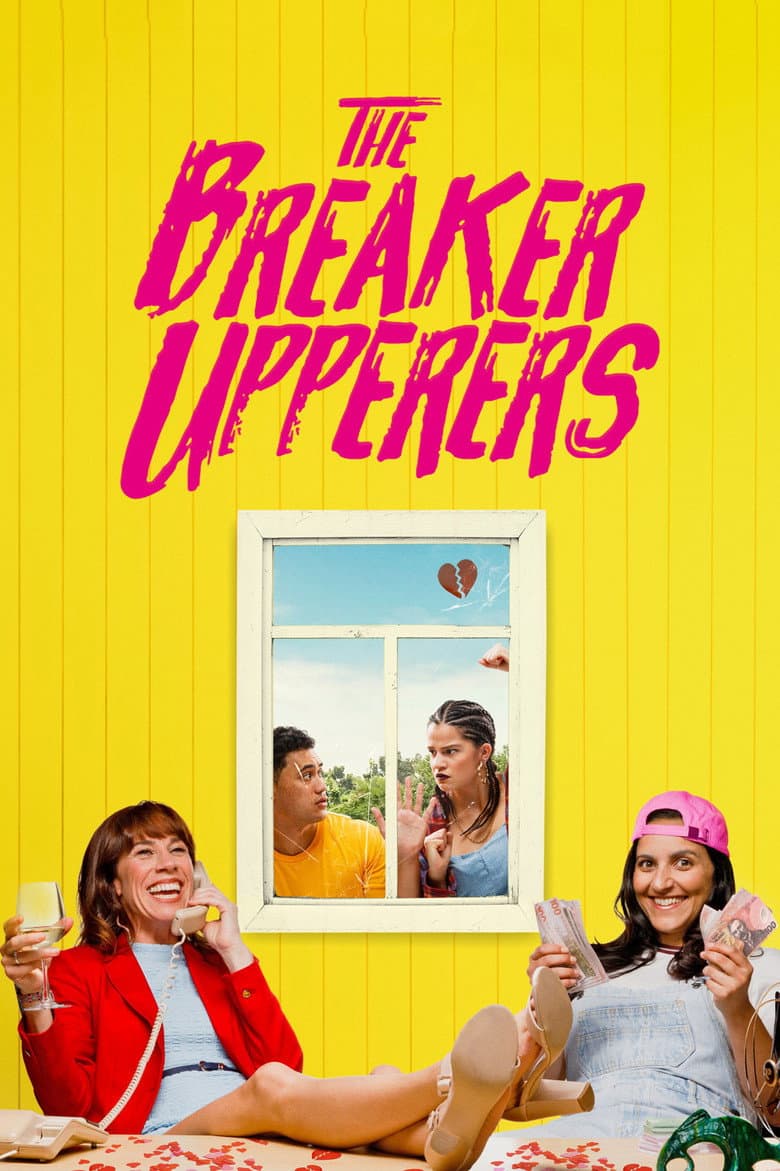
Jen and Mel run a small breakup service in Auckland, New Zealand. They earn money by ending relationships for people who are too scared to do it themselves, using fake deaths, songs, costumes, and other wild tricks. Their friendship starts to fall apart when Mel grows a conscience about their cruel work and becomes involved with Jordan, a young client. The movie uses rude jokes, silly stunts, and fast comic scenes, but it also gives the friends a warm emotional ending.
The movie makes the bond between two women more important than the usual man-woman romance. Jen and Mel are the skilled owners of the business, while some men are cheating partners, weak clients, or confused love interests. Mel openly says she is bisexual, and the movie treats her pregnancy with a much younger man as part of her life rather than a moral punishment. The story rejects the idea that women need marriage, a husband, or a neat life plan to be happy. The supporting cast also includes Māori and Pacific performers in important roles, and the movie mocks Jen's patronizing attitude toward brown people.
Community feedback
Was our 71% Woke rating accurate?
Breakdown
These are the editorial factors and ratings behind our score for The Breaker Upperers.
Woke representation / casting
The film puts two women at the center of a modern Auckland story. The visible cast also includes a mixed-heritage woman, Māori and Pacific performers, and a lesbian police officer in supporting roles. Sami said diversity was very intentional in casting, and the creators wrote the parts so anyone could play them. The setting makes the mix possible, but the repeated female and diversity focus gives the casting a clear identity signal.
62%
Woke political dialogue
Mel openly calls herself bisexual and talks about it with Jen. The film also jokes about whether Mel is having sex with a minor, then stresses that Jordan is 18 and the relationship is legal. These lines return in short jokes, but the film does not fill its dialogue with activist speeches.
34%
Identity-driven story themes
The film makes the friendship between Jen and Mel more important than their romances. The women run the business and drive nearly every major choice, while men are often cheating partners, weak clients, or confused love interests. Mel openly lives as a bisexual woman, becomes pregnant by a much younger man, and is not punished for either choice. The ending says that friendship, family help, and personal change can matter more than marriage.
68%
Western institutional / cultural critique
The film mocks the idea that women need to be saved by men or rewarded with marriage. The old boyfriend is shown as a selfish cheater, while the women control the business and openly discuss sex and desire. The story also jokes about Jen talking down to brown people. These ideas recur through the friendship and romance plots, but the movie does not make government, religion, capitalism, or other Western institutions its main target.
47%
Woke character or canon changes
Not relevant. The film is an original story about Jen and Mel. It does not change a known character, book, real person, or historical event.
0%
Anti-woke backlash and complaints
Not present. No clear anti-woke complaints were found in the reviewed news, audience, or social discussion. The separate X pass also found no such reaction.
0%
Creator track record context
Madeleine Sami has a recurring record of queer, gender, race, and diversity themes. Ainsley Gardiner and Georgina Conder often back Indigenous and women-led stories, while Taika Waititi has a clear record of anti-racism and minority-focused work. Jackie van Beek and Carthew Neal have weaker or more general signals. This background matches the film’s female, diversity, and bisexual focus.
55%
Production
Movie · 2018
Adam Sandler takes his comical musical musings back out on the road, from comedy clubs to concert halls to one very unsuspecting subway station.
Movie · 2016
A comedy that follows a group of friends as they navigate their way through the freedoms and responsibilities of unsupervised adulthood.
Movie · 2023
A chaotic intervention. An action-packed stay in rehab. After a weird couple of years, John Mulaney comes out swinging in his return to the stage.
Movie · 2016
Two teenage boys from inner-city Cork steal bicycles and ride off on a 160km quest to find an unrecovered bale of cocaine worth 7,000,000 euros.
Movie · 2022
Exploring every facet of ‘Weird Al’ Yankovic’s life, from his meteoric rise to fame with early hits like ‘Eat It’ and ‘Like a Surgeon’ to his torrid celebrity love affairs and…

Movie · 2019
An unlikely friendship between two neighbors becomes an unexpectedly emotional journey when the younger man is diagnosed with terminal cancer.
Movie · 2023
From his onstage tackle to the slap heard round the world, Dave Chappelle lets loose in this freewheeling and unfiltered stand-up comedy special.
Movie · 2024
Inseparable best friends AJ and Moose decide to run the local pool's snack shack after their plan to sell home-brewed beer goes down the drain.
