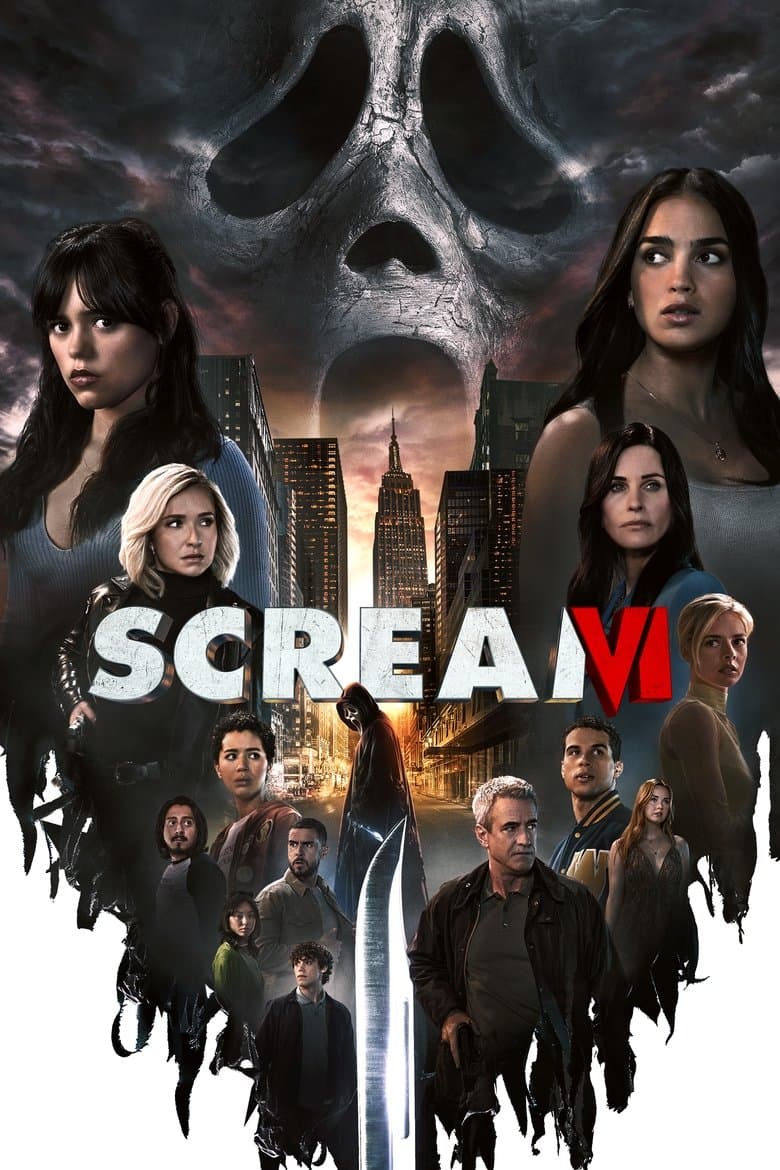
A year after the Woodsboro killings, survivors Sam and Tara Carpenter and twins Mindy and Chad Meeks-Martin try to start over at Blackmore University in New York. A new Ghostface stalks them with masks from past massacres and kills in public places such as a bodega and the subway. The killer also runs an online smear campaign that paints Sam as the real mastermind behind the violence. Legacy figures Gale Weathers and FBI agent Kirby Reed re-enter the fight. The core motive is personal revenge over Richie Kirsch’s death rather than a story built on modern identity politics.
The film still puts queer life on screen through Mindy and her girlfriend Anika, including kisses, couple dynamics, and pride cues in clothing. The young Core Four is led by Latina sisters and Black twins, and Mindy’s Asian girlfriend is part of their apartment group. That mix reads as a deliberate, highly visible diversity package even though the setting is a modern New York college story. These LGBTQ and casting choices are clear to viewers but stay secondary to the revenge plot, the kills, and franchise meta. The movie does not run on activist lectures about race, gender, or systemic oppression.
Community feedback
Was our 46% Woke rating accurate?
Breakdown
These are the editorial factors and ratings behind our score for Scream VI.
Woke representation / casting
The Core Four is led by Latina sisters and Black twins, and Mindy’s Asian girlfriend is part of their circle. Modern New York college life can support that mix. The group still reads as a deliberate high-visibility diversity package. Promo and press leaned into Latina and queer representation, and Mindy’s pride pin, queer wardrobe, and on-screen girlfriend make that signal hard to miss.
46%
Woke political dialogue
Talk is mostly classic Scream meta about franchise rules and not trusting the love interest, plus survivor banter. There are no long activist lectures on race, gender, systemic oppression, or DEI-style points. Online smear material about Sam is plot machinery for her public image, not progressive campaigning.
8%
Identity-driven story themes
The main story is revenge, trauma, and who is Ghostface. On top of that sits a confirmed lesbian relationship with kisses, couple dynamics, pride wardrobe cues, and Anika’s death as Mindy’s girlfriend. That LGBTQ content is clear to the audience even though the film is not a queer-thesis drama. Latina leads appear as survivors and fighters without the plot turning on ethnicity.
42%
Western institutional / cultural critique
A detective is a Ghostface ringleader and Kirby is a capable FBI agent. Those beats are franchise twists, not a long attack on police, patriarchy, Christianity, or Western institutions. Internet pile-ons against Sam fit true-crime and fandom culture more than activist institutional messaging.
12%
Woke character or canon changes
Not relevant. No identity-driven race, gender, or sexuality rewrite of legacy characters.
0%
Anti-woke backlash and complaints
Backlash was real but limited. Reddit and niche conservative and woke-watch commentary called out forced diversity, the lesbian character, and a non-white-centered survivor cast. Some sites treated the film as mildly progressive. It was not a mass go-woke-go-broke event.
30%
Creator track record context
Cached scores for the Radio Silence directors and most producers and writers sit low. Series figure Kevin Williamson is openly gay and has discussed queer inclusion in genre work, which lines up with Mindy’s expanded visibility. The overall creative bench is genre-first rather than activism-first.
20%
Production
Movie · 2016
A punk rock band is forced to fight for survival after witnessing an act of violence at a skinhead bar.
Movie · 2023
During a stormy night in the Scottish Highlands, two criminal brothers on the run seek refuge in a desolate farmhouse.

Movie · 2016
A group of teens break into a blind man's home thinking they'll get away with the perfect crime. They're wrong.
Movie · 2024
Stranded in the open sea after a fatal accident, a young woman and her two friends are rescued by a fishing vessel's captain, unaware that the ship harbors a chilling secret.
Movie · 2022
Chris, a wealthy divorcee, lives in a high-tech house of his own design in Montana. His life changes when he meets Sky, a mysterious young woman who draws him out of his shell and…
Movie · 2020
A family vacation takes a terrifying turn when parents Paul and Wendy discover their young daughter has vanished without a trace.

Movie · 2016
Newlyweds Claire and Ryan have just moved into a new house. Both are hoping Claire’s pregnancy will be the cement needed to hold their already fraying relationship together.
Movie · 2017
A young nurse is kidnapped by a group of violent teens who escape from a mental hospital and take her on the road trip from hell.
