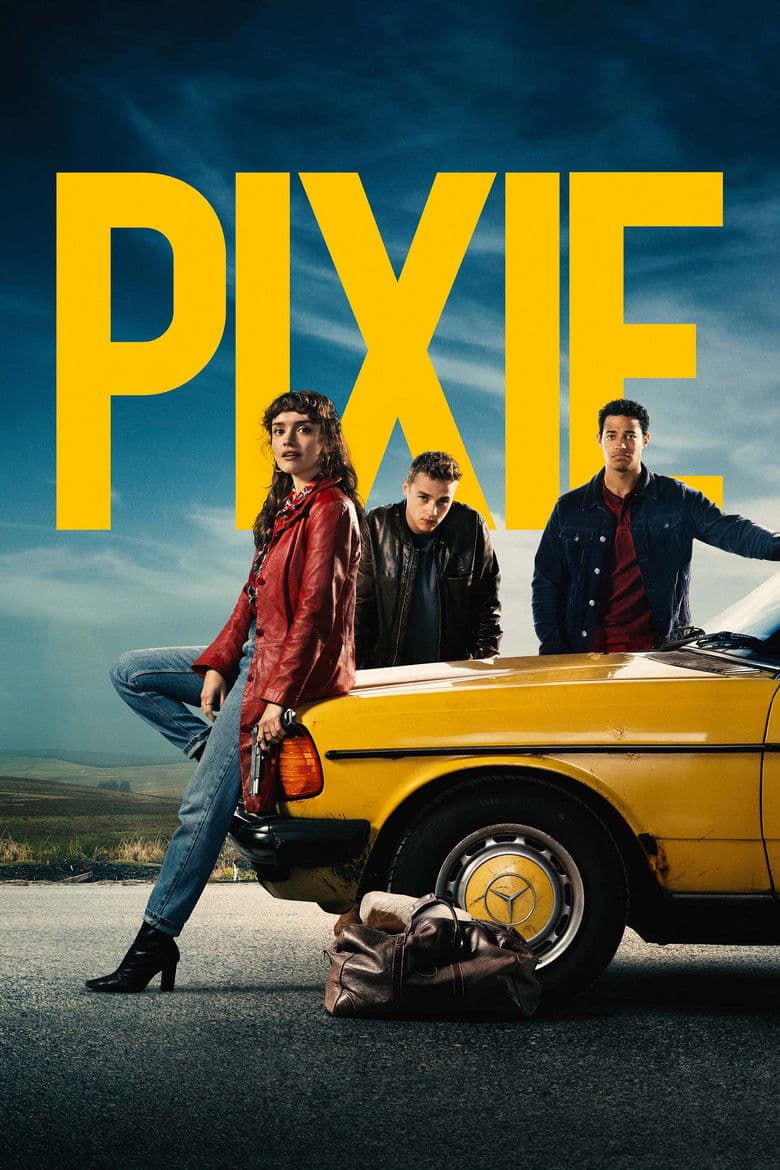
Pixie lives in rural western Ireland and comes from a local crime family. She wants revenge for her mother’s death and hopes to leave for art school in San Francisco. A drug robbery goes wrong, so she joins two inexperienced men, Frank and Harland, while gangsters chase them across the country. The film mixes black comedy, shootouts, drugs, and a fast road trip with a wild western style.
The film makes Pixie the smartest and most powerful person in the group. She plans the robbery, hides her real goal, uses charm to control men, and leaves them behind after getting revenge. The story links her freedom to escaping male control, and the ending tells her to break rules and make trouble on behalf of women. The film also turns priests and the Catholic Church into drug dealers and targets of a violent joke, but that attack is part of the crime comedy instead of a wider political story. A brief same-sex kiss appears during an interrupted threesome, but queer identity is not a main subject.
Community feedback
Was our 50% Woke rating accurate?
Breakdown
These are the editorial factors and ratings behind our score for Pixie.
Woke representation / casting
The film gives the main crime-planning role to a woman while the other central roles are men who need her help. The main cast is otherwise mostly white and Irish or British, so there is no clear race-based diversity push. Interviews and promotion frame the gender choice as a woman taking over a male genre and as an inversion of the male gaze. That is a clear gender signal, but it is limited to one lead role.
35%
Woke political dialogue
The film uses little political language during the chase. The closing airport scene quotes Pixie’s mother telling her not to be a lady, to break rules, and to make trouble on behalf of women. The scene then jokes that Pixie has caused trouble for a thousand women and wanted a million. This is a clear feminist message, but it is a short ending speech rather than a repeated talking point.
32%
Identity-driven story themes
Pixie drives the whole crime story and repeatedly outsmarts the men around her. Frank and Harland are helpers and comic sidekicks while she controls the robbery, hides her true plan, and gets revenge. The story ties her freedom to escaping male control and choosing her own future. A brief same-sex kiss appears during an interrupted threesome, but the film does not make queer identity a main subject. The plot and ending strongly favor a woman who breaks rules and leaves men behind.
60%
Western institutional / cultural critique
The film makes the Catholic Church a major part of the crime plot. A character jokes that priests can escape punishment for murder and long-running child abuse. The priest gang sells drugs and leads the final shootout in a church. The film treats this as dark comedy, so the church attack is strong but not a full modern political argument.
35%
Woke character or canon changes
Not relevant. No such change is present. The film is an original crime story and does not change an established character, source, or historical event.
0%
Anti-woke backlash and complaints
Not present. No clear anti-woke complaint, boycott, or review-bombing campaign was found. Online comments mainly discussed the plot, tone, accents, and Pixie’s behavior.
0%
Creator track record context
Barnaby Thompson’s creator score is 4/100, and Preston Thompson’s is 28/100. Preston Thompson’s title-linked idea was to turn the quirky woman who helps male characters into a woman who controls her own story. One producer has a Pride credit, but the wider team has no strong activist record. This is mild creator track record context.
15%
Production
Movie · 2023
Inspired by a true story, an oddball group of cops, criminals, tourists and teens converge in a Georgia forest where a 500-pound black bear goes on a murderous rampage after…
Movie · 2021
The world’s most lethal odd couple – bodyguard Michael Bryce and hitman Darius Kincaid – are back on another life-threatening mission.
Movie · 2020
An ordinary guy suddenly finds himself forced to fight a gladiator-like battle for a dark website that streams the violence for viewers.
Movie · 2018
A series of mysterious events changes the life of a blind pianist who now must report a crime that was actually never witnessed by him.
Movie · 2024
Broke and depressed, Ray is mistaken for a dangerous hitman and given an envelope of cash. Along with his P.I.
Movie · 2017
Lynn, a brilliant student, after helping her friends to get the grades they need, develops the idea of starting a much bigger exam-cheating business.
Movie · 2017
A disgraced former cop, fresh off a six-year prison sentence for attempted murder, returns home looking for redemption but winds up trapped in the mess he left behind.

Movie · 2017
When a depressed woman is burglarized, she finds a new sense of purpose by tracking down the thieves alongside her obnoxious neighbor.
