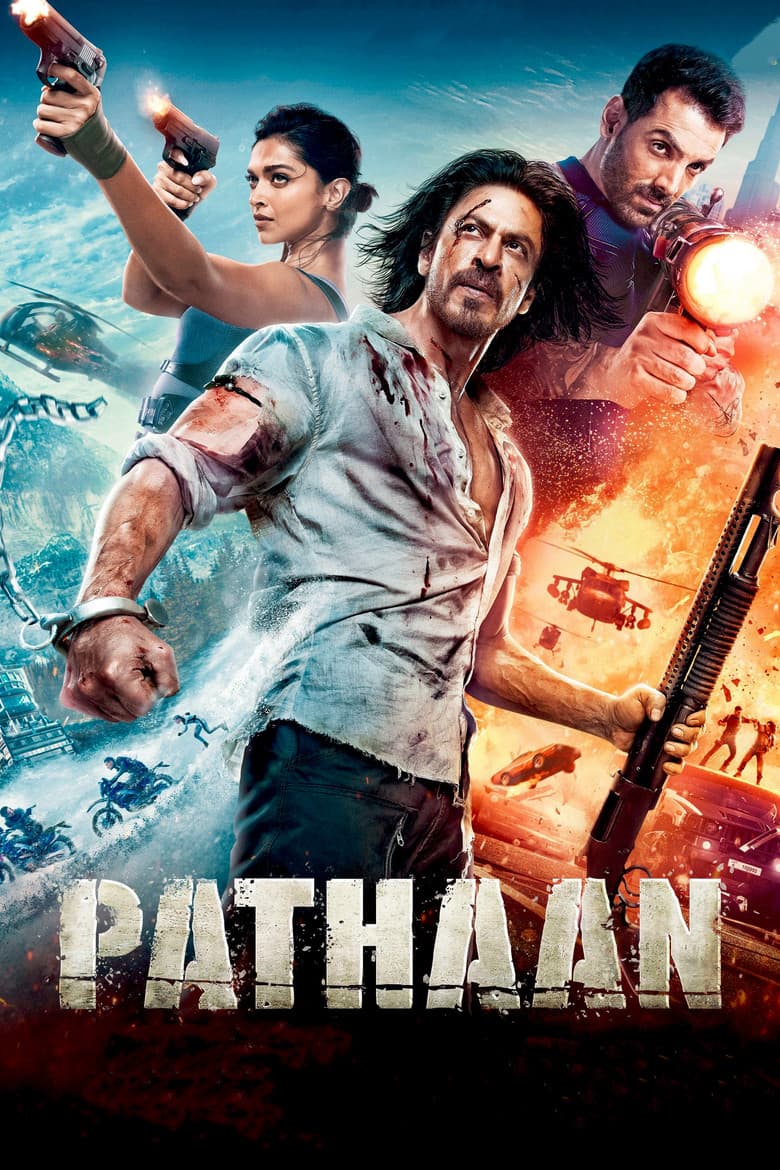
Pathaan is a Hindi action thriller about an exiled Indian spy who returns when a former RAW agent plans a deadly attack on the country. Pathaan travels from Afghanistan and Europe to India while chasing Jim and a virus called Raktabeej. He works with Rubai, a Pakistani intelligence agent whose loyalty keeps changing, and he faces old friends, new enemies, and huge fights. The film uses bright locations, jokes, songs, romance, and comic-book stunts to create a loud and playful spy adventure.
The film makes religion and national belonging part of Pathaan’s character. He is an orphan who takes the name Pathaan from Afghan villagers who saved him, and he says his faith does not decide whether he loves India. The story also joins this Muslim-named Indian hero with Rubai, a Pakistani agent, and asks viewers to judge people by their choices instead of their labels. Rubai is a skilled fighter and an important partner, but the male hero still drives the mission and gets the final heroic focus. These ideas give the film a clear message about shared humanity and cross-border teamwork, even though the main story remains a glossy revenge and rescue thriller.
Community feedback
Was our 57% Woke rating accurate?
Breakdown
These are the editorial factors and ratings behind our score for Pathaan.
Woke representation / casting
The film puts the Muslim-coded Pathaan at the center of an Indian patriotic spy story. It gives Rubai, a Pakistani intelligence agent, a major heroic role and gives Nandini command of the JOCR unit. These choices make religion, nationality, and female leadership visible in key roles. The choices fit the plot and are not sold as a wider diversity campaign, so the score stays mild.
27%
Woke political dialogue
The film has a short exchange about whether Pathaan is Muslim and who gets to define his identity. Pathaan links service to India with care for the people who raised him. Rubai says she joined the ISI to serve humanity and rejects killing civilians. Jim also attacks borders and power, but the film presents him as a terrorist, not as a guide.
28%
Identity-driven story themes
The story treats belonging as something people build through loyalty and care, not only through religion or birthplace. Pathaan is an orphan who takes his name from an Afghan family and serves India, while Rubai is a Pakistani agent who chooses to stop mass murder. The film also gives injured or traumatized former soldiers a second chance through JOCR. These ideas shape the hero’s past and the main alliance, but the film remains a star-led spy adventure.
50%
Western institutional / cultural critique
Not present. The film shows RAW and the army making serious mistakes, but that is part of the spy plot. It does not make a sustained modern activist attack on Western culture, capitalism, family, religion, or traditional gender roles.
0%
Woke character or canon changes
Not relevant. The film uses original YRF Spy Universe characters rather than changing an established hero or a real historical figure. The new backstories and crossovers do not change an older character’s race, gender, or sexuality.
0%
Anti-woke backlash and complaints
The film faced a sustained #BoycottPathaan campaign from Hindu groups, right-leaning accounts, and political voices. Complaints called the saffron bikini and the pairing of a Muslim-named hero with a Pakistani agent anti-Hindu, love-jihad, or identity propaganda. Other viral claims tied the film to Padukone’s JNU activism and Khan’s supposed anti-national politics. News reports covered protests, poster vandalism, threats, censor cuts, and the boycott before a huge hit weakened the campaign’s effect.
85%
Creator track record context
The director is mainly a commercial action and romance filmmaker with little activist record. The writer is known for crime and spy stories and has no clear identity campaign history. Aditya Chopra’s YRF has backed films about women’s safety, disability, education, and social prejudice, which gives mild support. The other listed crew members have little or no reported woke public profile.
18%
Production

Movie · 2016
A man who bears a striking resemblance to a renowned movie star becomes an obsessive fan, but when his fierce love is spurned by the star, he decides to destroy the star's life…

Movie · 2023
After a heroic job of successfully landing his storm-damaged aircraft in a war zone, a fearless pilot finds himself between the agendas of multiple militias planning to take the…

Movie · 2020
A soldier and his team battle hordes of post-apocalyptic zombies in the wastelands of the Korean Peninsula.

Movie · 2024
A former DEA agent and a former undercover operative revisit their romance during a fateful weekend in Taipei, unaware of the dangerous consequences of their past.
Movie · 2018
Framed and on the run, a former FBI agent must save his family from a blazing fire in the world's tallest building.
Movie · 2019
A battle for power ensues as warring gangters thrive to gain possession of a "black box" that can make them richer than they already are, and an undercover cop intervenes with the…
Movie · 2025
Ethan Hunt and team continue their search for the terrifying AI known as the Entity — which has infiltrated intelligence networks all over the globe — with the world's governments…
Movie · 2023
Special agent Orson Fortune and his team of operatives recruit one of Hollywood's biggest movie stars to help them on an undercover mission when the sale of a deadly new weapons…
