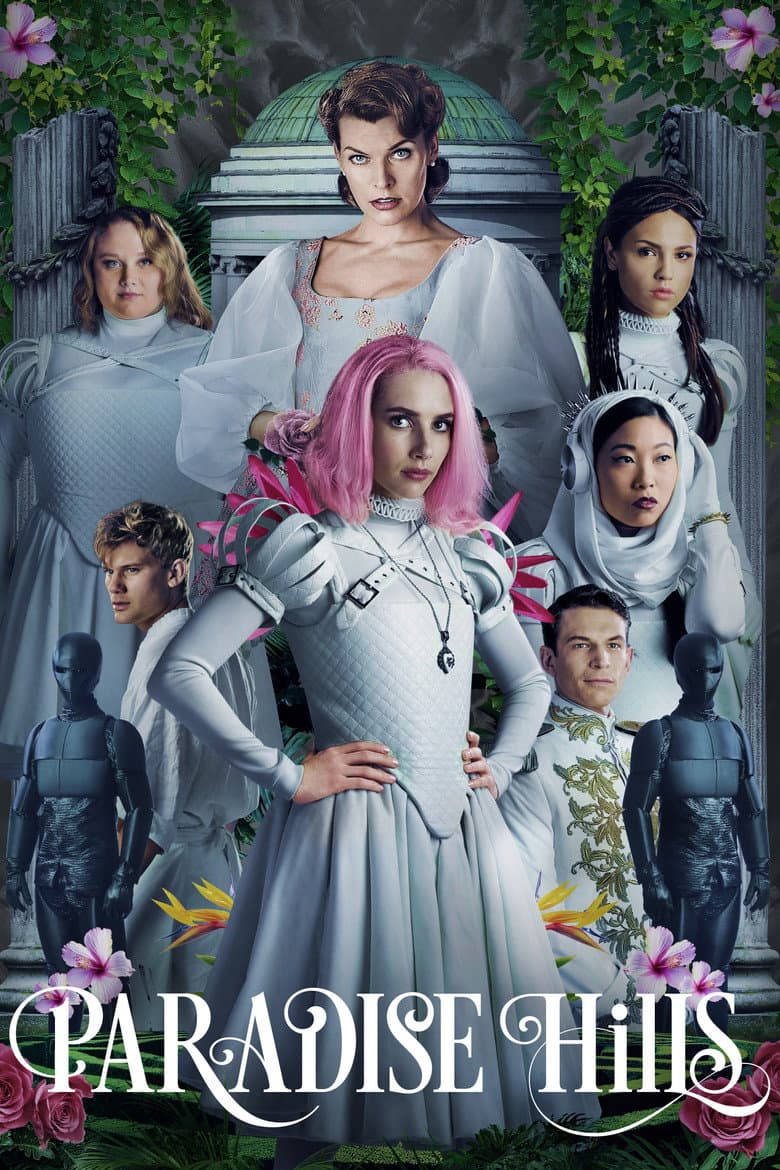
Uma is a wealthy young woman who refuses to marry Son, a man chosen by her family. Her mother sends her to Paradise Hills, a beautiful island center that promises to make difficult daughters obedient and perfect. The Duchess runs the center with drugged milk, forced diets, beauty lessons, exercise, and mind control. Uma joins Chloe, Yu, and Amarna, and the women uncover a plan to replace them with poor women who have been changed to copy them. The film has a bright, strange, and dark fairy tale tone.
The film makes women’s freedom the main message. The girls resist forced marriage, body shaming, anxiety treatment, family control, and pressure from the music business. The story treats friendship among women as the path to escape, while men often act as lovers, guards, buyers, or helpers. Uma also has a same-sex kiss with Amarna, and the film presents love and freedom of choice as better than obedience. The class system adds a second message because rich families use poorer women to protect their money and status.
Community feedback
Was our 76% Woke rating accurate?
Breakdown
These are the editorial factors and ratings behind our score for Paradise Hills.
Woke representation / casting
The main cast is led by five women with a visibly mixed group of backgrounds, including a Chinese character, a Mexican pop star, and a plus-size Southern woman. The story gives these women nearly all of the important roles, while men mostly appear as family controllers, guards, buyers, lovers, or helpers. The director said she wanted an inclusive, diverse fairy tale with different races and female points of view. The future setting makes the mix possible, but the repeated identity focus and direct diversity framing make the casting a clear representation choice.
48%
Woke political dialogue
Uma calls Paradise Hills a fascist boarding school and calls its lessons propaganda. The girls say their families are trying to shape them into someone else, and Uma says she is not the one who needs to change. The film also uses short lines about body control, perfect Upper women, and stepping on people below you. These ideas recur in brief scenes, but the film has no long political speech.
28%
Identity-driven story themes
The story centers on young women who are sent to an island to become obedient, thin, polished, and ready for arranged marriage. The women reject body shaming, family control, forced gender roles, and pressure to change their sexuality or personality. The plot makes female friendship and self-rescue the main way the heroes win. The film also includes a same-sex kiss and a class story in which rich families use poor women as copies. These themes shape nearly every major scene.
78%
Western institutional / cultural critique
The film attacks a social system that trains women to obey families, marry men they do not choose, lose weight, and look beautiful. The wealthy parents and the Duchess treat female bodies as things to fix, measure, and control. The story also mocks rich Uppers who use poorer Lowers as replaceable workers and bodies. The women resist traditional marriage, beauty rules, and male or family control. The critique is central and clearly modern in its focus on patriarchy, body image, and the beauty industry.
68%
Woke character or canon changes
Not relevant. The film is an original story and does not change an established character, source work, or real historical event.
0%
Anti-woke backlash and complaints
Not present. No clear anti-woke complaint appeared in the reviewed news, Reddit, YouTube, or audience material. The supplied X pass also found no such reaction.
0%
Creator track record context
The supplied creator profile gives Alice Waddington a score of 60/100 and describes feminist stories, inclusive casting, and women resisting social control. Nacho Vigalondo has a supplied score of 47/100, while Brian DeLeeuw has 0/100 and no strong identity-politics profile. The producers and casting director also have low supplied scores. This film closely matches Waddington’s stated focus on female freedom, diversity, and women saving themselves.
50%
Production
Movie · 2023
A powerful biotech company has breakthrough technology allowing them to clone history’s most influential people with just a few fragments of DNA.
Movie · 2016
Vampire death dealer Selene fends off brutal attacks from both the Lycan clan and the Vampire faction that betrayed her.
Movie · 2017
Jimmy is a committed child psychologist who uses his own playbook, but when he is brought in to work with Ellie, he is completely unprepared for his subject—a 9-year-old…
Movie · 2018
After being uprooted by his parents' separation and unable to fit into his new hometown, a teenager stumbles upon a magical app that causes his social media updates to come true.
Movie · 2019
A teenage girl is raised underground by a robot "Mother", designed to repopulate the earth following an extinction event.
Movie · 2020
A professional cellist has an encounter with a stranger on the subway which has unexpected and far-reaching ramifications on his life.
Movie · 2022
A prisoner in a state-of-the-art penitentiary begins to question the purpose of the emotion-controlling drugs he's testing for a pharmaceutical genius.
Movie · 2018
A group of friends stumble upon a mirror that serves as a portal to a "multiverse", but soon discover that importing knowledge from the other side in order to better their lives…
