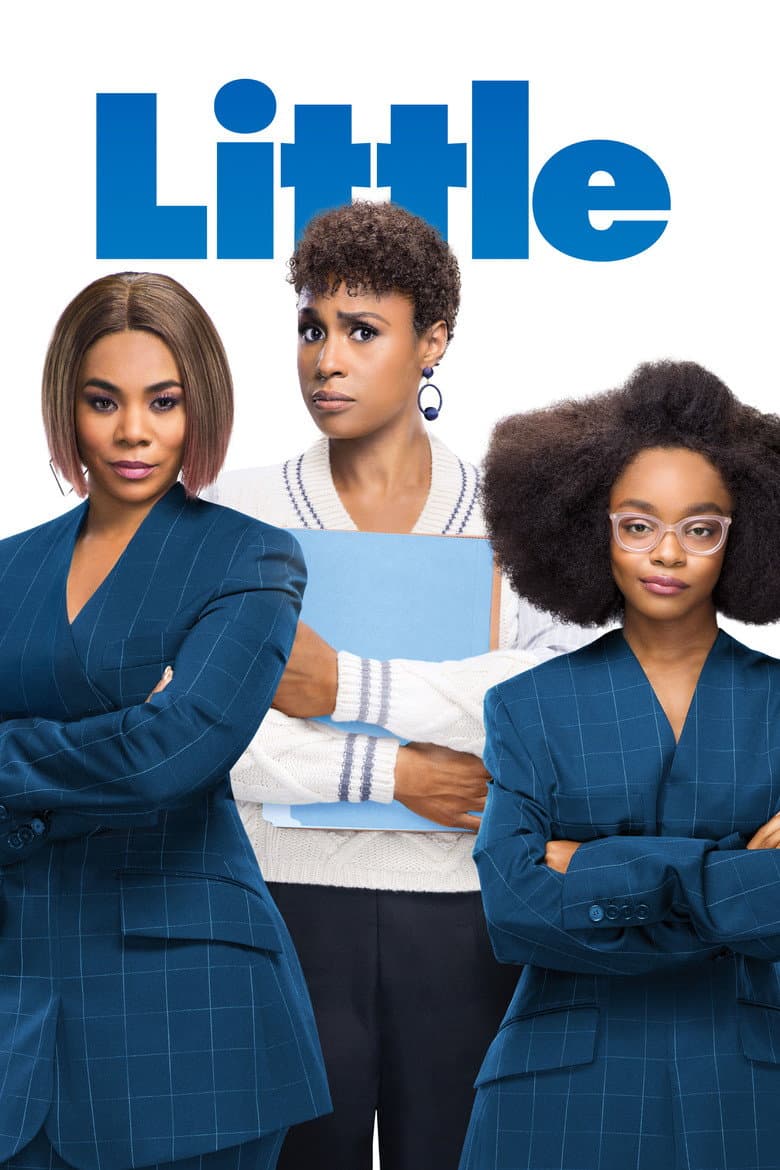
Little follows Jordan Sanders, a wealthy tech boss in Atlanta who treats her workers and neighbors badly. After she insults a young girl with a magic wand, a wish turns Jordan into her thirteen-year-old self on the day of a major business pitch. Her assistant April must pretend to be Jordan’s aunt, manage the company, and help Jordan return to normal. Jordan faces the middle school bullies who shaped her while April tries to keep the business alive. The tone is bright, loud, and sometimes crude, with a lesson about kindness, fear, friendship, and second chances.
The film places black women and girls at the center of its story. Jordan is a highly successful black female tech CEO, and April grows from a timid assistant into a confident business leader. The story treats Black girl magic as a source of talent, confidence, and literal fantasy power. The identity and empowerment focus is easy to notice in the main roles, the school group, the costumes, and the friendship between Jordan and April. The plot still spends most of its time on bullying, cruel behavior, personal growth, and learning to value other people.
Community feedback
Was our 45% Woke rating accurate?
Breakdown
These are the editorial factors and ratings behind our score for Little.
Woke representation / casting
The film centers three prominent black women, with Regina Hall as a tech CEO, Issa Rae as her key assistant, and Marsai Martin as the younger Jordan. The casting makes black female success highly visible across the office and school story. The film’s public framing calls Jordan the first black female tech CEO shown in a movie and presents the project as “Black girl magic.” The repeated focus on black female achievement makes representation a major visible choice, even though the story does not depend on a race-based conflict.
45%
Woke political dialogue
Not present. The characters do not give sustained speeches about parties, elections, or public policy. The dialogue focuses on work, bullying, relationships, and kindness.
0%
Identity-driven story themes
The film makes Black girl magic a repeated idea through Stevie’s spell and Jordan’s talent and success. Jordan and April are shown as capable women who learn to use power better and support each other. The story highlights black girls and women as creators, leaders, and role models. The main lesson is still personal kindness and growth, so the identity message is important but not the whole plot.
42%
Western institutional / cultural critique
Not present. The film shows a cruel boss and a timid worker in one company. It does not attack men, marriage, religion, capitalism, or Western institutions as a wider system.
0%
Woke character or canon changes
Not relevant. The movie uses a body-swap setup similar to Big, but it follows original characters named Jordan and April. It does not rewrite a known character, real person, or historical event.
0%
Anti-woke backlash and complaints
Not present. No clear anti-woke backlash was found. Public complaints focused on the uneven comedy and a scene called transphobic, while other viewers praised the cast and message. No major report tied the film to DEI, identity politics, or left-wing propaganda complaints.
0%
Creator track record context
The writers and several key producers have a clear record of supporting black-centered stories and wider representation. Tina Gordon and Tracy Oliver have centered black women, while Marsai Martin and Kenya Barris have promoted diverse projects. The casting and production team also includes people linked to representation-focused work. This context is strong, but it comes mainly from the creators’ broader work rather than direct political activism in the film.
58%
Production

Movie · 2019
A struggling musician realizes he's the only person on Earth who can remember The Beatles after waking up in an alternate reality where the group was forgotten.
Movie · 2021
Teddy wakes up the morning after his wedding to discover that he's jumped forward a year in his life to his first anniversary.

Movie · 2023
Hapless family man Paul Matthews finds his life turned upside down when millions of strangers suddenly start seeing him in their dreams.
Movie · 2021
Two teenagers trapped in an endless time loop set out to find all the tiny things that make that one day perfect.

Movie · 2023
After a disastrous first date, wild-child Nicole and socially-anxious Max vow to lose each other’s numbers until they learn that their dogs found a love match, and now puppies are…
Movie · 2026
Poppy's a free spirit. Alex loves a plan. After years of summer vacations, these polar-opposite pals wonder if they could be a perfect romantic match.
Movie · 2023
Paul and Sophie, interns at a mysterious London firm, become steadily aware their employers Humphrey and Dennis are anything but conventional – they are disrupting the world of…
Movie · 2016
From Jane Austen’s novella, the beautiful and cunning Lady Susan Vernon visits the estate of her in-laws to wait out colorful rumors of her dalliances and to find husbands for…
