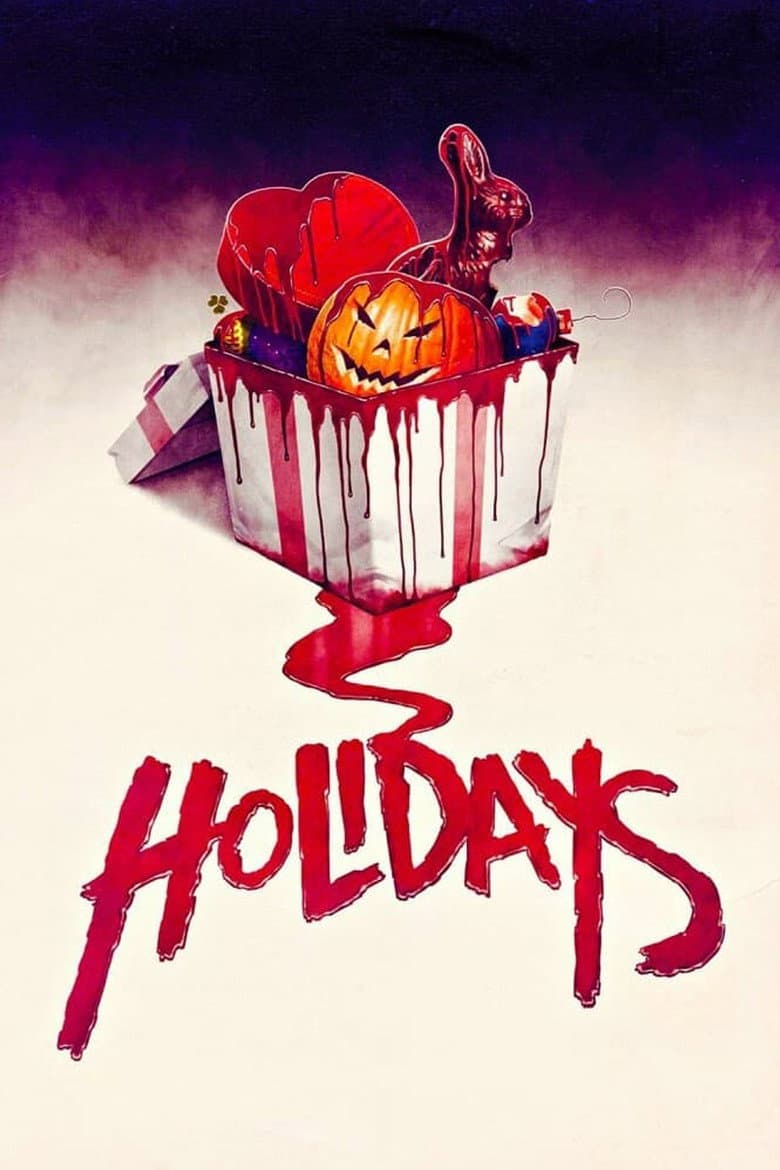
Holidays is a collection of eight short horror stories set around Valentine’s Day, St. Patrick’s Day, Easter, Mother’s Day, Father’s Day, Halloween, Christmas, and New Year’s Eve. Each story follows a different person who faces a cruel twist tied to the holiday, such as a bullied girl, a pregnant woman, a daughter searching for her father, or a father chasing a rare gift. The stories move between homes, schools, shops, a beach town, and a desert retreat. The tone is grim, bloody, strange, and sometimes darkly funny.
The film gives unusual weight to women and girls, who lead most of the stories and often become the people who cause the violence or take revenge. The Mother’s Day story centers on a woman who cannot control her pregnancies and is forced into a frightening birth, while the Halloween story has webcam workers turn on a sexually abusive boss. The New Year’s Eve story also places a woman at the center of a dating and murder story, and she mentions a past girlfriend. These ideas make gender, sex, pregnancy, and female power recurring parts of the collection, but the film presents them through short horror shocks rather than a single political plot.
Community feedback
Was our 49% Woke rating accurate?
Breakdown
These are the editorial factors and ratings behind our score for Holidays.
Woke representation / casting
Women and girls are the main characters in most of the eight segments, and several have the strongest or most violent roles. The film repeatedly places female characters at the center of its horror stories. The cast is mostly white, so ethnicity is not the main signal. The visible casting signal is the strong gender pattern.
37%
Woke political dialogue
The Halloween segment has the women reject being called girls and present themselves as women with shared power. The same scene uses witch and coven language while the women confront their boss. The lines are direct and identity-based, but they stay inside one short segment. The rest of the collection has no repeated modern activist speech.
24%
Identity-driven story themes
The collection repeatedly links its horror to women’s bodies, sex, pregnancy, motherhood, and male abuse. Mother’s Day makes control over pregnancy central and shows a woman resisting a group that tries to control her body. Halloween turns an abusive male boss into the target of a women-led revenge story. The repeated pattern makes female power and gender conflict clear, even though the film remains a set of short horror shocks.
54%
Western institutional / cultural critique
The Halloween segment shows a male boss recruiting young women, insulting them, and demanding sexual acts. The women then take over and punish him, which gives the segment a clear complaint about male entitlement. Mother’s Day presents pregnancy as a loss of control and shows doctors and a women’s group directing the main character’s body. Easter uses Christian images for horror, but it does not clearly attack Christianity.
31%
Woke character or canon changes
Not relevant. The film uses familiar holiday figures and myths, but it is an original collection. It does not recast or rewrite a known franchise character or historical figure.
0%
Anti-woke backlash and complaints
Not present. No anti-woke complaints, boycott, or review-bombing were found in the supplied X pass or broader searches. Public reviews mostly discuss uneven quality, gore, and gender treatment.
0%
Creator track record context
Kevin Smith describes the Halloween segment as female empowerment and as turning the story against a man. Sarah Adina Smith frames Mother’s Day around women’s control over pregnancy and a woman’s right to choose. Most other directors in the cached context have little activist history, while producer Joshua Bachove has a stronger LGBTQ and underrepresented-community record. The mixed record gives a modest creator signal.
30%
Production
Movie · 2019
A driving instructor must use her other-worldly gifts to save a lonely man’s daughter from a rock star looking to use her for Satanic purposes.
Movie · 2023
An American family fulfills their dream of moving back to their roots after inheriting a remote cabin in the mountains of Norway. But there's a surprise waiting for them.
Movie · 2023
Having grown sick and tired of his centuries as Dracula's lackey, Renfield finds a new lease on life — and maybe even redemption — when he falls for feisty, perennially angry…
Movie · 2025
When 24-year-old Jason Hochberg arrives for counsellor weekend at his beloved Camp Pineway, his biggest problem is feeling out of touch with his teenage co-workers.
Movie · 2018
A zombie apocalypse threatens the sleepy town of Little Haven—at Christmas—forcing Anna and her friends to fight, slash, and sing their way to survival.
Movie · 2021
Reeling from the unexpected death of her husband, Beth is left alone in the lakeside home he built for her. Soon she begins to uncover her recently deceased husband's disturbing…
Movie · 2022
A disgraced internet personality attempts to win back his followers by livestreaming one night alone in a haunted house.
Movie · 2022
The roguishly charming and endlessly troublesome Fletch becomes the prime suspect in a murder case while searching for a stolen art collection.
