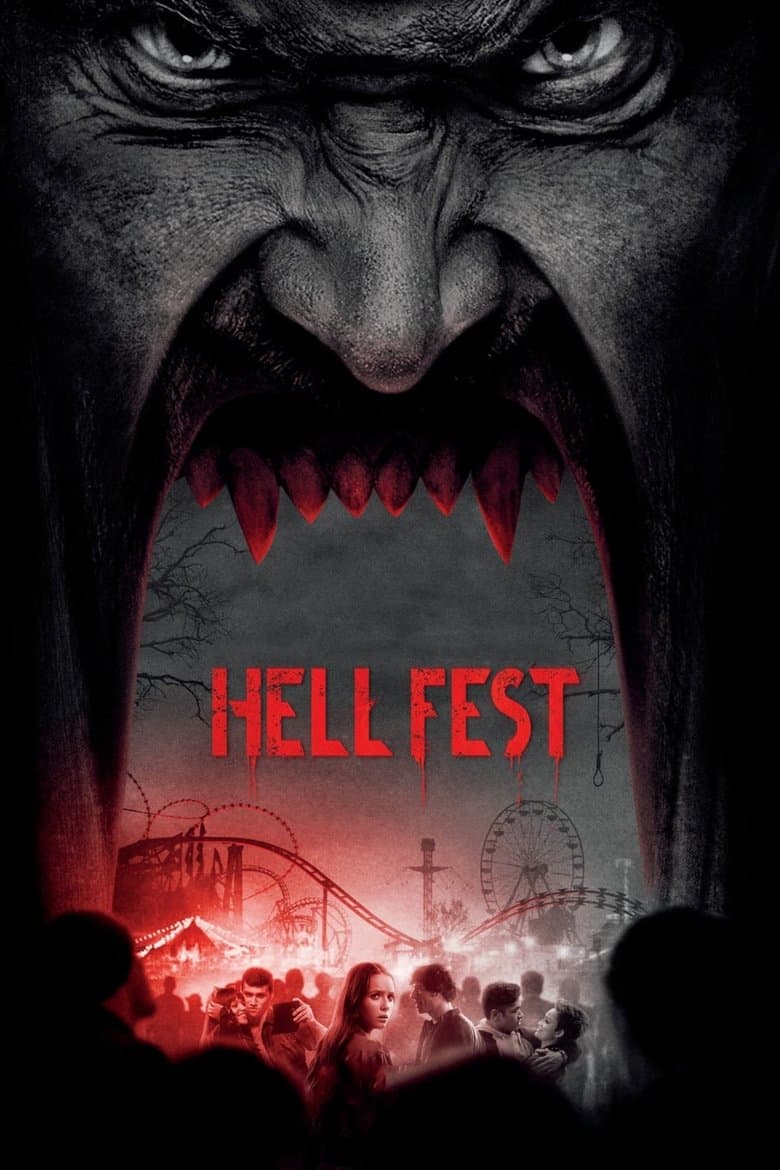
Hell Fest follows Natalie, a college student who visits her old friend Brooke on Halloween. Brooke brings Natalie, Taylor, their boyfriends, and Gavin to a traveling horror park filled with mazes, rides, actors, and fake killings. A masked man uses the crowds and costumes to hide real murders, while everyone else thinks the violence is part of the show. The night starts as a messy friend outing and turns into a tense fight to escape a killer who can hide in plain sight.
The movie places three young women at the center of the danger and gives Natalie and Brooke the final fight. The men in their group are mostly passive or are killed before the women stop the killer themselves. The women talk about dating and sex, but the movie does not make their interest or affection the reason they are attacked. The movie gives a mild message that women should not be helpless or wait for men to save them, but it spends far more time on stalking, escape, gore, and Halloween scares than on social ideas.
Community feedback
Was our 27% Woke rating accurate?
Breakdown
These are the editorial factors and ratings behind our score for Hell Fest.
Woke representation / casting
The film puts three young women at the center of the friend group and presents them as the main heroes. Natalie and Brooke take the final fight while the men are mostly less useful or already dead. Brooke is played by a black actress in a prominent role, but the story does not make race part of her character. The gender pattern is clear, yet it is still a mild slasher update rather than a diversity-first design.
28%
Woke political dialogue
Not present. The dialogue covers Halloween, dating, friendship, and the killer. No character gives a political or activist speech.
0%
Identity-driven story themes
The movie repeatedly makes women the active survivors rather than helpless victims. Natalie and Brooke fight the killer after the male friends are killed or fail to help. The women talk about dating and sex, but the movie does not treat their interest or affection as a reason they deserve violence. This gives the slasher a mild female empowerment message, although the message stays inside the survival story.
32%
Western institutional / cultural critique
Not present. The killer hides among park workers, but the film does not turn that danger into a modern critique of men, families, religion, business, or public institutions.
0%
Woke character or canon changes
Not relevant. Hell Fest is an original slasher story. It does not change a known character, source story, historical figure, or real event.
0%
Anti-woke backlash and complaints
Not present. The reviewed news, audience posts, and provided X pass show no anti-woke complaints about the film. The complaints that do appear focus on weak scares, dull writing, and the simple plot.
0%
Creator track record context
Cached profiles describe the director and most writers as genre-focused creators with low woke scores. Gale Anne Hurd’s profile includes support for women in film and gender equity. Akela Cooper has spoken about horror as escape and resisted pressure to add explicit social or racial commentary. That context lightly supports the film’s strong female focus, but it does not show a broad activist record.
18%
Production
Movie · 2018
Laurie Strode comes to her final confrontation with Michael Myers, the masked figure who has haunted her since she narrowly escaped his killing spree on Halloween night four…
Movie · 2026
College student Lucy and her friends spend their vacation at her family's home in Hawaii, which includes her pet chimpanzee, Ben.

Movie · 2019
When a huge hurricane hits her hometown in Florida, Haley ignores evacuation orders to look for her father. After finding him badly wounded, both are trapped by the flood.
Movie · 2018
A man recently released from a mental institute inherits a mansion after his parents die. After a series of disturbing events, he comes to believe it is haunted.
Movie · 2025
Four years after defeating The Grabber, Finney Blake is struggling with life after captivity. When his younger sister Gwen begins receiving calls in her dreams from the Black…
Movie · 2025
When Polly receives a mysterious box, it comes with one rule: place inside something she needs, something she hates, and something she loves.
Movie · 2024
A group of criminals kidnap a teenage ballet dancer, the daughter of a notorious gang leader, in order to obtain a ransom of $50 million, but over time, they discover that she is…

Movie · 2018
Two sisters are trapped under the fiberglass cover of an Olympic sized public pool and must brave the cold and each other to survive the harrowing night.
