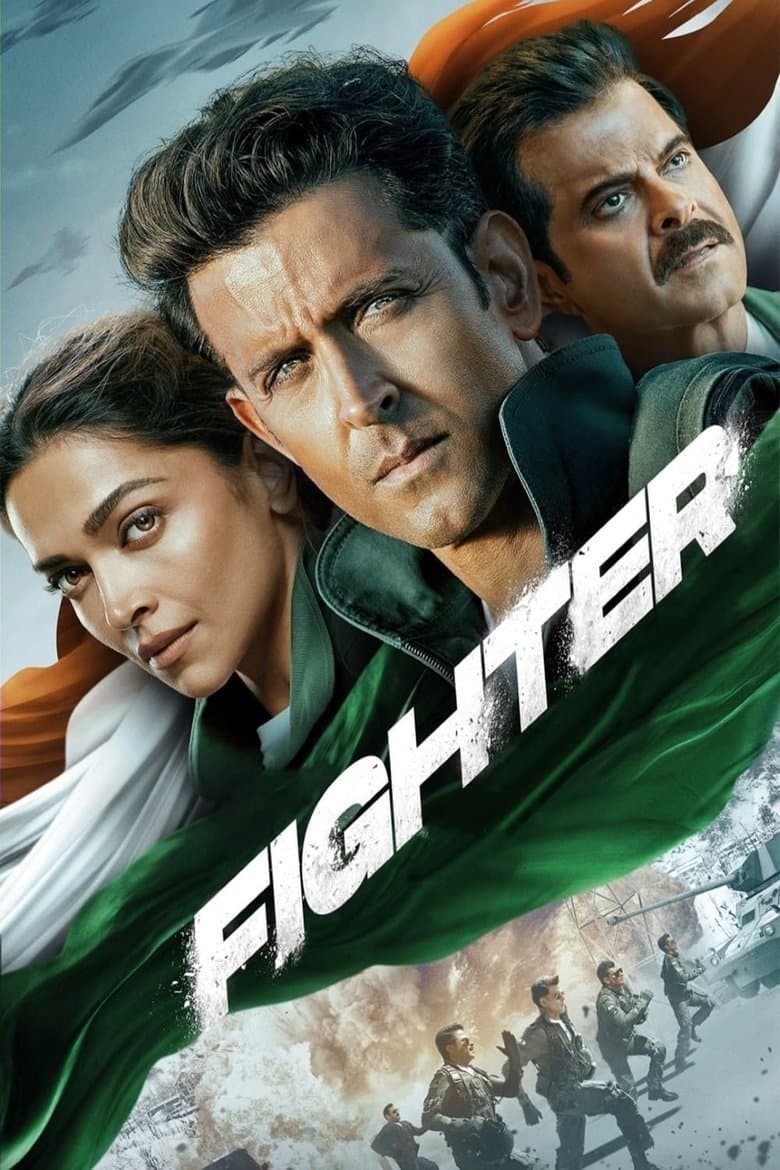
Fighter follows Squadron Leader Shamsher “Patty” Pathania, a gifted but reckless Indian Air Force pilot who hides guilt from a past mission. Group Captain Rocky Jai Singh brings Patty together with Minni, Taj, Bash, and other skilled pilots in the Air Dragons unit at a base in Srinagar. After a deadly attack on Indian security forces, the team faces Pakistani fighters and the terrorist leader behind the attack. Patty must learn to trust his team while he fights to rescue a captured friend and protect his country. The film mixes jet battles, military training, romance, grief, jokes, and loud patriotic drama.
The film gives Minni a clear gender-equality story. Her father wanted her to study, marry, and stay away from the Air Force, but she becomes a brave pilot and says women and men are equal in the sky. Several scenes call out the idea that girls should not fly, and her father later admits that he treated a daughter as a duty instead of a person with her own dream. This message is easy to notice, but it stays inside Minni’s family story rather than controlling the whole film. The main message remains that soldiers from different backgrounds should trust one another, face fear, and put duty before personal pride.
Community feedback
Was our 48% Woke rating accurate?
Breakdown
These are the editorial factors and ratings behind our score for Fighter.
Woke representation / casting
The film gives Deepika Padukone’s Minni a prominent Air Force pilot role. Minni is skilled, brave, and part of the Air Dragons team. India has real women pilots in the Air Force, so the role fits the story’s time and place. The film still uses her gender as a visible part of her backstory, which makes the casting more than ordinary background diversity.
28%
Woke political dialogue
The film gives Minni several direct lines about women being told to marry instead of joining the Air Force. Minni says people still dislike seeing a girl fly and says women and men are equal in the sky. A senior officer tells the team that enemy bullets do not judge gender but people do. Minni’s father later says that he treated a daughter as a duty and celebrates her rank.
45%
Identity-driven story themes
Minni’s family story centers on a daughter rejecting the expected path of study, marriage, and home. Her father first treats her career as a danger and later apologizes after she becomes a squadron leader. The story uses her success to support equal chances for women in military work. This is a clear secondary theme, while Patty’s guilt, team trust, terrorism, and patriotism drive most of the movie.
46%
Western institutional / cultural critique
The film treats old ideas about women, marriage, and family duty as wrong. Minni’s father says he wanted her to settle down instead of fly. Her later success forces him to reject the belief that sons are assets and daughters are duties. The story does not attack Christianity, capitalism, or wider Western institutions, and the critique stays inside one family subplot.
34%
Woke character or canon changes
Not relevant. The movie uses fictional pilots and a fictional Air Dragons unit while drawing on recent India-Pakistan events. It does not change an established character or known canon identity.
0%
Anti-woke backlash and complaints
Not present. The reported complaints called the film jingoistic or anti-Pakistan, not woke or identity-driven. The supplied X research found no anti-woke complaints, while right-leaning viewers praised the film as patriotic and not woke. The uniform-kiss complaint concerned respect for the Air Force, so it does not count as an anti-woke complaint.
0%
Creator track record context
Siddharth Anand brings a commercial action style and no clear activist record. Ramon Chibb brings military and factual-story experience, while Biswapati Sarkar has a stronger record of asking for wider and more honest representation of young Indians. Ajit Andhare and Anku Pande have backed women-led and socially focused projects, and Mukesh Chhabra has widened access for newcomers. These links give some background support, but the key creative message here is patriotic military drama rather than identity politics.
30%
Production
Movie · 2023
Denmark, 1755. Captain Ludvig Kahlen sets out to conquer a Danish heath reputed to be uncultivable, with an impossible goal: to establish a colony in the name of the king, in…
Movie · 2021
A widowed farmer and his son warily take in a mysterious, injured man with a satchel of cash. When a posse of men claiming to be the law come for the money, the farmer must decide…
Movie · 2020
A small unit of U.S. soldiers, alone at the remote Combat Outpost Keating, located deep in the valley of three mountains in Afghanistan, battles to defend against an overwhelming…
Movie · 2022
A fictional history of two legendary revolutionaries' journey away from home before they began fighting for their country in the 1920s.
Movie · 2016
A story set on the offshore drilling rig Deepwater Horizon, which exploded during April 2010 and created the worst oil spill in U.S. history.
Movie · 2024
In the near future, a group of war journalists attempt to survive while reporting the truth as the United States stands on the brink of civil war.
Movie · 2023
Set in the fictional dystopian city-state of Khansaar, the film follows the friendship between Deva, a tribesman, and Varadha, the prince of Khansaar.

Movie · 2023
The hardened son of a powerful industrialist returns home after years abroad and vows to take bloody revenge on those threatening his father's life.
