Movie review
August 8, 2019 · 102 min · PG · Kids · Comedy · Adventure · Family
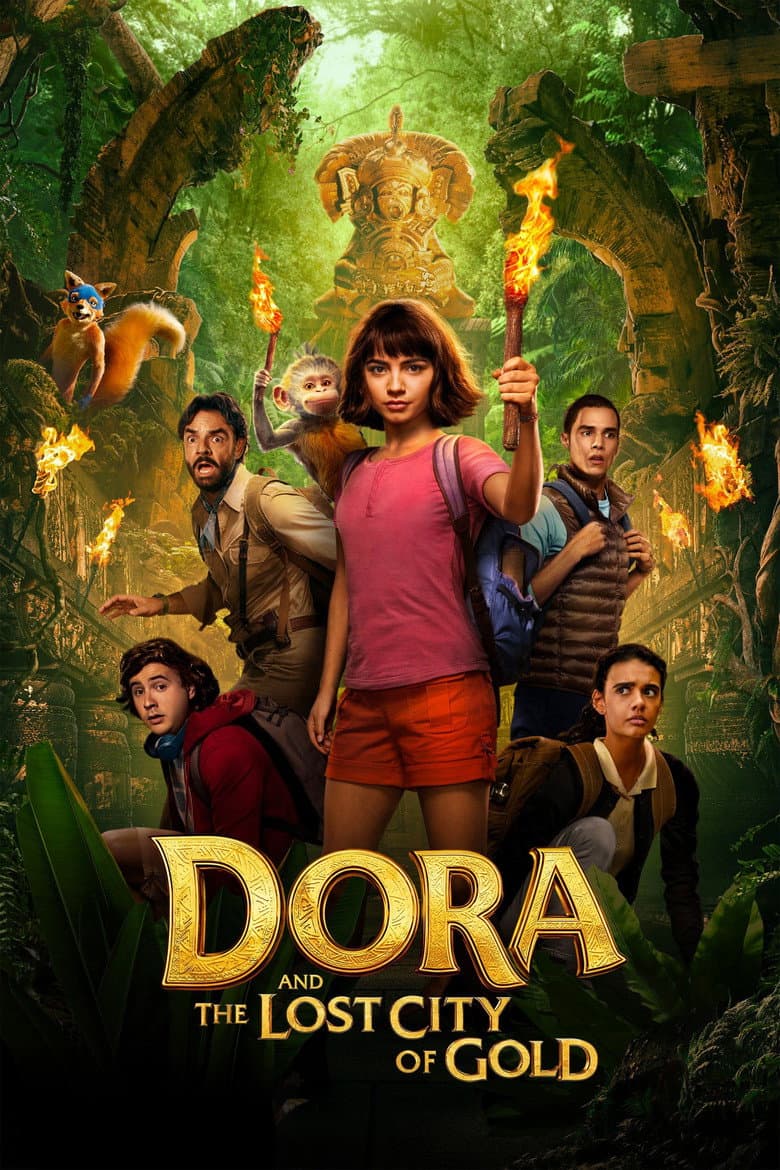
Dora Márquez has spent her childhood exploring the Peruvian jungle with her scientist parents and her cousin Diego. When Dora turns sixteen, her parents send her to live with Diego's family and attend high school in Los Angeles while they search for Parapata, a hidden Inca city. Dora struggles with classmates who see her cheerful, curious nature as strange, but the trouble becomes deadly when mercenaries kidnap her and several students. Dora leads the group through the rainforest, ancient traps, and dangerous puzzles to rescue her parents. The movie uses bright jokes, cartoon references, and family adventure to keep the danger light.
The film makes Dora's Latina identity visible through her Spanish and English speech, her close family life, and her connection to Peruvian and Quechua culture. Dora's school story says that she can enter a new social world without hiding the language, habits, and warmth that make her different. Her friends first urge her to act normal, but the adventure shows that her knowledge, courage, and kindness help save everyone. The story treats Latino and Indigenous characters as capable, caring people and presents learning about the past as more important than taking gold. These ideas support a clear representation and identity message, but they sit inside a traditional rescue adventure rather than taking over the whole movie.
Community feedback
Was our 36% Woke rating accurate?
Breakdown
These are the editorial factors and ratings behind our score for Dora and the Lost City of Gold.
Woke representation / casting
Dora is a Latina lead, and the main family and several major roles are played by Latino actors. The film also gives visible roles to Quechua characters and a varied Los Angeles student group. Marketing and interviews openly highlighted the rare Latino lead cast and a Latina superhero. The casting fits Dora's established identity and the story's setting, so the emphasis is clear but not a major mismatch.
38%
Woke political dialogue
Not present. The characters discuss school, family, language, and exploration, but the movie has no sustained modern political speech.
0%
Identity-driven story themes
The school conflict centers on Dora's pressure to act normal after classmates laugh at her open, curious behavior. Dora keeps her Spanish, family ties, and love of learning while she enters a new social world. The story says that being different does not make her weak and that her own skills help the group survive. This message matters to her personal arc, but the main plot remains a rescue and puzzle adventure.
35%
Western institutional / cultural critique
Not present. The film has a brief joke that foreign powers may have taken Parapata's gold, but it does not turn that history into a modern critique of Western institutions. The high school conflict targets peer pressure rather than family, religion, or social institutions.
0%
Woke character or canon changes
Not relevant. The movie ages Dora, turns the cartoon into live action, and gives her a new adventure, but these changes are not identity-driven. The film keeps Dora's established Latina and bilingual identity.
0%
Anti-woke backlash and complaints
Not present. Online complaints focused on the weak plot, awkward effects, tone, and toilet jokes. Searchable coverage did not show a meaningful claim that the movie pushes woke, DEI, or identity politics.
0%
Creator track record context
Several key creators have representation-focused work. The Dora co-creators built the character around Latina and bilingual representation. Nicholas Stoller has a separate record of queer representation, while Eugenio Derbez and Sarah Halley Finn have public diversity-focused work. James Bobin and most of the other listed crew have little activist history, so this context is noticeable but not dominant.
40%
Production
Movie · 2022
Puss in Boots discovers that his passion for adventure has taken its toll: He has burned through eight of his nine lives, leaving him with only one life left.
Movie · 2021
As Emily struggles to fit in at home and at school, she discovers a small red puppy who is destined to become her best friend.
Movie · 2021
Peter Rabbit runs away from his human family when he learns they are going to portray him in a bad light in their book.
Movie · 2025
When a young girl’s sketchbook falls into a strange pond, her drawings come to life—chaotic, real, and on the loose.
Movie · 2018
Christopher Robin, the boy who had countless adventures in the Hundred Acre Wood, has grown up and lost his way.
Movie · 2023
A magical meteor crash lands in Adventure City and gives the PAW Patrol pups superpowers, transforming them into The Mighty Pups.
Movie · 2017
Ferdinand, a little bull, prefers sitting quietly under a cork tree just smelling the flowers versus jumping around, snorting, and butting heads with other bulls.
Movie · 2020
After losing his wife seven years earlier, the eccentric Dr. John Dolittle, famed doctor and veterinarian of Queen Victoria’s England, hermits himself away behind the high walls…
