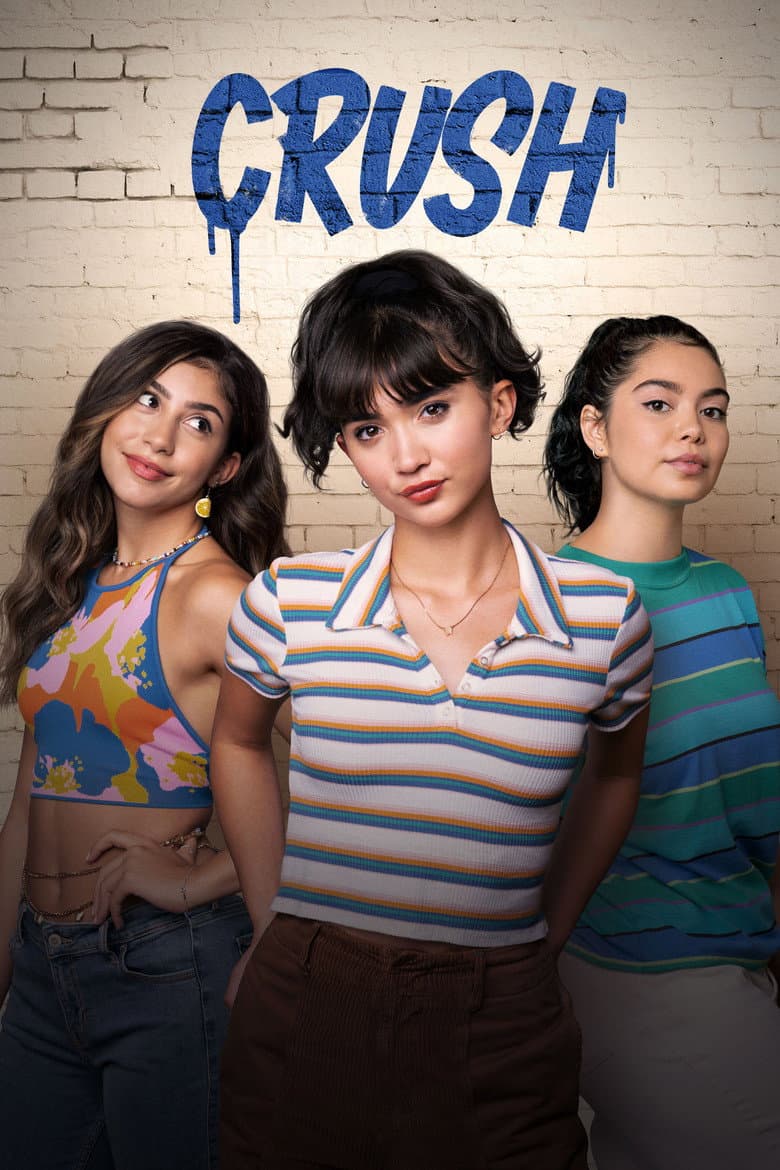
Crush follows Paige Evans, a high school artist who wants to enter a summer art program. She joins the track team to spend time with Gabby, the popular girl she has liked for years. The plan changes when Gabby’s twin sister AJ trains Paige and the two begin to fall for each other. Paige also tries to find the student behind funny graffiti while school rules and a messy love triangle create trouble. The movie has a bright, playful teen-romance tone.
Queer romance drives the whole story instead of appearing in a side plot. Paige is openly lesbian, AJ is bisexual, and Gabby is also queer, so the central triangle involves three girls. The film treats same-sex love as normal and joyful, and the school and parents are mostly accepting. The main cast and friend group show strong racial, ethnic, and LGBTQ representation, while Paige’s mother supports a single-parent home and open talk about sex. These choices make identity-driven themes easy to notice even though the movie has little direct political debate.
Community feedback
Was our 82% Woke rating accurate?
Breakdown
These are the editorial factors and ratings behind our score for Crush.
Woke representation / casting
The film puts a lesbian teen and a bisexual teen in the main romance. The love triangle is led by three girls, and several prominent roles go to people from different ethnic backgrounds. The film also gives a Latina girl the role of the popular, admired student, a choice the actor publicly linked to Latina representation. These repeated identity choices make representation a clear part of the film’s visible design.
72%
Woke political dialogue
Not present. The characters discuss sexuality, dating, and consent, but they do not give political or activist speeches. The movie does not make current laws, elections, parties, or public policy part of the dialogue.
0%
Identity-driven story themes
Paige is an openly lesbian teenager, and her love story with AJ drives the main plot. AJ identifies as bisexual, Gabby is queer, and the school group treats several identities as normal. The film presents same-sex romance as joyful and gives Paige a happy ending without making suffering or rejection the main conflict. The writers and director described the goal as a queer rom-com about life after coming out and queer joy. Queer identity is central from the first scene to the ending.
90%
Western institutional / cultural critique
Paige’s mother presents single motherhood by choice and open talk about sex as normal. The school also accepts queer students and does not treat their relationships as a problem. These choices gently push against older family and sexual rules, but the movie does not build a larger attack on religion, men, capitalism, or Western institutions.
14%
Woke character or canon changes
Not relevant. Crush is an original high-school story. It does not change an established character, canon, or historical figure.
0%
Anti-woke backlash and complaints
A few audience comments on Reddit called the film an SJW-style effort or complained that Paige talks about being gay too often. One user review attacked the LGBTQ framing by wrongly describing the love triangle between twins and Paige as incest. These comments are scattered and do not show a large campaign. Most public reactions either welcomed the queer romance or criticized the predictable plot and uneven jokes.
18%
Creator track record context
The cached context gives Cohen and both writers strong records of queer storytelling and representation work. Natasha Lyonne and several producers also have ties to LGBTQ or feminist projects. Other producers and Ben Pollack have little or no activist record, so the wider team is mixed. The strongest creative voices closely match the film’s central queer focus.
72%
Production
Movie · 2023
Two twenty-somethings, both reeling from bad break-ups, connect over the course of an eventful day in South London – helping each other deal with their nightmare exes, and…
Movie · 2023
On the brink of losing her childhood home, Maddie discovers an intriguing job listing: wealthy helicopter parents looking for someone to “date” their introverted 19-year-old son…

Movie · 2020
When carefree Nyles and reluctant maid of honor Sarah have a chance encounter at a Palm Springs wedding, things get complicated when they find themselves unable to escape the…

Movie · 2023
After a disastrous first date, wild-child Nicole and socially-anxious Max vow to lose each other’s numbers until they learn that their dogs found a love match, and now puppies are…
Movie · 2024
In the summer of 1986, three sixteen year old friends spend their Saturdays sneaking into movies at the local multiplex.
Movie · 2021
Teddy wakes up the morning after his wedding to discover that he's jumped forward a year in his life to his first anniversary.

Movie · 2023
College freshman Abby tries to distance herself from her dark past while resisting her attraction to bad boy Travis.
Movie · 2022
Peter and Emma thought they were on the precipice of life’s biggest moments – marriage, kids, and houses in the suburbs – until their respective partners dumped them.
