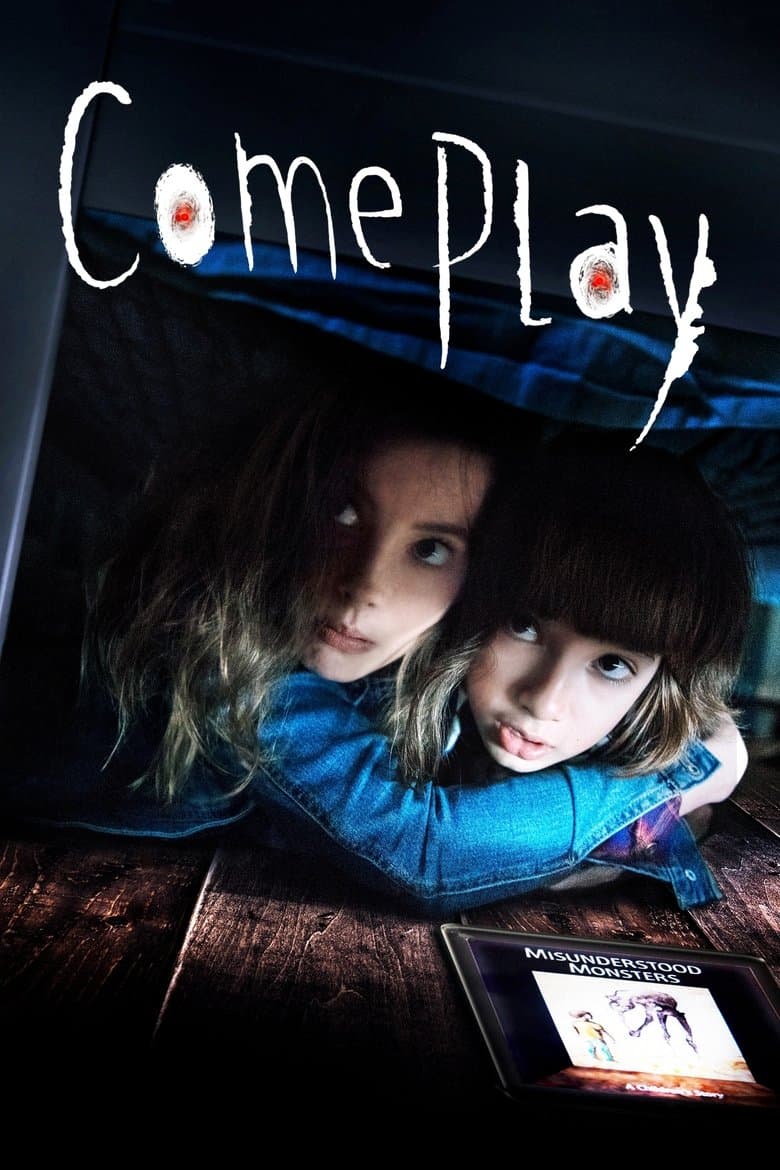
Come Play follows Oliver, a lonely autistic boy who uses a phone and tablet to communicate and find comfort. The story takes place in a modern American home, a school, and nearby public places as Oliver’s parents struggle with a breakup. A strange digital story introduces Larry, a tall creature who wants a friend and begins to enter the real world through screens and electricity. Oliver’s parents must learn to understand his warnings while they try to protect him, his friends, and themselves. The film uses jump scares, dark rooms, and a sad story about loneliness, so its tone is tense but also gentle and emotional.
Oliver’s autism is not a side detail because it shapes how he speaks, how other people treat him, and how the monster reaches him. The film shows bullying and adult fear of his behavior, then asks the family to listen to him instead of treating him as a danger or a problem. It presents his tablet as both a useful communication tool and a doorway to danger. The story supports empathy for a child who is often misunderstood, but it does not use political speeches, current identity slogans, queer themes, or a broad attack on Western institutions. Its main social message is that screens can deepen loneliness and that real human connection matters.
Community feedback
Was our 26% Woke rating accurate?
Breakdown
These are the editorial factors and ratings behind our score for Come Play.
Woke representation / casting
The film places an autistic, nonverbal boy in the main role, and his communication app is visible in many key scenes. Jacob Chase said he had long wanted an autistic character in a horror movie and consulted autistic children and adults while developing Oliver. The film shows a clear disability-representation choice, but it does not present a wider diversity-first cast or a quota message.
25%
Woke political dialogue
Not present. The characters do not debate parties, elections, race, gender politics, or social policy. Larry’s warning about screens and human connection is a general message, not political dialogue.
0%
Identity-driven story themes
Oliver’s autism drives the central conflict because his limited speech affects how he warns others and how Larry targets him. The film returns to bullying, family strain, social isolation, and adults misreading his behavior. The story asks viewers to see Oliver as a child with real thoughts and feelings instead of treating him as a problem. The message supports empathy and better understanding, but it stays personal and family-focused rather than becoming current identity politics.
34%
Western institutional / cultural critique
The film shows school bullies, adults who fear Oliver’s behavior, and Larry telling him that his parents want him to be normal. Those moments question pressure on a disabled child to act like everyone else. The story does not attack Christianity, capitalism, traditional family life, or Western institutions, so this remains a small cultural-critique element.
12%
Woke character or canon changes
Not relevant. The film expands Jacob Chase’s own 2017 short, but it does not change a known character, real person, or established canon for identity reasons.
0%
Anti-woke backlash and complaints
Not present. No credible anti-woke backlash about Come Play’s DEI or identity-politics message was found in the reviewed coverage. Online discussion focused on scares, technology, and the portrayal of autism, with both praise and criticism, which does not count as anti-woke backlash.
0%
Creator track record context
The cached record gives Jacob Chase 0, Alan C. Blomquist 0, Andrew Rona 6, and Alex Heineman 7. The two small producer scores are the only mild woke-context signals, and no activist or identity-driven record is linked to this film. The creator context therefore adds very little to the title.
3%
Production

Movie · 2021
Alice is a young hearing-impaired girl who, after a supposed visitation from the Virgin Mary, is inexplicably able to hear, speak and heal the sick.

Movie · 2020
A man providing overnight watch to a deceased member of his former Orthodox Jewish community finds himself opposite a malevolent entity.

Movie · 2017
Law enforcement finds itself chasing the ghost of a man dead for over a decade, embroiled in a diabolical new game that's only just begun.
Movie · 2020
After a family moves into the Heelshire Mansion, their young son soon makes friends with a life-like doll called Brahms.
Movie · 2024
After the brutal murder of her twin sister, Darcy goes after those responsible by using haunted items as her tools for revenge.

Movie · 2016
A young American woman takes a job as a nanny in a remote English village, soon discovering that the family's eight-year-old son is a life-sized doll that comes with a list of…

Movie · 2025
Plagued by a violent recurring nightmare, college student Stefanie heads home to track down the one person who might be able to break the cycle and save her family from the grisly…

Movie · 2017
A group of college friends reunite for a trip to the forest, but encounter a menacing presence in the woods that's stalking them.
