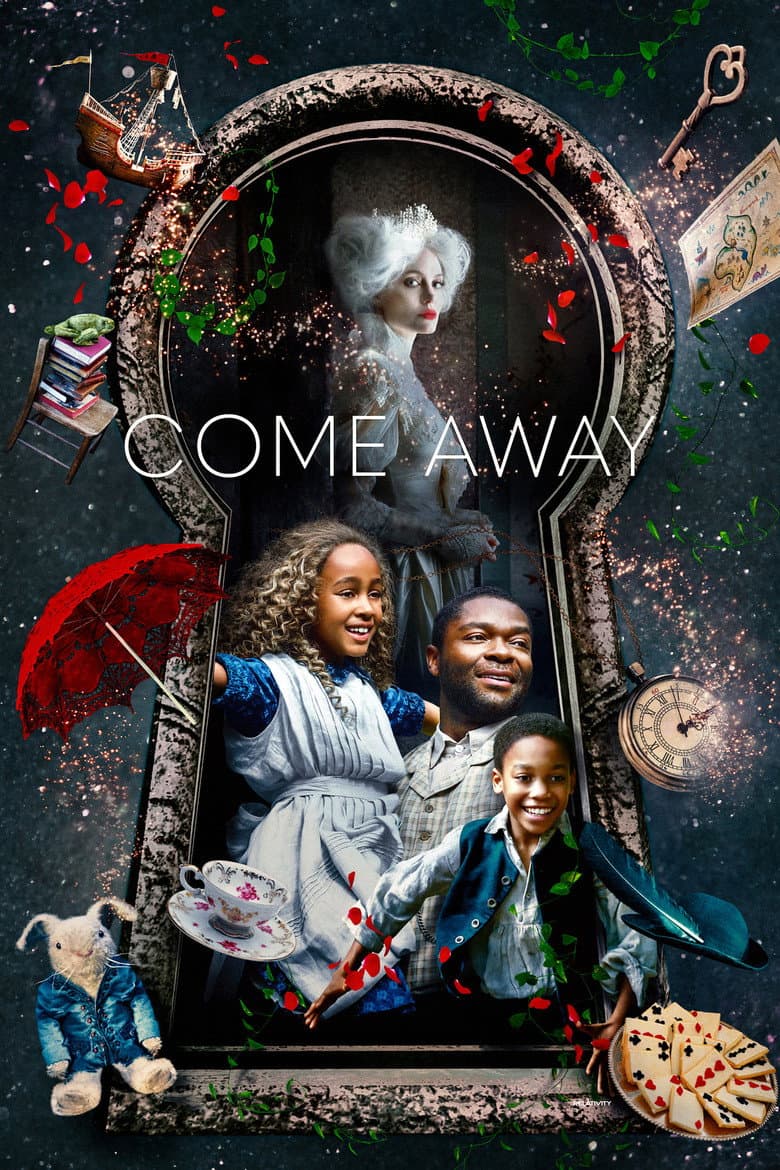
Come Away follows Alice and Peter Littleton, siblings who grow up with their older brother David in the English countryside near London. Their happy games end when David dies in an accident, and their parents fall into grief, drinking, gambling, and debt. Alice and Peter travel to London, where danger and strange adults push them toward the worlds later known as Wonderland and Neverland. The film has a dark, sad tone, with family fantasy mixed with addiction, violence, and loss.
The film gives Alice and Peter a black father, a white mother, and three mixed-race children, which changes the usual white image of these characters. The family’s race is easy to see, but the story does not make race the main problem or give the children activist speeches. The main message is that children use play and imagination to survive pain while adults struggle to care for them. The movie also treats Aunt Eleanor’s class snobbery and rules about becoming a proper lady as harmful, but that idea stays inside a smaller family conflict.
Community feedback
Was our 45% Woke rating accurate?
Breakdown
These are the editorial factors and ratings behind our score for Come Away.
Woke representation / casting
The central family is a black father, a white mother, and three mixed-race children living in Victorian England. Alice and Peter hold the most important child roles, so the choice is easy to see. Brenda Chapman and David Oyelowo discussed the casting as a way to show children who look like Oyelowo and his family. The film does not make race a large plot problem, which keeps this below the highest range.
42%
Woke political dialogue
Not present. The characters do not give modern political speeches about race, gender, sexuality, or activism. The film uses a few class-based insults, but those are part of the family conflict rather than sustained woke political dialogue.
0%
Identity-driven story themes
The film gives its mixed-race family a small identity-based conflict through Aunt Eleanor’s class insults toward black father Jack. The insults sit beside the family’s interracial marriage, so class prejudice can also point toward race. The main story stays with grief and imagination, so identity is a minor undercurrent rather than a central theme.
18%
Western institutional / cultural critique
Aunt Eleanor says Jack belongs to the lower class and tries to train Alice to be a proper lady. The film shows her class rules and gender training as cold and harmful. This idea appears in a smaller family conflict and does not drive the whole story. The film does not attack Christianity or Western institutions.
12%
Woke character or canon changes
The film changes Alice and Peter from the familiar white versions linked to the original stories into children in a mixed-race family. The film also makes them siblings, but that is a fantasy plot invention rather than an identity message. The race change was publicly tied to the goal of showing children who look like David Oyelowo’s family. The story does not build a long race-centered plot around it, so the change is important but contained.
32%
Anti-woke backlash and complaints
The film drew pre-release complaints about Alice and Peter being played by nonwhite children. Entertainment reports said IMDb faced review bombing after the trailer, with comments focused on the casting. The supplied X review found only a few tiny accounts and no large boycott, sustained thread, or major review-bomb drive. The backlash was real but small and short-lived.
15%
Creator track record context
Brenda Chapman’s stored creator profile describes feminist views and criticism of male-dominated Hollywood. David Oyelowo’s stored profile shows a repeated focus on race, diversity, and industry bias, and his interviews link this film to representation. The writers and most other stored producers have little or no activist record. The key director and producer give the film a moderate creator track record signal.
45%
Production
Movie · 2016
12-year-old Conor encounters an ancient tree monster who proceeds to help him cope with his mother's terminal illness and being bullied in school.
Movie · 2019
In a world where people collect pocket-size monsters (Pokémon) to do battle, a boy comes across an intelligent monster who seeks to be a detective.
Movie · 2016
After a threat from the tiger Shere Khan, Mowgli, a man-cub fostered by wolves, is forced to flee the jungle, and he embarks on a journey of self-discovery with the help of the…
Movie · 2021
An ordinary young boy called Nikolas sets out on an extraordinary adventure into the snowy north in search of his father who is on a quest to discover the fabled village of the…

Movie · 2019
It's been ten years since the dragons moved to the Hidden World, and even though Toothless doesn't live in New Berk anymore, Hiccup continues the holiday traditions he once shared…
Movie · 2025
Four misfits find themselves struggling with ordinary problems when they are suddenly pulled through a mysterious portal into the Overworld: a bizarre, cubic wonderland that…
Movie · 2022
Suzume, 17, lost her mother as a little girl. On her way to school, she meets a mysterious young man. But her curiosity unleashes a calamity that endangers the entire population…
Movie · 2025
When a young girl’s sketchbook falls into a strange pond, her drawings come to life—chaotic, real, and on the loose.
