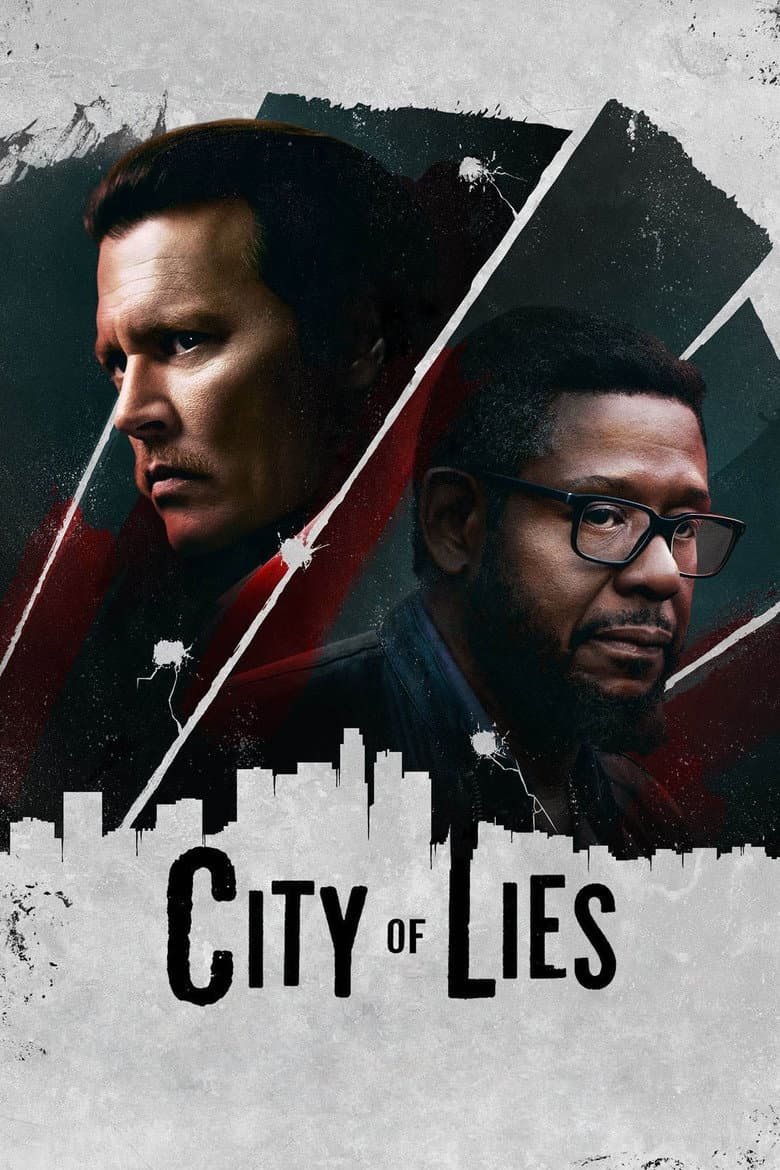
City of Lies follows Russell Poole, a former Los Angeles police detective who cannot let go of the murders of Tupac Shakur and The Notorious B.I.G. A reporter named Jack Jackson joins him as they review clues from the late 1990s and the years that followed. Their search points toward police officers, gang figures, and city officials who may have hidden the truth. The film uses flashbacks, tense interviews, gun violence, and a dark crime-thriller mood.
The film repeatedly questions whether a police department can police itself when its own officers break the law. It shows the Rampart scandal, links corrupt officers to Death Row Records, and connects the unsolved murders to public distrust of law enforcement. The story also places a black journalist beside a white detective and talks about how race shaped the cases and the city's response. These ideas support the investigation, but the movie keeps them inside a specific crime story instead of building a separate campaign about identity or social change.
Community feedback
Was our 28% Woke rating accurate?
Breakdown
These are the editorial factors and ratings behind our score for City of Lies.
Woke representation / casting
Forest Whitaker plays Jack Jackson, a fictionalized version of white author Randall Sullivan. The role is a main partner to the white detective, so the visible casting choice changes the source figure's race. The film does not build a wider diversity-first cast pattern, and Jackson's race is not a main part of his personal arc.
18%
Woke political dialogue
Russell Poole and other officers repeatedly talk about a police department that protects itself. The film calls the Rampart unit a criminal group inside the department and says public trust has been damaged. This language supports a strong law-enforcement critique, but it does not become a broad party-political speech.
25%
Identity-driven story themes
The film connects the failure to solve the deaths of two Black rappers with racial tension, police treatment of Black residents, and unequal justice. The story also places a black journalist inside a case about police abuse and public trust. These themes appear around the case but do not drive a separate identity storyline.
18%
Western institutional / cultural critique
The film presents the LAPD as an institution that hides crimes and protects officers. Poole says the department lost public trust and that a homicide stays unsolved when police do not want to solve it. The story also links police power to city officials, courts, and Death Row Records. This message stays tied to a real 1990s corruption case.
32%
Woke character or canon changes
Not relevant. The film changes some names and combines story details for a crime adaptation. No clear identity-based rewrite of the real people or case shapes the plot.
0%
Anti-woke backlash and complaints
Not present. The separate X research found no anti-woke reaction or specific complaints. News stories focused on the delayed release, Depp's lawsuit, and claims about LAPD pressure, not woke or DEI messaging.
0%
Creator track record context
Brad Furman's public profile centers on crime thrillers and shows no clear identity-activist pattern. Christian Contreras and Randall Sullivan also have no recurring DEI or representation campaign history. One producer has made an Indigenous-centered film, but that work is separate from this title.
6%
Production
Movie · 2016
A U.S Customs official uncovers a massive money laundering scheme involving Pablo Escobar.
Movie · 2019
A charismatic New York City jeweler always on the lookout for the next big score makes a series of high-stakes bets that could lead to the windfall of a lifetime.
Movie · 2021
When the aging Meyer Lansky is investigated one last time by the Feds who suspect he has stashed away millions of dollars over half a century, the retired gangster spins a…
Movie · 2016
As a math savant uncooks the books for a new client, the Treasury Department closes in on his activities and the body count starts to rise.
Movie · 2019
In New York, former convict Pete Koslow, related to the Polish mafia, must deal with both Klimek the General, his ruthless boss, and the twisted ambitions of two federal agents…
Movie · 2017
After a botched bank robbery lands his younger brother in prison, Connie Nikas embarks on a twisted odyssey through New York City's underworld to get his brother Nick out of jail.

Movie · 2022
After escaping a Michigan prison, a charming career criminal assumes a new identity in Canada and goes on to rob a record 59 banks and jewellery stores while being hunted by a…

Movie · 2017
A newly-released prison gangster is forced by the leaders of his gang to orchestrate a major crime with a brutal rival gang on the streets of Southern California.
