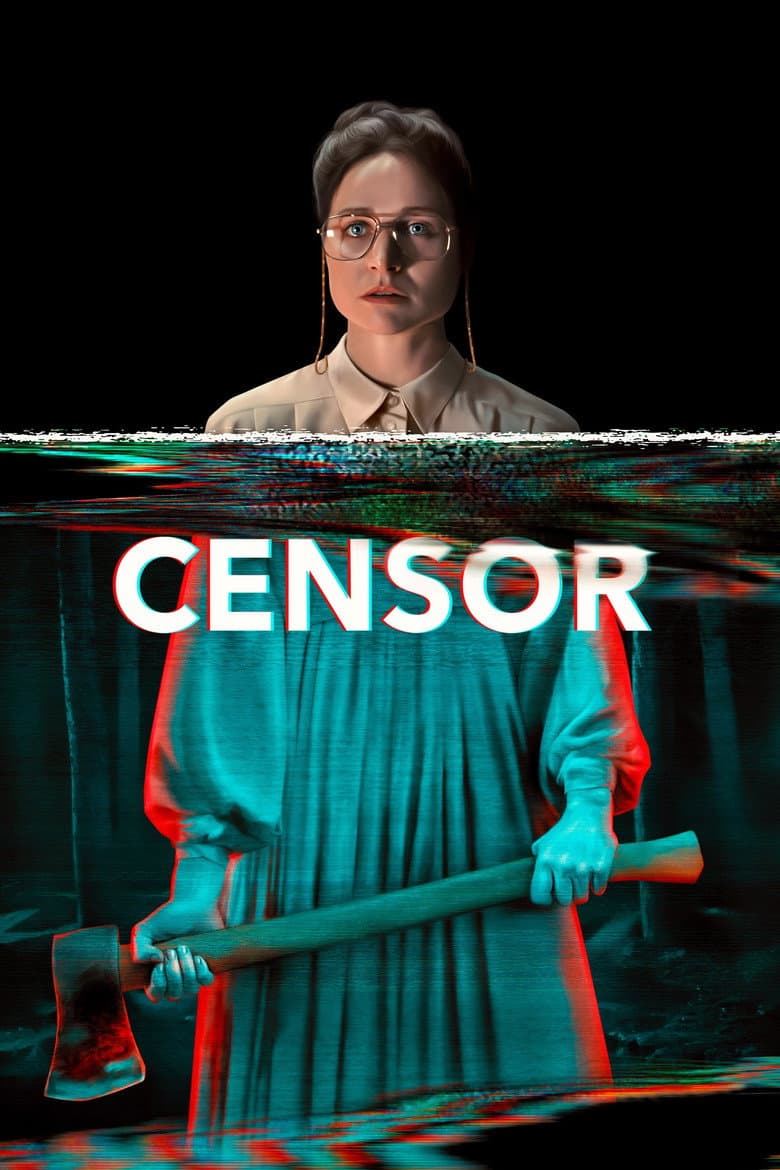
Censor follows Enid Baines, a careful young woman who reviews violent VHS films for a British film board in the mid-1980s. She has earned a hard reputation because she cuts scenes that she thinks could harm viewers. After a murder seems to copy a film she approved, Enid sees another tape that looks like the day her little sister vanished. Her search leads her toward a horror director and a film set, while her grip on reality slowly breaks down. The movie has a grim, strange, and bloody tone, with fake films and real memories blending together.
The film repeatedly shows women being attacked in the horror tapes and asks why male filmmakers make violence against women seem easy or entertaining. Enid and a female co-worker talk about that pattern, while male co-workers and a producer treat Enid in patronizing and sexist ways. The story presents Enid as a woman with real skill and power at work, but it also shows that her need to protect others grows from guilt and grief rather than simple heroism. The film also treats Thatcher-era censorship and moral panic as a way for officials and newspapers to blame horror films for wider social problems. These ideas matter to the story, but the main focus stays on Enid’s trauma, fear, and confused search for her sister.
Community feedback
Was our 53% Woke rating accurate?
Breakdown
These are the editorial factors and ratings behind our score for Censor.
Woke representation / casting
The film puts a woman at the center of a censor office and gives her a female co-worker while several men serve as patronizing or threatening foils. The female-led setup fits the story and the period, so it is not a strong mismatch. Interviews and coverage also present the film within the rise of women-led horror. That creates a mild gender-representation signal, but the cast does not show a broad diversity pattern.
18%
Woke political dialogue
Enid says that male co-workers seem unconcerned about violence against women. She describes the films as driven by male weakness and revenge. A female co-worker asks why male directors keep hurting women on screen. A producer also makes sexist remarks to Enid. These lines appear in more than one office scene and connect gender criticism to her job.
43%
Identity-driven story themes
Enid’s job and breakdown are built around violence against women, female trauma, and the way male horror makers treat women on screen. The story makes Enid’s view central while men around her dismiss, patronize, or threaten her. The film questions old horror habits instead of treating them as harmless fun. Enid is not shown as a simple heroic winner because guilt and confusion drive her final violence. These ideas recur from the censor office to the ending.
52%
Western institutional / cultural critique
The film shows Thatcher-era officials, newspapers, and censors treating horror films as a cause of social violence. The story suggests that public fear lets leaders blame films for deeper problems instead of facing them. The censor office also exposes male entitlement and a narrow idea of what the public should be allowed to see. News footage, office talk, and the final fantasy return to these ideas. The critique stays tied to the 1980s setting rather than becoming a full modern political program.
42%
Woke character or canon changes
Not relevant. The film is an original fictional story and does not change an established character, source, or real historical figure. The 1980s censor office is a fictional setting.
0%
Anti-woke backlash and complaints
Not present. The separate X pass found no anti-woke complaints, and wider searches found no clear boycott or review-bombing. Reddit and audience reviews focused on the ending, pace, and horror style rather than woke or DEI messaging.
0%
Creator track record context
Prano Bailey-Bond has a clear history of supporting women in horror and speaking about the lack of women behind the camera. Her earlier work and this film often center women’s trauma and violence. Mary Burke has backed films with central LGBTQ+ stories, and Kimberley Warner has worked on access and inclusion in Welsh film. Anthony Fletcher and most of the other cached creators show little public activist or identity-focused activity. The combined signal is moderate and comes mainly from Bailey-Bond.
42%
Production
Movie · 2016
A stranger arrives in a little village and soon after a mysterious sickness starts spreading. A policeman is drawn into the incident and is forced to solve the mystery in order to…
Movie · 2021
A lone drifter suffering from partial memory loss accepts a job to look after a psychologically troubled woman in an abandoned house on an isolated island.
Movie · 2023
After a Black Friday riot ends in tragedy, a mysterious Thanksgiving-inspired killer terrorizes Plymouth, Massachusetts - the birthplace of the holiday.
Movie · 2023
Between the events of 'Saw' and 'Saw II', a sick and desperate John Kramer travels to Mexico for a risky and experimental medical procedure in hopes of a miracle cure for his…
Movie · 2022
After witnessing a bizarre, traumatic incident involving a patient, Dr. Rose Cotter starts experiencing frightening occurrences that she can't explain.
Movie · 2018
A filmmaker discovers a box of video tapes depicting two students' disturbing film project featuring a local horror legend, The Peeping Tom.
Movie · 2022
When Keira Woods' daughter mysteriously vanishes in the cellar of their new house in the country, she soon discovers there is an ancient and powerful entity controlling their home…
Movie · 2016
In a small Midwestern town, a troubled teen with homicidal tendencies must hunt down and destroy a supernatural killer while keeping his own inner demons at bay.
