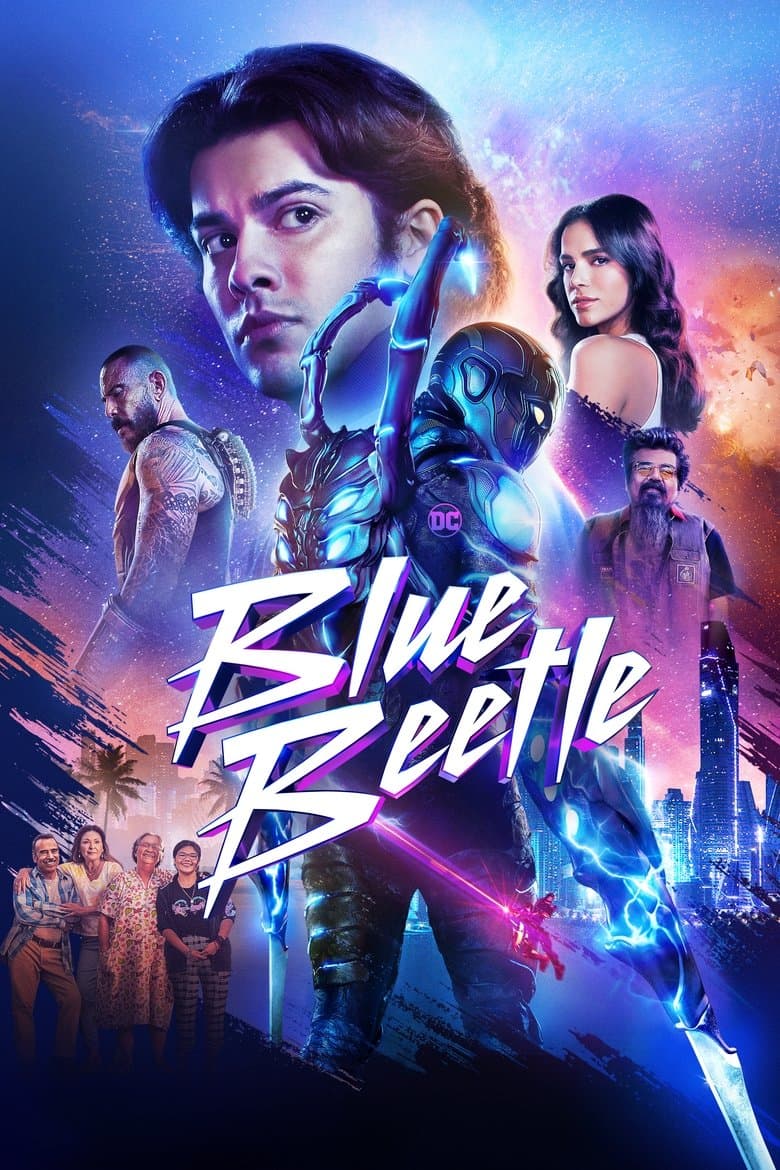
Blue Beetle follows Jaime Reyes, a recent college graduate who returns to his home in Palmera City. Jaime finds that his Mexican-American family is struggling to keep their house while a powerful company changes the neighborhood. An alien scarab joins with Jaime and gives him a living suit with weapons and flight. Jaime and his family then fight Victoria Kord and her plan to build a private army. The movie mixes bright superhero action with jokes, family warmth, and sad moments.
Latino identity is visible in the hero, the large family cast, Spanish speech, music, food, and family customs. The story treats family history and cultural roots as the source of Jaime’s strength, while it presents gentrification, immigration pressure, corporate greed, and U.S. power in Latin America as serious harms. Nana’s past as a revolutionary and the family’s fight against Kord Industries make these ideas part of the main conflict. The film makes representation and social themes clear, but it remains mainly a funny, fast superhero story rather than a constant political speech.
Community feedback
Was our 56% Woke rating accurate?
Breakdown
These are the editorial factors and ratings behind our score for Blue Beetle.
Woke representation / casting
Jaime is played by Xolo Maridueña, and most of his close family is played by Latino actors. The film uses Spanish, Latino music, Mexican family customs, and the label of DC’s first Latino superhero as part of its public identity. These choices fit the established Jaime Reyes character and the story setting, so the score stays moderate rather than high. The cast and marketing still make representation a visible selling point.
30%
Woke political dialogue
The film has several direct political lines. Jaime’s uncle talks about family members being undocumented, and the story connects border crossing with years of hard life in America. Nana shouts “Down with the imperialists,” while the film refers to the School of the Americas and U.S. action in Central America. These moments support the film’s attack on corporate and military power, but most dialogue remains family comedy and superhero talk.
34%
Identity-driven story themes
Latino family life is part of the movie’s main story, not just background. Jaime’s family faces job trouble and the loss of their home while their shared history, Spanish, music, food, and jokes shape the hero’s choices. Nana’s past as a revolutionary and the family’s fight to stay together tie identity to survival and courage. The story treats family and cultural roots as the source of Jaime’s strength.
52%
Western institutional / cultural critique
Kord Industries is shown as a powerful company that pushes a working-class Latino neighborhood out of its home. Victoria Kord wants to turn alien technology into OMAC soldiers for sale, linking real-estate power to private weapons and control. Carapax’s past ties Victoria’s experiments to U.S.-backed violence in Central America, and Nana calls the enemy imperialists. The movie repeatedly places the Reyes family and its community against corporate, military, and colonial power.
48%
Woke character or canon changes
Not relevant. The film uses the established Latino Jaime Reyes as Blue Beetle. It adds movie-specific supporting characters and changes the location, but those changes are not shown as identity-driven.
0%
Anti-woke backlash and complaints
A few small accounts called the film woke garbage, DEI, or feminist propaganda. Niche reviewers questioned its Latino cast and political themes, and some right-leaning video posts mocked its Latino branding. Nerdrotics made a taco joke, but the evidence does not show a large boycott or organized review-bomb campaign. Much negative talk focused on Warner Bros. marketing or general DC fatigue.
15%
Creator track record context
Ángel Manuel Soto has a moderate record of supporting Latino stories and speaking about colonialism and privatization. Gareth Dunnet-Alcocer often writes about Latino family life, but cached context shows no public activist record. Soto and Dunnet-Alcocer also described this film as a Latino story about family, ancestors, strong women, and authentic culture. The other cached crew profiles show little political activity, so the creator context is mixed and moderate.
34%
Production

Movie · 2024
Following their explosive showdown, Godzilla and Kong must reunite against a colossal undiscovered threat hidden within our world, challenging their very existence – and our own.

Movie · 2019
When Alita awakens with no memory of who she is in a future world she does not recognize, she is taken in by Ido, a compassionate doctor who realizes that somewhere in this…

Movie · 2022
A mysterious force knocks the moon from its orbit around Earth and sends it hurtling on a collision course with life as we know it.
Movie · 2020
After he and his wife are murdered, marine Ray Garrison is resurrected by a team of scientists. Enhanced with nanotechnology, he becomes a superhuman, biotech killing…

Movie · 2017
Fuelled by his restored faith in humanity and inspired by Superman's selfless act, Bruce Wayne and Diana Prince assemble a team of metahumans consisting of Barry Allen, Arthur…

Movie · 2023
65 million years ago, the only 2 survivors of a spaceship from Somaris that crash-landed on Earth, must fend off dinosaurs to reach the escape vessel in time before an imminent…

Movie · 2010
Cobb, a skilled thief who commits corporate espionage by infiltrating the subconscious of his targets is offered a chance to regain his old life as payment for a task considered…
Movie · 2021
Peter Parker is unmasked and no longer able to separate his normal life from the high-stakes of being a super-hero.
