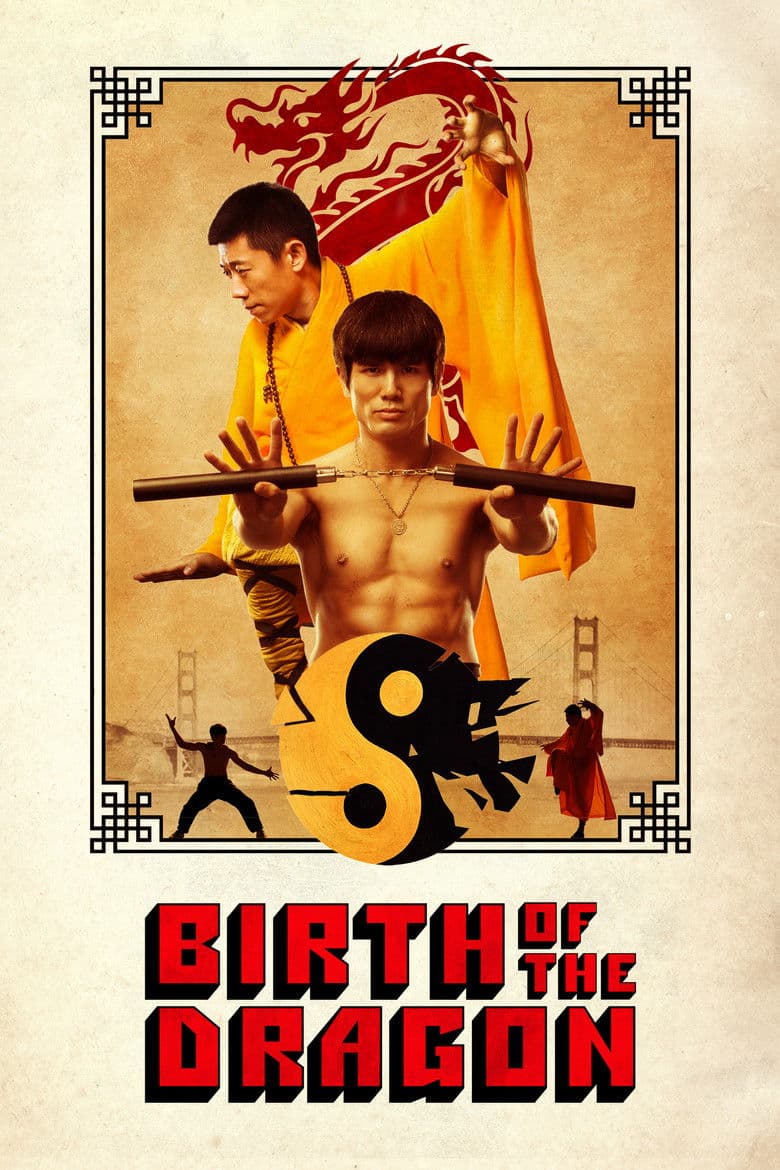
Birth of the Dragon takes place in San Francisco’s Chinatown in 1964. Young Bruce Lee runs a kung fu school and wants to build a name in American movies. He clashes with Wong Jack Man, a quiet Shaolin master who comes from China after hurting another fighter. Their private match becomes the center of a rough action story about pride, discipline, and change. The film also follows Steve McKee, a white student who falls for Xiulan, a Chinese waitress trapped by gangsters.
The movie gives Steve a large role in a story named for Bruce Lee, and Steve helps bring Lee and Wong together. Steve also tries to free Xiulan, so a white outsider becomes a key link between two Chinese martial artists and a Chinese woman in danger. Bruce says that some people dislike his white students and his white wife, while the film presents kung fu as something that can cross cultural lines. These ideas remain tied to the period setting, and the main focus stays on fighting, personal pride, and Lee’s growth toward a new style.
Community feedback
Was our 46% Woke rating accurate?
Breakdown
These are the editorial factors and ratings behind our score for Birth of the Dragon.
Woke representation / casting
The film has a largely Chinese and Chinese American cast that fits 1964 Chinatown and the martial-arts setting. Steve McKee is the one major white role, but he is an invented student who becomes the main bridge, romantic lead, and rescuer. The film does not market the casting as a diversity campaign. The white outsider is still unusually central in a story about Bruce Lee and Wong Jack Man.
38%
Woke political dialogue
Bruce says that some people in Chinatown dislike that he teaches white students and married a white woman. Other scenes present kung fu as something that should move between cultures. The talk is brief and tied to the 1964 conflict. The film does not turn it into a long modern political speech.
24%
Identity-driven story themes
The film repeatedly makes cultural mixing part of the plot. Steve is the white outsider learning from two Chinese masters and trying to free a Chinese woman. Lee’s choice to teach white students drives part of his conflict with Wong. The film still spends most of its time on fights and personal growth.
36%
Western institutional / cultural critique
Not present. The film attacks Chinatown gangsters and personal pride, not Western institutions. It does not frame family, Christianity, capitalism, or traditional roles as modern political problems.
0%
Woke character or canon changes
The movie turns a real Bruce Lee and Wong Jack Man fight into a largely invented story. The fictional white student Steve becomes the main link between the fighters and gets the romance and rescue plot. That change shifts attention away from Lee and changes the meaning of the historical event. The movie also leaves Bruce Lee’s wife Linda out while mentioning his white marriage.
48%
Anti-woke backlash and complaints
Not present. Public complaints focused on whitewashing, sidelining Bruce Lee, and a white-savior story. Those complaints came from diversity and Asian representation concerns, not claims that the film pushed woke or DEI ideas. The X research pass found no anti-woke reaction.
0%
Creator track record context
George Nolfi described the movie as a story about people from different cultures learning from each other. The writers have some past work about race, civil rights, and political history. Kelly Mullen and PoPing AuYeung have stronger representation-related work. Most of the other key creators have little public activist history.
24%
Production
Movie · 2022
Harry Haft is a boxer who fought fellow prisoners in the concentration camps to survive. Haunted by the memories and his guilt, he attempts to use high-profile fights against…
Movie · 2023
After dominating the boxing world, Adonis Creed has thrived in his career and family life. When a childhood friend and former boxing prodigy, Damian Anderson, resurfaces after…
Movie · 2016
A story set on the offshore drilling rig Deepwater Horizon, which exploded during April 2010 and created the worst oil spill in U.S. history.
Movie · 2019
American car designer Carroll Shelby and the British-born driver Ken Miles work together to battle corporate interference, the laws of physics, and their own personal demons to…
Movie · 2018
One year after the events of "Kickboxer: Vengeance", Kurt Sloan has vowed never to return to Thailand. However, while gearing up for a MMA title shot, he finds himself sedated and…
Movie · 2022
After more than thirty years of service as one of the Navy’s top aviators, and dodging the advancement in rank that would ground him, Pete “Maverick” Mitchell finds himself…
Movie · 2019
Cal is a dedicated cop who also serves as a sergeant in the Marine Corps Reserve. When his reckless half brother lands in jail for accidentally killing a man, Cal and his buddies…
Movie · 2020
The incredible true story of Vietnam War hero William H. Pitsenbarger, a U.S. Air Force Pararescuemen medic who personally saved over sixty men.
