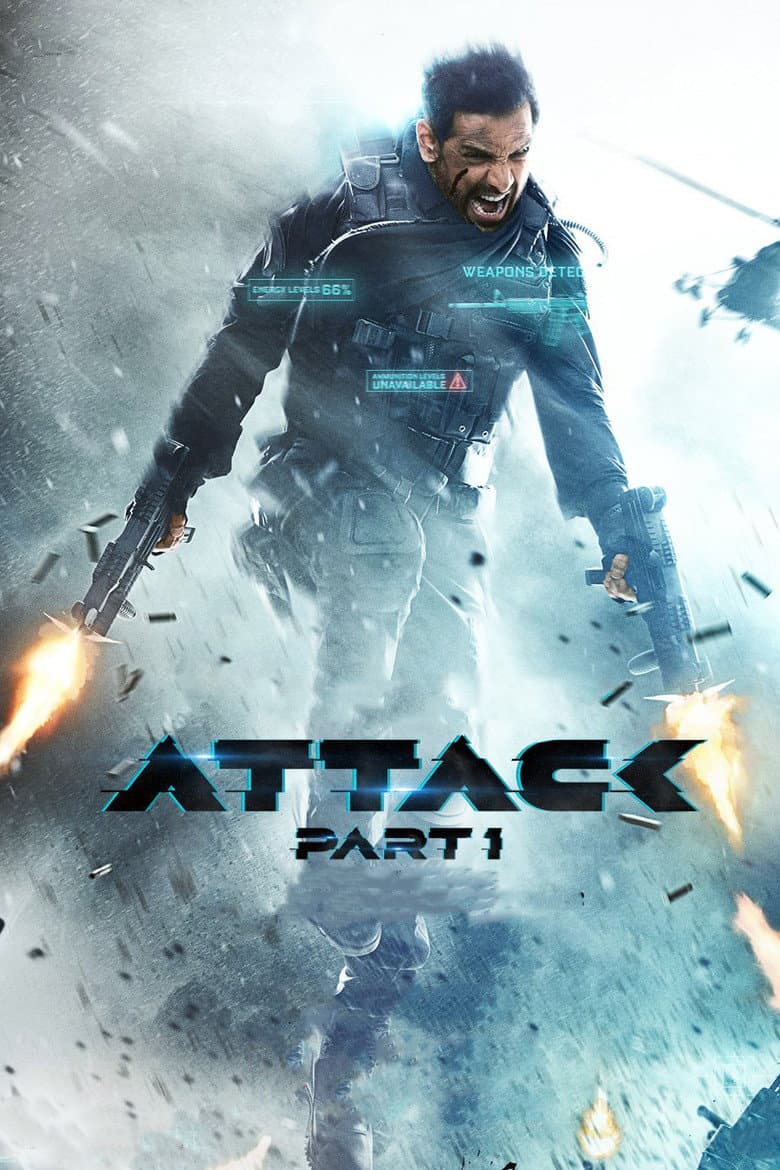
Attack follows Major Arjun Shergill, an Indian Army officer who survives a terrorist attack but becomes paralyzed and loses the woman he loves. A government team asks him to test a brain chip made by scientist Sabah Qureshi, and the chip lets him walk, fight, and use an AI helper. When terrorists seize Parliament and threaten Delhi with a chemical bomb, Arjun becomes India’s first super soldier and races to rescue the Prime Minister and the hostages. The movie has a fast, loud, patriotic tone, and it mixes science fiction with grief and revenge.
The clearest identity-related element is Sabah, a prominent woman scientist who creates the technology that changes Arjun’s life. The story shows her as skilled, serious, and important to the mission, but it does not turn her role into a larger debate about gender or rights. Arjun’s paralysis gives the movie a disability and recovery thread, yet the story uses it mainly to create a super-soldier origin. The main themes are duty, national safety, sacrifice, and stopping terrorism, so the visible woke material stays limited and secondary to the action.
Community feedback
Was our 13% Woke rating accurate?
Breakdown
These are the editorial factors and ratings behind our score for Attack.
Woke representation / casting
The film gives Dr. Sabah Qureshi a prominent job as the computer expert behind the super-soldier program. The story shows her as skilled, serious, and necessary to the mission. Her role fits a modern Indian science team, and the film does not make her identity a larger political subject. The gender signal is visible but limited to one major supporting role.
14%
Woke political dialogue
Not present. The dialogue centers on terrorism, military orders, artificial intelligence, national duty, and saving India. It does not use modern identity, DEI, or activist arguments.
0%
Identity-driven story themes
The film gives Dr. Sabah Qureshi a serious role as the woman scientist behind the brain chip. The story also uses Arjun’s paralysis as a major part of his origin. Neither thread becomes a wider argument about gender, disability rights, or identity politics. The main arc stays with a male soldier’s duty and revenge.
10%
Western institutional / cultural critique
Not present. Officials debate risky human testing, but the story treats this as a military choice in the plot. The film does not attack Western culture, traditional family life, Christianity, or social institutions through modern activist ideas.
0%
Woke character or canon changes
Not relevant. Attack tells an original story with fictional characters. It does not change a known character, source, or real historical figure.
0%
Anti-woke backlash and complaints
Not present. Public reaction focused on action quality, weak writing, film comparisons, and poor ticket sales. No sustained anti-woke complaint, boycott, or DEI backlash was found.
0%
Creator track record context
The directors and producers have mostly commercial, patriotic, or technical careers with no strong activist pattern. Writer Vishal Kapoor has returned to women-centered social issues in Lapachhapi and Chhorii. John Abraham has limited civic and animal welfare ties but no strong DEI or identity-politics persona. Attack does not strongly repeat those social themes, so the creator context is mild.
15%
Production
Movie · 2017
An assassin seeks redemption after being given a second chance at life.
Movie · 2016
Set in a near future, technology-reliant society that pits man against killing machines. Against this backdrop an elite army unit is helicoptered to a remote, off-the-grid island…
Movie · 2023
When a tech blogger lands an interview with a tech guru and stops an attack on him, he finds a mysterious ring that takes him back 57 seconds into the past.
Movie · 2026
In the near future, a detective stands on trial accused of murdering his wife. He has ninety minutes to prove his innocence to the advanced AI Judge he once championed, before it…
Movie · 2021
A former special forces agent is trapped in a time loop and relives his death over and over again. To escape the terrible situation, he must track down those responsible and stop…
Movie · 2016
A special-ops team is dispatched to fight supernatural beings that have taken over a European city.
Movie · 2016
While testing the latest first person shooter from global game developer, Sentinel, video game champion Max Troy discovers the events happening within the game are being reflected…
Movie · 2019
A man steps out of a park fountain in Ho Chi Minh City with no recollection of who he is or where he came from.
