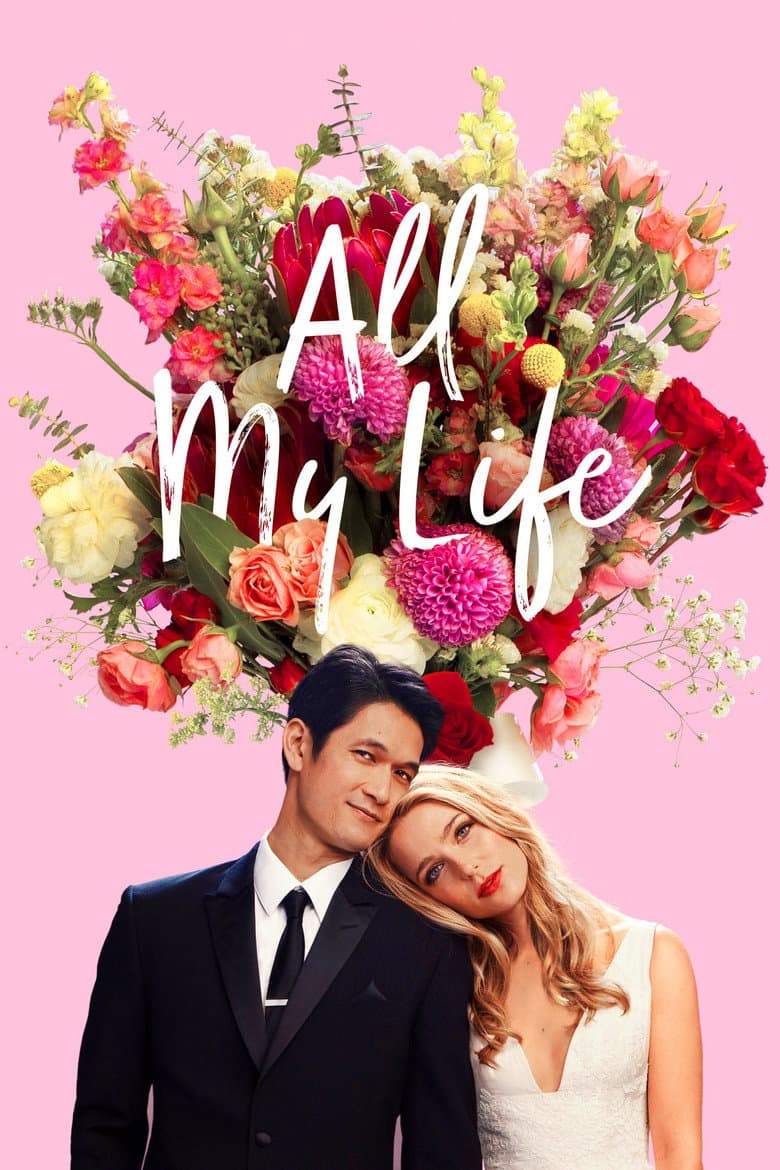
All My Life follows Jennifer Carter and Solomon “Sol” Chau, a young couple who meet by chance and quickly fall in love. They live a normal modern life while Jenn studies for a psychology career and Sol works toward becoming a chef. Their plans change when doctors find a liver tumor and tell Sol that his cancer is terminal. The couple moves their wedding forward, while family and friends work to give them a joyful day before time runs out. The tone stays warm and romantic even when the story turns sad.
The movie centers on love, marriage, illness, grief, and the choice to value each day. Jenn pushes Sol to follow his dream, and Sol tries to protect her from the fear of losing him. Their friends raise money, plan the wedding, and offer steady help as treatment becomes harder. The main audience-visible identity element is an Asian male romantic lead in an interracial couple, with a mixed group of friends, but the story treats those facts as part of the couple’s life rather than a political lesson. Interviews also include praise for Asian representation, yet the movie itself does not build its conflict around race, gender, sexuality, or activism.
Community feedback
Was our 11% Woke rating accurate?
Breakdown
These are the editorial factors and ratings behind our score for All My Life.
Woke representation / casting
The movie puts an Asian male actor in the main romantic role and pairs him with a white female lead. The friends around them form a visibly mixed group. Harry Shum Jr. also described the role as part of better Asian representation in leading roles. The real couple’s story explains Sol’s identity, so the casting does not look like it was built around a political message.
18%
Woke political dialogue
Not present. The characters talk about cancer, love, marriage, work, and fear. The movie has no speeches about politics, activism, DEI, or current identity issues.
0%
Identity-driven story themes
Not present. The story is about a couple facing illness and death. It does not make race, gender, sexuality, or group identity the main lesson.
0%
Western institutional / cultural critique
Not present. The movie does not attack family, religion, capitalism, traditional relationships, or Western institutions. Its conflict comes from cancer and grief, not from a social system.
0%
Woke character or canon changes
Not relevant. The movie is a fictionalized version of a real couple’s story. It does not center on an identity-driven change to an established character or real person.
0%
Anti-woke backlash and complaints
Not present. The separate X research found no anti-woke reaction, named complaints, campaign, review-bombing, or boycott. Wider reviews focused on the romance, cancer, sentiment, and acting. No reliable report says that the movie pushes woke politics or DEI.
0%
Creator track record context
Marc Meyers previously directed My Friend Dahmer, which explores a closeted gay teenager and received support from LGBT film festivals. That gives the director a mild identity-related context, but the cached record describes his wider work as character-driven rather than activist. Todd Rosenberg and the other listed creators have no strong cached record of activist or DEI-focused work.
10%
Production

Movie · 2018
Katie, a 17-year-old, has been sheltered since childhood and confined to her house during the day by a rare disease that makes even the smallest amount of sunlight deadly.
Movie · 2022
A young couple's relationship clashes with the harsh realities of the California Gold Rush of 1850. Angel, experiencing love for the first time and facing demons unsurmountable…

Movie · 2020
Young musician Zach Sobiech discovers his cancer has spread, leaving him just a few months to live. With limited time, he follows his dream and makes an album, unaware that it…

Movie · 2016
Lou Clark, a directionless 26-year-old from the English countryside, takes a job at the local castle as a caregiver and companion to a wealthy young banker, Will Traynor.

Movie · 2023
Hadley and Oliver begin falling in love on a flight from New York to London, but when they lose each other at customs, can they defy all odds to reunite?

Movie · 2020
When illness strikes two people who are polar opposites, life and death bring them together in surprising ways.

Movie · 2025
Two artistic souls find harmony through music despite their contrasting worlds. As feelings deepen, age and circumstances challenge their undeniable bond.

Movie · 2025
Morgan Grant and her daughter Clara explore what's left behind after a devastating accident reveals a shocking betrayal and forces them to confront family secrets, redefine love…
