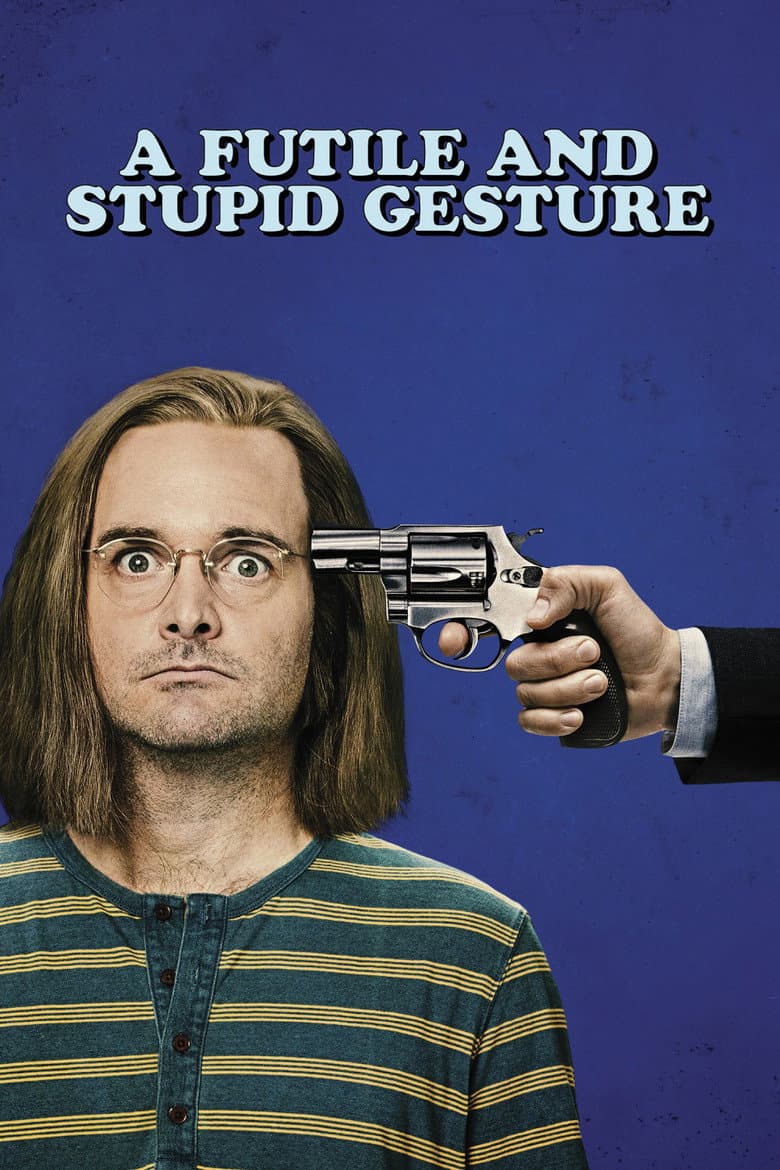
Doug Kenney is a sharp but troubled writer who wants to turn the Harvard Lampoon into a national comedy business. The story follows him and Henry Beard from college in the late 1960s through the rise of National Lampoon in New York and Hollywood. Kenney fights for control, praise, and new ideas while his drinking, drug use, cheating, and fear of failure damage his work and friendships. The film uses fast jokes, fake interviews, direct talk to the audience, and comic scenes, but it also becomes a sad story about a gifted man who cannot enjoy his success.
The film briefly calls attention to the old comedy group's lack of women and black writers. Anne Beatts enters the male office and faces crude treatment, while a black actor challenges the way a nightclub scene is handled in Animal House. The movie says the group did not look for more women or black writers, and a brief yearbook joke uses a homosexual label without creating a queer character arc. These points appear in a short self-aware section and do not control the main plot. Most of the film remains about white male writers, crude jokes, ambition, addiction, friendship, and a lonely death.
Community feedback
Was our 30% Woke rating accurate?
Breakdown
These are the editorial factors and ratings behind our score for A Futile and Stupid Gesture.
Woke representation / casting
The film uses a mostly white male cast that fits the real National Lampoon circle. The story gives Anne Beatts a visible role and includes a black actor in a scene that asks why the early group had no black writers. The movie says the creators did not look for more women or black writers. That brief focus gives the casting a small identity signal, but it is not a broad representation-first design.
18%
Woke political dialogue
The film has a short exchange about the early staff having no black writers and only one woman. The characters say they did not look for them, and a black actor defends the nightclub scene as a black man. The dialogue also includes brief comments about sexism and racism. These lines call attention to identity, but they do not form repeated modern political speeches.
26%
Identity-driven story themes
The film briefly examines how the early Lampoon group left out women and black writers. Anne Beatts enters the male office and faces crude treatment before leaving. A black actor challenges a scene tied to a black nightclub in Animal House. That theme adds a modern identity-aware layer, but Doug’s ambition, addiction, friendship, and collapse remain the main story.
28%
Western institutional / cultural critique
Not present. The film mocks schools, politicians, studios, and rich people, but it treats them as parts of the 1970s comedy story. It does not build a modern critique of patriarchy, capitalism, Christianity, or Western institutions.
0%
Woke character or canon changes
Not relevant. The film changes timing and combines events for a comic biography, but it does not change a real person’s race, gender, sexuality, or hero role.
0%
Anti-woke backlash and complaints
A Hollywood in Toto review called the film’s apology for having no people of color and one prominent female writer an example of getting woke. The review also said the film treats conservatives as comedy curmudgeons and complained about modern PC culture. A NewsBusters article mentioned the film while warning that National Lampoon’s later brand plans were becoming inclusive. The separate X pass found no anti-woke posts or named complaints. The reaction was limited and mostly came from partisan entertainment coverage.
18%
Creator track record context
David Wain, John Aboud, Michael Colton, and Josh Karp have low scores and no strong activist pattern. Ed Helms has voting-access work and a later show about native sovereignty and representation. Jonathan Stern has a feminist production credit, while most other producers have little political history. The film itself focuses more on comedy history than on those side activities.
18%
Production
Movie · 2019
The story of Mötley Crüe and their rise from the Sunset Strip club scene of the early 1980s to superstardom.
Movie · 2016
An improv group deals with several crises, including the loss of their lease and one member hitting the big time.
Movie · 2017
Matt Ryder is convinced to drive his estranged and dying father Benjamin Ryder cross country to deliver four old rolls of Kodachrome film to the last lab in the world that can…
Movie · 2019
A young Scottish singer, Rose-Lynn Harlan, dreams of making it as a country artist in Nashville after being released from prison.
Movie · 2018
Tony Lip, a bouncer in 1962, is hired to drive pianist Don Shirley on a tour through the Deep South in the days when African Americans, forced to find alternate accommodations and…
Movie · 2018
Vignettes weaving together the stories of six individuals in the old West at the end of the Civil War. Following the tales of a sharp-shooting songster, a wannabe bank robber, two…

Movie · 2024
While caring for her brother along with her audacious mother, a teenager strikes up an unlikely friendship with an eccentric activist who is protesting one of the most landmark…

Movie · 2021
Veteran comedy writer Charlie Berns, who is slowly but surely losing his grip on reality, befriends a talented young New York street singer Emma Payge.
