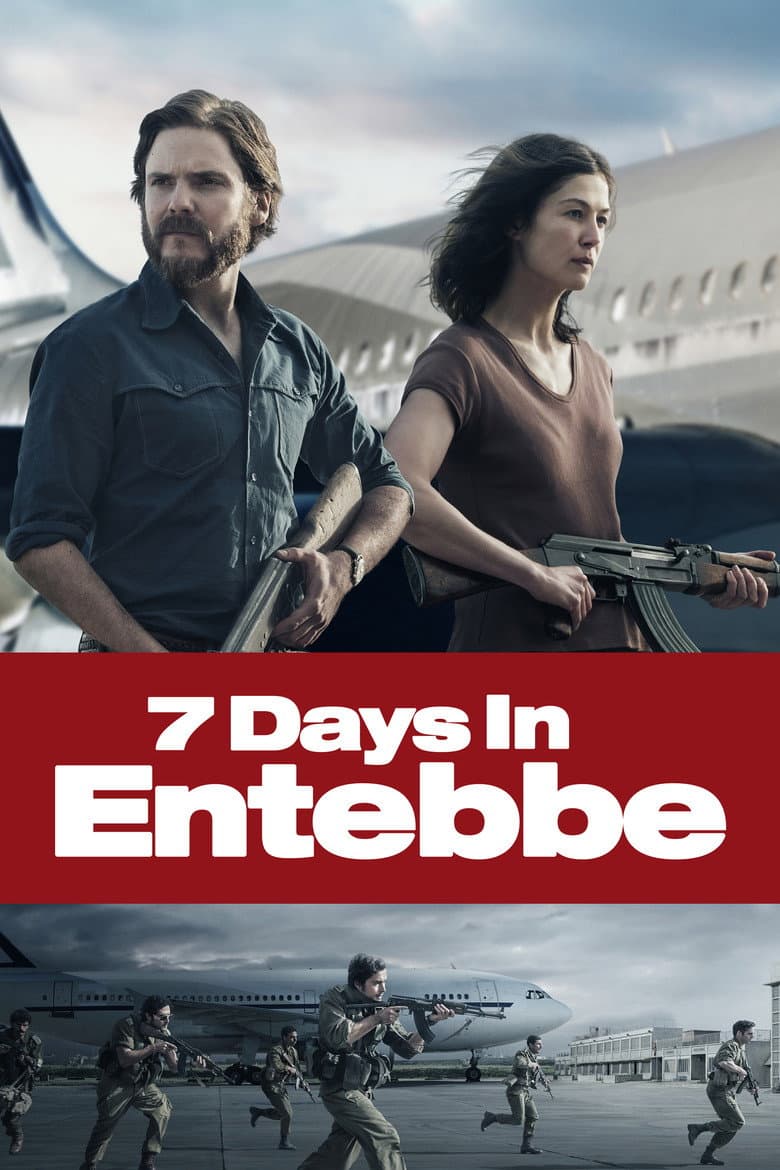
In 1976, German radicals Wilfried Böse and Brigitte Kuhlmann join two Palestinian fighters to hijack an Air France plane. They force the plane to Entebbe, Uganda, where they hold Israeli and other passengers while Israel debates a deal or a rescue. The film follows the hijackers, the hostages, Israeli leaders, and soldiers during the week-long standoff. Its tone is serious and tense, but it often slows down for political talks and a repeated modern dance performance.
The film gives unusual attention to the hijackers and shows Böse as a left-wing idealist who doubts the violence of the mission. It presents the Palestinian cause, talk of fighting fascism, revolution against capitalism, and the Israeli debate over force and negotiation as central parts of the story. A dance based on a Jewish song is used as a repeated sign of people shedding old beliefs and opening themselves to different views. The film still shows the rescue and the deaths, but its focus on motives and moral doubt makes the terrorists more human and spreads blame across the conflict.
Community feedback
Was our 45% Woke rating accurate?
Breakdown
These are the editorial factors and ratings behind our score for 7 Days in Entebbe.
Woke representation / casting
Not present. The main roles are tied to real German, Israeli, Palestinian, and Ugandan people in the 1976 story. The film does not present the cast as a diversity or identity statement.
0%
Woke political dialogue
Wilfried Böse and the Palestinian hijacker give direct political speeches about the Palestinian struggle. The dialogue calls Israel a fascist, Zionist, and racist state and presents revolution against capitalism as a right. The Israeli cabinet repeatedly argues over force, negotiation, and the meaning of Israel’s survival. These ideas belong to the film’s 1976 conflict rather than a current identity campaign.
33%
Identity-driven story themes
The film makes the German left-wing hijackers its main emotional focus instead of making the hostages the main characters. Wilfried Böse and Brigitte Kuhlmann are shown as people with moral doubts, and Böse may choose not to kill the hostages. The story gives the Palestinian cause and the Israeli debate over negotiation major space. The repeated dance presents old beliefs as something people should shed so they can live with people who are different.
44%
Western institutional / cultural critique
The film treats Israel’s hard-line refusal to negotiate as a serious mistake and presents talks as the wiser path. The dance sequence shows people in strict Haredi dress breaking free from old rules. The film links fear of enemies with political power. This is a recurring critique of Israeli political and religious rigidity, but it is not a broad attack on Western family life or Christian institutions.
30%
Woke character or canon changes
Not relevant. The film uses some fictional scenes and characters, but no confirmed race, gender, sexuality, or identity change to an established character or historical role appears.
0%
Anti-woke backlash and complaints
A few conservative and religious reviews called the film politically correct or Palestinian propaganda. Those reviews objected to its sympathy for the German hijackers and its moral balance between the hijackers and Israel. Some audience comments made similar complaints about treating terrorists as decent people and turning a clear evil into a two-sided debate. No large social media campaign, boycott, or review-bomb was found.
23%
Creator track record context
José Padilha often makes films about violence, corruption, state power, and social inequality, but he has rejected fixed left-right labels. Gregory Burke often writes about war, class, identity, and the cost of state power without a strong DEI activist record. Jeff Skoll brings a stronger cause-driven link through Participant Media’s focus on social issues and activism. The overall creator context is mixed and modest.
26%
Production
Movie · 2019
In New York, former convict Pete Koslow, related to the Polish mafia, must deal with both Klimek the General, his ruthless boss, and the twisted ambitions of two federal agents…
Movie · 2017
Cairo, 2011. A police officer investigates the murder of a woman in a luxurious hotel in the days leading up to the Egyptian revolution.
Movie · 2017
The story of the kidnapping of 16-year-old John Paul Getty III and the desperate attempt by his devoted mother to convince his billionaire grandfather Jean Paul Getty to pay the…

Movie · 2017
A newly-released prison gangster is forced by the leaders of his gang to orchestrate a major crime with a brutal rival gang on the streets of Southern California.
Movie · 2017
After a botched bank robbery lands his younger brother in prison, Connie Nikas embarks on a twisted odyssey through New York City's underworld to get his brother Nick out of jail.
Movie · 2020
A small time delinquent, turned police mechanic for a go fast task force, is forced to defend his innocence when his mentor is killed by dirty cops.
Movie · 2019
A leader of a drug cartel sends his two toughest henchmen to investigate why a shipment was botched.
Movie · 2021
Based on true events, "Nitram" lives with his parents in suburban Australia in the mid-90s. He lives a life of isolation and frustration at never fitting in.
