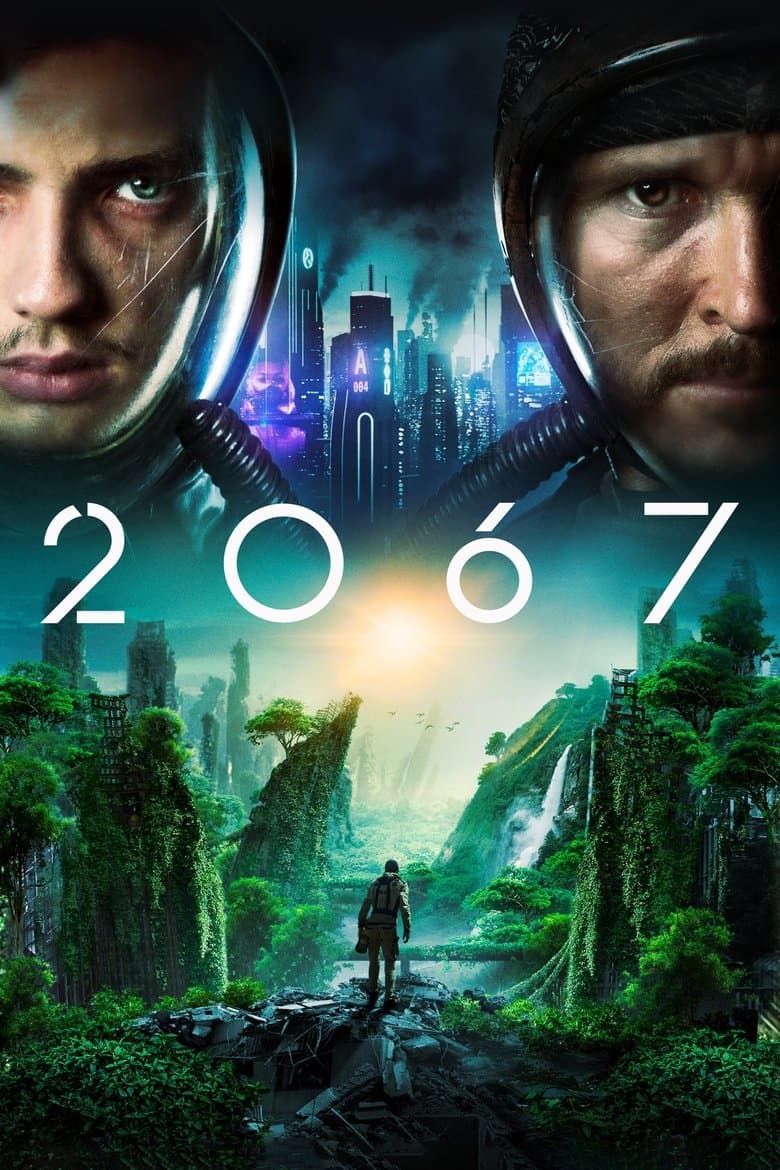
2067 follows Ethan Whyte, a utility worker who lives with his sick wife in the last surviving city in Australia in 2067. Climate change and deforestation have destroyed nature, so people depend on company-made oxygen that causes a deadly sickness. A message from 400 years ahead sends Ethan through a time machine to find a cure and learn why it names him. The film has a dark science-fiction mood, but family love, fear, betrayal, and hope keep the story personal.
Environmental collapse is the film's strongest message, and the story treats human damage to nature as the cause of the crisis. The company that controls the air plans to send only a chosen group into the future, which makes corporate power part of Ethan's main problem. Ethan finds his own dead body and learns that his father was killed to protect the plan. He sends living plants and proof of the crime into the past, so the ending links human responsibility with a future where nature returns. The film's visible woke material is mainly a strong climate warning and a smaller criticism of corporate rule.
Community feedback
Was our 35% Woke rating accurate?
Breakdown
These are the editorial factors and ratings behind our score for 2067.
Woke representation / casting
The film gives its most powerful leadership role to Deborah Mailman, an Aboriginal Australian actor, who plays Chronicorp CTO Regina Jackson. Sana'a Shaik plays Ethan's wife, adding another visibly non-white lead beside the two white male leads. The story does not make these identities part of the plot or present them as a diversity campaign. The future Australian setting makes the casting mix plausible.
20%
Woke political dialogue
The film directly states that climate change, deforestation, and human neglect caused the collapse of the natural world. Characters discuss extinction, synthetic oxygen, and the need to repair the damage. The message returns in the ruined city, the time-machine mission, and Ethan's final choice to send plants into the past. The film does not use party politics or current political slogans.
35%
Identity-driven story themes
Not present. The story follows climate collapse, time travel, grief, father-son betrayal, and human survival. It does not center race, gender, sexuality, or other group identity.
0%
Western institutional / cultural critique
Chronicorp controls the oxygen supply after environmental collapse. Regina Jackson hides a plan to send a chosen group into the future and leave ordinary people behind. Ethan exposes the plan after learning that Regina killed his father to protect it. The film attacks corporate power and elite escape, but it does not target religion, family life, or men as a social class.
31%
Woke character or canon changes
Not relevant. 2067 is an original science-fiction film, so it does not alter an established character, source, or real historical figure.
0%
Anti-woke backlash and complaints
A few Reddit comments called the movie a “climate agenda” film or said it was pushing an environmental message. Other viewers focused on plot holes, bad science, acting, and pacing instead of ideology. Mainstream reviews did not report a major anti-woke campaign. The available backlash is small, fringe, and mixed.
10%
Creator track record context
Seth Larney and Gareth Davies have no recorded high-confidence activist pattern in the available creator record. Kelly Valentine Hendry has a strong diversity-focused casting record. Several producers have links to queer, feminist, Indigenous, or diversity projects, while others have low or zero scores. The overall creative background gives a modest supporting signal.
24%
Production

Movie · 2025
During the Vietnam War, a recon unit ventures to an isolated jungle valley to uncover the fate of a missing platoon.

Movie · 2017
Thirty years after the events of the first film, a new blade runner, LAPD Officer K, unearths a long-buried secret that has the potential to plunge what's left of society into…
Movie · 2019
Three astronomers accidentally intercept what they believe to be a signal from a distant alien civilization, but the truth is even more incredible than any of them could have…

Movie · 2017
This in-world short film takes place in the year 2036 and revolves around Jared Leto’s character, Niander Wallace.

Movie · 2023
A lonely woman battles extraterrestrials who threaten her future while forcing her to face her past.

Movie · 2022
In 1998, Beavis and Butt-Head are sentenced to Space Camp by a “creative” judge. Their obsession with a docking simulator (huh huh) leads to a trip on the Space Shuttle, with…

Movie · 2026
The evil Empire has fallen, and Imperial warlords remain scattered throughout the galaxy. As the fledgling New Republic works to protect everything the Rebellion fought for, they…

Movie · 2017
A service which creates holographic projections of late family members allows an elderly woman to spend time with a younger version of her deceased husband.
