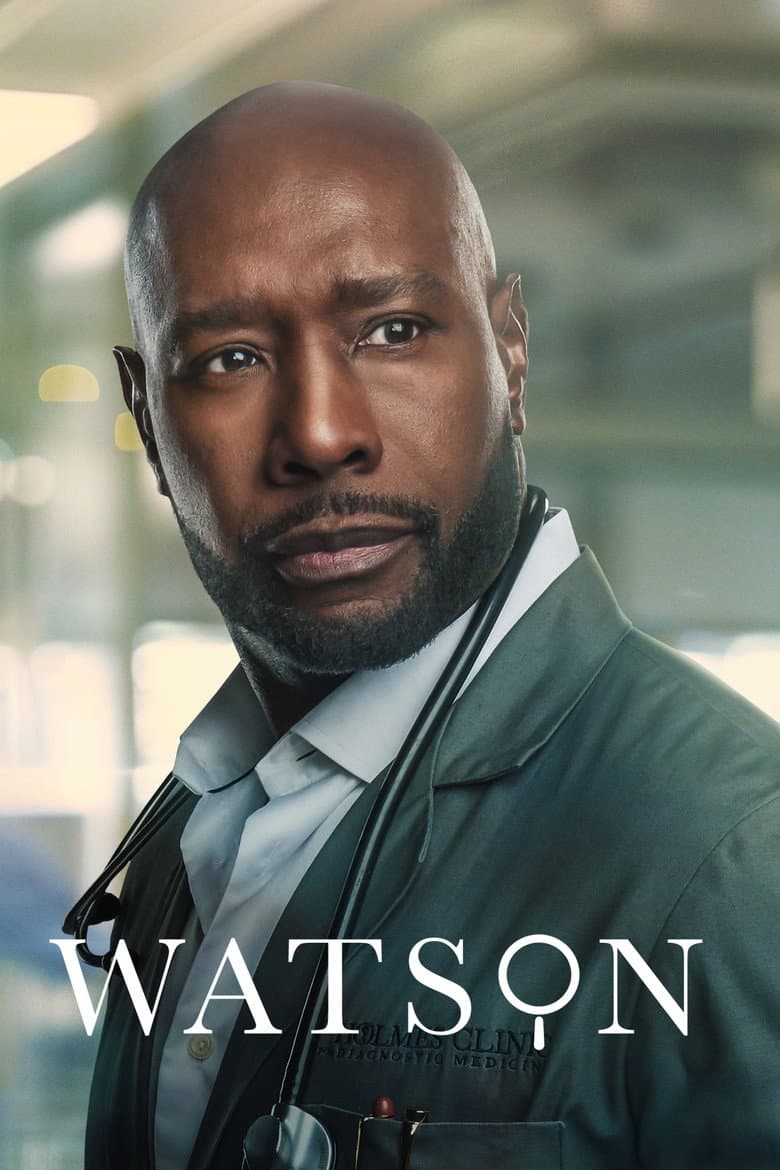
Started January 26, 2025 · Canceled · Based on 2 seasons, 33 episodes through May 3, 2026 · TV-14
Watson follows Dr. John Watson, a gifted doctor and former partner of Sherlock Holmes. After Holmes appears to die at Reichenbach Falls, Watson runs a rare disease clinic in present-day Pittsburgh. Watson uses his detective skills to solve unusual medical cases while he faces a brain injury, grief, and old enemies. Season two brings Holmes back, but Watson cannot tell whether Holmes is real or part of his illness. The show mixes hospital cases with crime, family drama, trust, and personal loss.
The show makes its casting changes easy to see. Watson is a black American lead, Moriarty is played by an Asian American actor, and Lestrade is a woman. The clinic includes several women and doctors from different backgrounds. Mary has a relationship with a woman before she dates a man, and Sasha searches for her birth mother. These choices add visible themes about race, gender, sexuality, and identity, but the main stories focus on rare illnesses, medical ethics, grief, family trouble, and personal trust. The show does not center its dialogue on activist politics or attacks on Western institutions.
Community feedback
Was our 64% Woke rating accurate?
Breakdown
These are the editorial factors and ratings behind our score for Watson.
Woke representation / casting
John Watson is a black American lead. Moriarty is played by an Asian American actor. Lestrade is changed to a woman. The clinic features black female medical leaders and a Chinese-born doctor. The modern Pittsburgh hospital can plausibly be mixed, but the repeated pattern is prominent and easy for viewers to see. Interviews present Chestnut’s casting as a fresh take and discuss the racial criticism, but they do not present a clear diversity-first plan.
48%
Woke political dialogue
Not present in this title.
0%
Identity-driven story themes
The show repeatedly gives women major expert and leadership roles, including Mary, Ingrid, Sasha, Laila, and Lestrade. Mary has a visible relationship with a woman in Season 1. Sasha spends part of Season 2 searching for her birth mother. These arcs make gender, sexuality, and personal identity visible, but they are not the main purpose of the series. Watson’s medical work, grief, family troubles, and fight with Holmes and Moriarty remain the main story.
39%
Western institutional / cultural critique
Not present in this title.
0%
Woke character or canon changes
John Watson is changed from Doyle’s Victorian British doctor into a black American doctor. James Moriarty is played by an Asian American actor. Inspector Lestrade is changed from a male Scotland Yard figure into a female Pittsburgh detective. Watson is also made into the main hero and head of a rare-disease clinic rather than Holmes’s usual supporting narrator. These changes alter the identities and roles of well-known Holmes characters.
68%
Anti-woke backlash and complaints
Right-leaning and anti-woke posts repeatedly called the series a race-swapped or woke Watson. Complaints focused on Morris Chestnut as Watson, Randall Park as Moriarty, female doctors, and Mary’s same-sex relationship. The reaction appeared on X and on small anti-woke sites. One larger right-leaning account repeated the point from the premiere through the cancellation. No organized boycott or major review-bomb campaign was found, so the backlash was visible but scattered.
52%
Creator track record context
Craig Sweeny has no notable public activist or identity-politics record. Mario Van Peebles has a history of racial and social commentary. Anton Cropper has supported diversity and directed a Juneteenth episode of black-ish. Samuel Evan Horowitz has a writing project for people affected by prison. Morris Chestnut has spoken about greater opportunities for black actors. The wider crew mostly has mainstream or neutral records, so this context does not show a strong shared activist program.
29%
Production

TV Show · 2021
Facing an existential threat that could bring down the Crime Lab, a brilliant team of forensic investigators must welcome back old friends and deploy new techniques to preserve…
TV Show · 2022
A dying man's enigmatic last words send vicar's son, Bobby Jones, and his socialite friend, Lady Frankie Derwent, on a crime-solving adventure.
TV Show · 2020
In an isolated and inaccessible Antarctic research station in which winter has fallen on the South Pole and the sun will soon disappear for the next six months, a small team…
TV Show · 2018
In 1994, a toddler disappeared from a small Welsh village, never to be seen again. 23 years later, in London, the mother of rising cello star Matilda Gray commits suicide, without…
TV Show · 2019
A Philadelphia couple are in mourning after an unspeakable tragedy creates a rift in their marriage and opens the door for a mysterious force to enter their home.
TV Show · 2021
A detective in a small Pennsylvania town investigates a local murder while trying to keep her life from falling apart.
TV Show · 2022
Lucy wakes every night at exactly 3:33am. Nothing in her life has made sense for a long time. But the answers are out there, somewhere, at the end of a trail of brutal murders.

TV Show · 2026
The mayor of a New England town resolves to turn it into the next tourist hot spot, despite local warnings that it's cursed.
