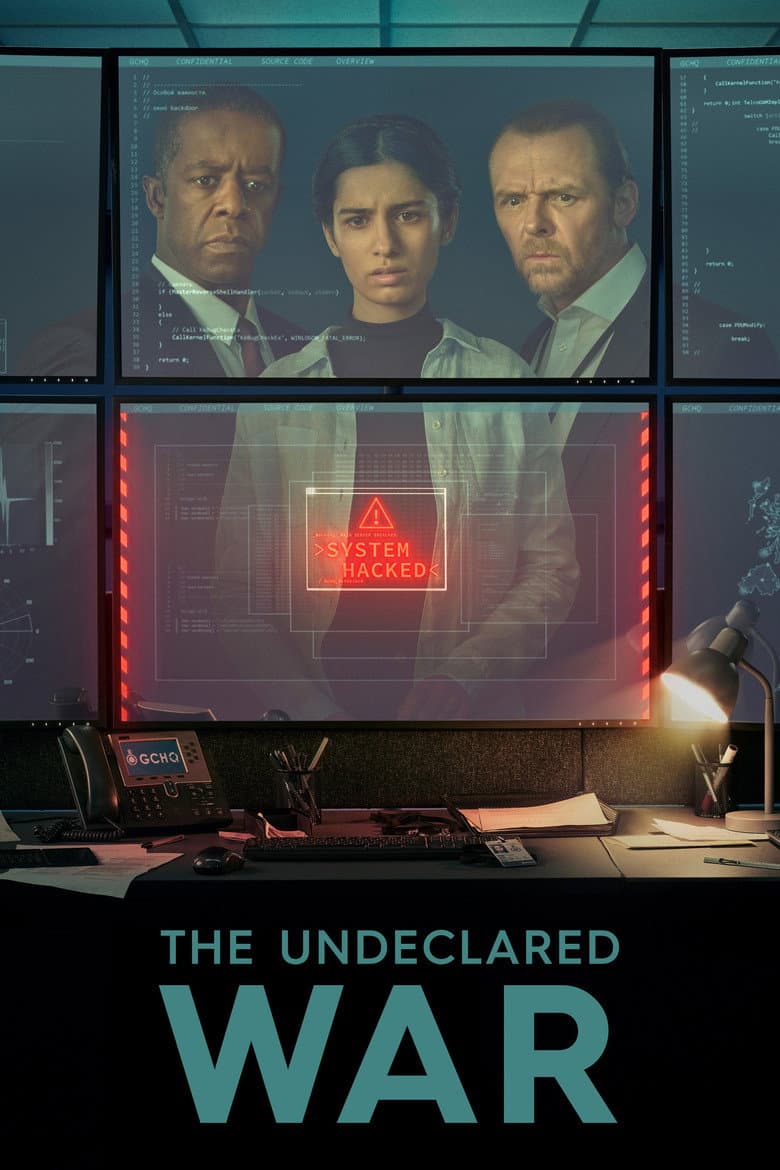
Started June 30, 2022 · Ended · Based on 2 seasons, 12 episodes through August 5, 2026 · K12 · 47 min
The Undeclared War follows Saara Parvin, a gifted computer science student who starts work at GCHQ during a cyberattack on Britain. The attack spreads through internet systems, election data, military links, and public news during an election involving Britain’s first Black Conservative prime minister. Season two begins soon after the first crisis and shifts more attention to GCHQ boss Danny Patrick, his wife Barbara, a mole inside the agency, and a new threat linked to China. The show is a tense spy drama with long talks about code, truth, loyalty, and the risk of a wider war.
Saara is a British South Asian Muslim woman who is shown as a rare coding talent in a mostly white male workplace. Her family life and her same-sex relationship with Kathy make race, religion, bisexuality, and personal choice part of the first season. The election plot says Black and Asian voters are blocked from voting, blames a plan that helps the Conservatives, and shows unrest with a Black Lives Matter chant. Season two gives major power to women and black characters and adds dialogue about Britain’s past treatment of Chinese people, but it spends less time on Saara’s identity than season one.
Community feedback
Was our 67% Woke rating accurate?
Breakdown
These are the editorial factors and ratings behind our score for The Undeclared War.
Woke representation / casting
The show puts a young British South Asian Muslim woman at the center as the coder who repeatedly sees what senior experts miss. Season one also gives major roles to a black female NSA analyst and a Black Conservative prime minister. Season two adds a black security chief, a female military cyber leader, and a senior female Chinese linguist. Channel 4 and lead-actor interviews openly frame Saara as representation for young brown girls, although the modern UK and US setting makes the wider cast believable.
54%
Woke political dialogue
Season one names Saara as Muslim and links her personal life to her family and faith. Election scenes say Black and Asian citizens were removed from voter lists, suggest the plan favors the Tories, and use a Black Lives Matter chant during unrest. Season two has Barbara say she acted to right historical wrongs and answer Britain’s tarnishing of Chinese people for political gain. Most other political talk concerns cyberwar, Russia, China, and the danger of escalation, so identity-focused speech is recurring but not the show’s main dialogue.
43%
Identity-driven story themes
Saara’s story repeatedly combines her South Asian Muslim family, bisexual relationship, and fight to prove herself in a mostly white male agency. She is written as a gifted young woman who solves problems that senior men miss and later helps hunt a mole. Season one makes racial voting exclusion and police violence part of the election crisis, while season two adds British treatment of Chinese people and Hong Kong to Barbara’s past. Season two shifts toward Danny, marriage, loyalty, and cyberwar, which lowers the identity focus after the first season.
55%
Western institutional / cultural critique
The show presents GCHQ, the government, the media, and election systems as open to serious abuse and failure. Season one ties that failure to ethnic voters being denied ballots, police violence, and a claim that the system is helping the Tories. Season two has Barbara describe British harm to Chinese people as a historical wrong and says MI6 abandoned Hong Kong residents. Other scenes praise public service, intelligence work, and caution against war, so the critique is strong in parts but does not attack Western culture as a whole.
48%
Woke character or canon changes
Not relevant. The show is an original cyber thriller and does not adapt a novel, franchise, or historical cast of characters. Saara, Danny, Makinde, Barbara, and the other main characters are original creations.
0%
Anti-woke backlash and complaints
Digital Spy viewers called the same-sex romance a tick-box choice and said the show was too left leaning. The same thread also complained that a new female lead was the best coder and saved the country on her first day. Other replies defended the show and noted that it praises GCHQ and includes sympathetic Conservative politicians. News reports mainly covered misleading emergency-style adverts, not a large woke culture-war fight.
30%
Creator track record context
Peter Kosminsky has a supplied score of 58/100 and a long record of politically engaged dramas about public policy, state power, and institutional failure. The show’s interest in elections, cyberwar, race, and agency failures fits that pattern. Declan Lawn and Adam Patterson have supplied scores of 7/100, Amelia Spencer has 20/100, and Robert Jones has 7/100, with no strong identity-first record. The mixed team supports a middle score rather than a high one.
42%
Production

TV Show · 2023
At the brink of going to hell, Yee-jae must cycle through twelve separate lives and twelve separate deaths in this reincarnation drama.
TV Show · 2017
Set in a near-dystopian future, a former cop is forced to take part in a death race where the cars run on human blood. You lose a leg and you lose your head.

TV Show · 2020
Korean emperor Lee Gon tries to close the doors to a parallel world which was opened by demons; a detective tries to protect the people and the one she loves.
TV Show · 2024
Rick and Michonne are thrown into another world, built on a war against the dead... And ultimately, a war against the living.
TV Show · 2016
A disgraced, 75-year-old ex-sheriff, whose life ends at the hands of corrupt cops, is brought back to life and given a second chance by a pair of young tech scientists, as a…
TV Show · 2021
Two federal agents from two different continents, and two different mindsets, must work together to investigate when wreckage from a destroyed alien spacecraft has mysterious…
TV Show · 2019
A police chief takes in a young child she finds near the site of a mysterious accident who has no memory of what has happened.
TV Show · 2021
A single mother enters a world of twisted mind games when she begins an affair with her psychiatrist boss while secretly befriending his mysterious wife.
