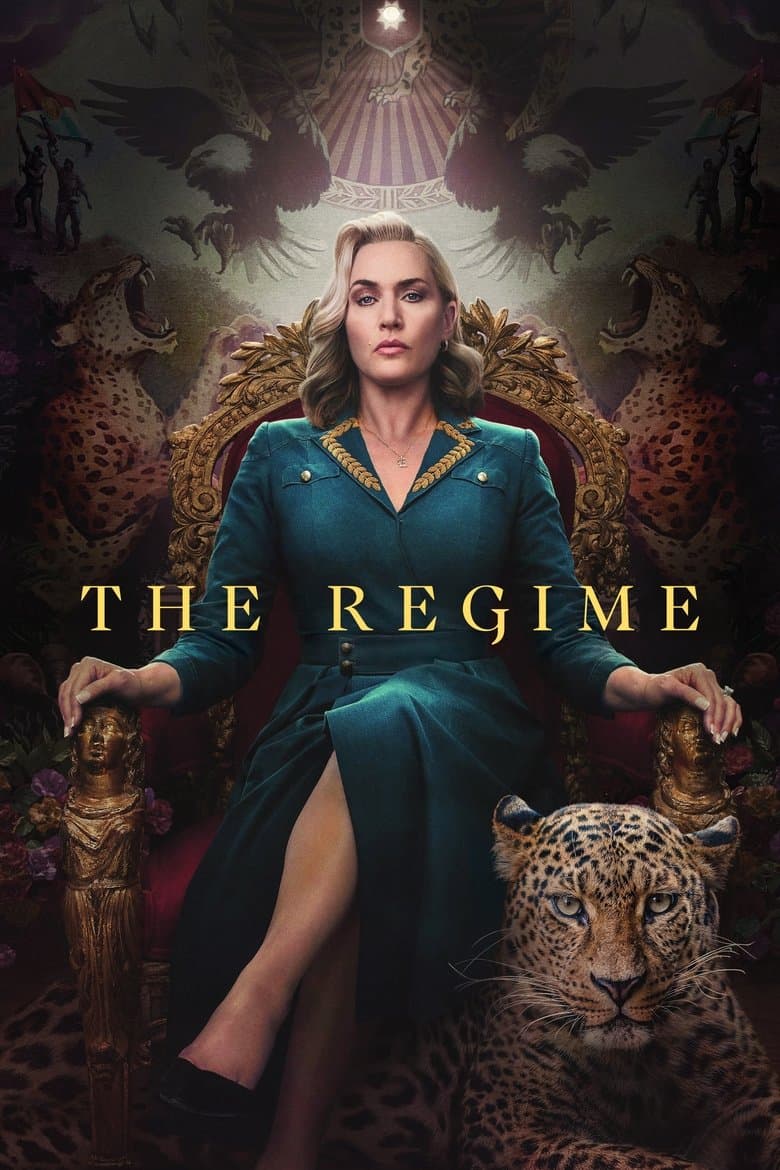
Started March 3, 2024 · Ended · Based on 1 season, 6 episodes through April 7, 2024 · TV-MA · 50 min
The Regime follows Elena Vernham, the unstable chancellor of a small, unnamed country in Central Europe. She rules from a grand palace while fear of mold, illness, and betrayal shapes every decision. Her life changes when Herbert Zubak, a violent soldier blamed for killing protesting miners, becomes her guard and then her lover and adviser. The six episodes mix dark comedy with palace drama as their bond helps push the country toward rebellion and civil war.
The season makes politics its main subject through power, class conflict, and foreign control. It mocks a woman leader who calls her people “my loves” while using threats, radio propaganda, land plans, and military force to keep control. It also shows the United States and China seeking the country’s cobalt while ordinary sugar-beet workers lose jobs. The story treats right-wing populism, American war-making, capitalism, and support for dictators as parts of a broad political joke. The story shows its female leader as dangerous rather than empowering.
Community feedback
Was our 34% Woke rating accurate?
Breakdown
These are the editorial factors and ratings behind our score for The Regime.
Woke representation / casting
Not present. The visible main cast is largely European, and the story puts a woman in charge of a fictional modern European country. A woman chancellor, a woman palace manager, and a woman U.S. senator fit the setting, and the show does not present them as a diversity message.
0%
Woke political dialogue
Elena repeatedly talks about love, the people, war, and national unity while she uses propaganda and crushes dissent. The show attacks American war-making and later shows the United States trading cobalt access for help that returns Elena to power. Zubak pushes land redistribution and rural politics, while the season links his populism to violence and control. These ideas recur across the six episodes, but the writing keeps them broad and satirical instead of building a detailed activist program.
37%
Identity-driven story themes
Not present. The story does not make race, sexuality, gender identity, or DEI part of the conflict. Elena’s female leadership is shown as a tool of power and a source of danger, not as a message that women should rule. The main relationships are a man and woman marriage and a man and woman affair.
0%
Western institutional / cultural critique
The palace treats workers and rural people as tools while leaders make land plans and foreign deals. The show criticizes the United States and China for using the country’s cobalt and helping the regime survive when it benefits them. These points create a recurring critique of global capitalism, foreign power, and political elites across the season. The story mainly attacks dictatorship and greed, so it does not make toxic masculinity, patriarchy, Christianity, or family rules the target.
33%
Woke character or canon changes
Not relevant. The series is an original story about an invented country and has no earlier canon to change.
0%
Anti-woke backlash and complaints
Not present. No sustained anti-woke or anti-left complaint was found in the reviewed public reaction. Critics and viewers mostly argued about weak writing, unclear satire, and the show’s political target.
0%
Creator track record context
Will Tracy, Gary Shteyngart, and Stephen Frears mostly bring liberal or classic-left political themes rather than strong DEI activism. Jessica Hobbs has a mild interest in identity and gender stories. Kate Winslet has supported LGBTQ acceptance and spoken against sexism, while Leo Davis and Lissy Holm have stronger diversity records. This gives the project a moderate background signal, but no strong activist campaign is tied to this show.
34%
Production
TV Show · 2019
Burned out on life, Miles undergoes a strange procedure at a strip mall spa -- and wakes to find he's been replaced by a better version of himself.
TV Show · 2026
The mayor of a New England town resolves to turn it into the next tourist hot spot, despite local warnings that it's cursed.

TV Show · 2022
In disguise as her friend, Ha-ri shows up to a blind date to scare him away. But plans go awry when he turns out to be her CEO — and makes a proposal.
TV Show · 2020
The heartwarming and humorous adventures of a young country vet in the Yorkshire Dales in the 1930s. A remake of the 1978 series.
TV Show · 2016
In his funky California beach enclave, Chip's the go-to guy for personal insights. But he isn't quite as enlightened when it comes to his own baggage.
TV Show · 2024
When aristocratic Eddie inherits the family estate, he discovers that it's home to an enormous weed empire — and its proprietors aren't going anywhere.

TV Show · 2016
Rebellious Mickey and good-natured Gus navigate the thrills and agonies of modern relationships.
TV Show · 2019
In a city of coaching centers known to train India’s finest collegiate minds, an earnest but unexceptional student and his friends navigate campus life.
