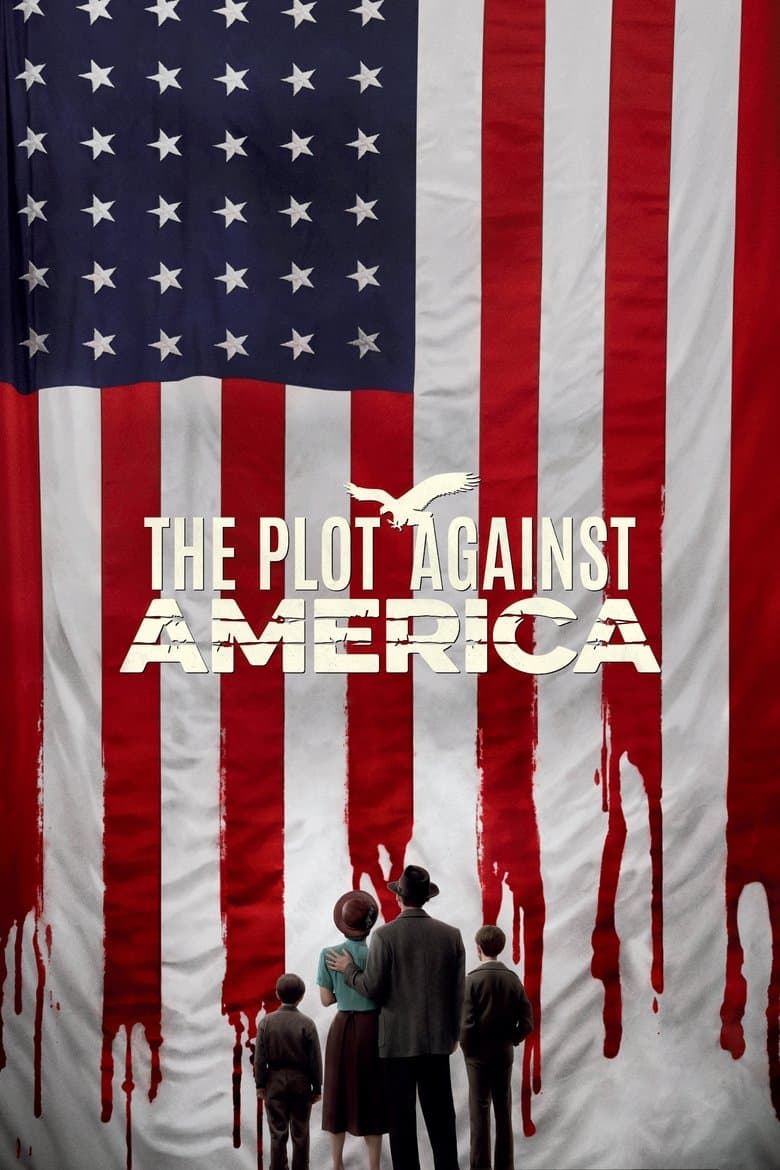
Started March 16, 2020 · Ended · Based on 1 season, 6 episodes through April 20, 2020 · TV-MA · 61 min
Young Philip Levin lives with his working-class Jewish family in Newark, New Jersey, in an alternate 1940s America. Charles Lindbergh wins the presidency and keeps the country out of World War II. His government uses friendly language while it turns neighbors against Jews and breaks families apart. Philip, his parents, his brother, and his cousin struggle to stay safe as fear enters their home and town. The show has a slow, tense, and bleak tone.
The story gives strong attention to anti-Semitism, Jewish identity, political fear, and the loss of trust in public leaders. Lindbergh supporters use claims about Jews to win votes, and government programs pressure Jewish families to become more American. The family argues over whether to resist, cooperate, leave, or fight, so the political message drives nearly every episode. The show also connects its alternate history to modern fears about populism, treating minorities as outsiders, and threats to democracy. The later episodes make that warning more direct as violence, forced relocation, and election interference spread.
Community feedback
Was our 69% Woke rating accurate?
Breakdown
These are the editorial factors and ratings behind our score for The Plot Against America.
Woke representation / casting
Not present. The main roles fit the show's 1940s Jewish Newark setting. The show does not make casting a visible diversity message.
0%
Woke political dialogue
The show gives political arguments a central place in nearly every episode. Herman argues against Lindbergh's isolationism and anti-Semitic speeches, while Bengelsdorf defends the administration and Sandy repeats its claims. Characters debate fascism, Jewish loyalty, forced relocation, violence, military rule, and a damaged election. The series also uses the 1940 story to speak directly about the Trump era and threats to democracy.
63%
Identity-driven story themes
The show centers on a Jewish family whose safety depends on how the country treats its group. Anti-Semitic speech, forced assimilation, relocation, and Klan violence shape the family's choices across the six episodes. The story asks viewers to see how fear turns a minority group into a political target. The series also frames this history as a warning about treating modern minority groups as outsiders.
53%
Western institutional / cultural critique
The show repeatedly presents government agencies, police, courts, media, and elections as weak or captured by the ruling movement. The FBI follows Alvin, the police stand aside during attacks, and officials force Jewish families into relocation programs. The final election is damaged by government interference, while a rabbi and public figures help the regime gain trust. These events are used as a warning about modern democratic failure.
49%
Woke character or canon changes
Not relevant. The adaptation changes the family name, adds scenes, and uses a more open ending. Those are story changes, not identity changes.
0%
Anti-woke backlash and complaints
Breitbart accused the series of targeting Donald Trump and his supporters by linking “America First” to hatred of Jews. Some Reddit users called the show liberal propaganda and objected to its Trump comparison. Mainstream coverage more often praised the show as a timely warning, so the anti-woke backlash was real but limited. The available complaints focus on politics, not casting or LGBTQ content.
36%
Creator track record context
David Simon has a strong progressive and system-critical record, and his cached score is 65/100. Ed Burns's cached score is 39/100 and reflects repeated stories about broken institutions and social problems. Philip Roth's cached score is 0/100, so the original novel was not built from a known activist public profile. Simon's current interviews openly connect the show to the 2016 election, Trump-era fears, and a call for viewers to act.
49%
Production

TV Show · 2022
Irene and Franklin York, a retired couple, have a secret: a Chamber buried in their backyard that miraculously leads to a strange, deserted planet.
TV Show · 2016
Hundreds of years from now, the last surviving humans discover the means of sending consciousness back through time, directly into people in the 21st century.
TV Show · 2024
Rick and Michonne are thrown into another world, built on a war against the dead... And ultimately, a war against the living.

TV Show · 2023
At the brink of going to hell, Yee-jae must cycle through twelve separate lives and twelve separate deaths in this reincarnation drama.
TV Show · 2016
Kyle Barnes has been plagued by possession since he was a child. Now an adult, he embarks on a spiritual journey to find answers, but what he uncovers could mean the end of life…

TV Show · 2024
When a fatal accident occurs on board the International Space Station, a lone astronaut makes the heroic journey back to Earth, only to discover key pieces of her life—including…
TV Show · 2022
Gary is an emotional wreck and struggles to provide for his daughter since the death of his wife. Mary has a secret she can't bring herself to share with anyone.
TV Show · 2024
A mysterious event traps people on a rural Georgia farm, forcing them to unite against an unknown, deadly force. A young boy named Arlo becomes central to uncovering the truth.
