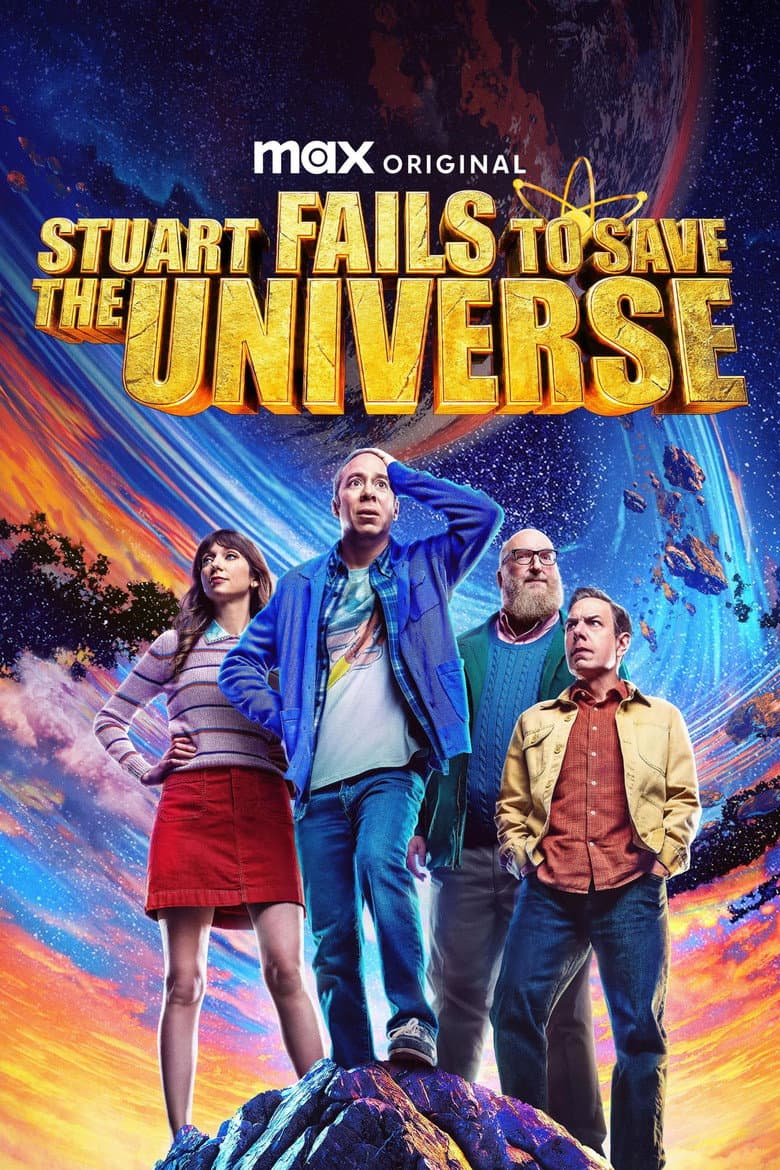
Started July 23, 2026 · Returning Series · Based on 1 season, 5 episodes through August 20, 2026 · TV-MA · 24 min
Stuart Bloom runs a comic book store in Pasadena and usually feels like the least heroic person in the room. He breaks a quantum device made by Sheldon, Leonard, and Howard, and the accident tears the multiverse apart. Stuart travels through strange versions of Earth with Denise, Bert, and Barry Kripke while he searches for a way to restore reality. The group faces a ruined Pasadena, a calm world ruled by an AI, a world where magic is real, and a mental hospital that may be another universe. The tone mixes fast science fiction, dark jokes, monster attacks, comic book references, and an ongoing question about what is real.
The main woke elements are limited and sit beside the larger adventure plot. Denise is a central member of the team, and the story often treats her as practical and brave while Stuart remains the unsure lead. One alternate world shows Barry Kripke married to a man, while other worlds turn Penny into a resistance leader and Bernadette into a powerful sorcerer. These choices add a small identity and role-change layer, but the show mainly uses them for multiverse jokes and character twists rather than activist speeches or a message about modern politics.
Community feedback
Was our 24% Woke rating accurate?
Breakdown
These are the editorial factors and ratings behind our score for Stuart Fails to Save the Universe.
Woke representation / casting
Not present. The main team is a normal mixed-gender group in modern Pasadena. The show does not frame its casting as a diversity or identity statement.
0%
Woke political dialogue
Not present. The episodes do not center on speeches or recurring lines about identity, gender, DEI, or activism. The AI, magic, and psychiatric facility scenes serve the science-fiction plots.
0%
Identity-driven story themes
Barry Kripke has a husband named Gary in one alternate universe. The relationship appears as part of the episode’s strange version of normal life. Denise is a capable member of the team, but the show does not build a repeated women-versus-men message around her. The larger story follows multiverse survival rather than identity politics.
24%
Western institutional / cultural critique
Not present. The AI world warns about control and surveillance, but it does not target a Western institution or modern identity group. The other worlds do not create a repeated argument about family, Christianity, or traditional social rules.
0%
Woke character or canon changes
Penny becomes the leader of a resistance against an AI ruler. Bernadette becomes a powerful sorcerer and then a giant demon. Barry Kripke is shown married to Gary in an alternate world. These repeated versions change established characters’ roles and sexuality, although the multiverse plot explains the changes.
38%
Anti-woke backlash and complaints
Not present. A fringe X account asked whether the show was woke, but the only reply said it was not especially woke and was simply not very good. No wider anti-DEI backlash, boycott, or review-bombing was found.
0%
Creator track record context
Chuck Lorre has a liberal public record and has criticized conservative politicians. Jonathan Frakes has supported progressive causes. Penn, Prady, and Newacheck have little public record of identity-focused activism. Their title interviews frame the show as an underdog science-fiction comedy.
22%
Production
TV Show · 2016
In a world where superheroes have been real for decades, an accountant with zero powers comes to realize his city is owned by a super villain.

TV Show · 2016
In his quest for a bride to break his immortal curse, a 939-year-old guardian of souls meets a grim reaper and a sprightly student with a tragic past.
TV Show · 2022
Gary is an emotional wreck and struggles to provide for his daughter since the death of his wife. Mary has a secret she can't bring herself to share with anyone.
TV Show · 2016
A comedic thriller that follows the bizarre adventures of eccentric “holistic” detective Dirk Gently and his reluctant assistant Todd.

TV Show · 2022
Irene and Franklin York, a retired couple, have a secret: a Chamber buried in their backyard that miraculously leads to a strange, deserted planet.
TV Show · 2016
Shigeo Kageyama, a.k.a. "Mob," is a boy who has trouble expressing himself, but who happens to be a powerful esper.
TV Show · 2022
Denji has a simple dream—to live a happy and peaceful life, spending time with a girl he likes. This is a far cry from reality, however, as Denji is forced by the yakuza into…
TV Show · 2021
Interconnected phone conversations chronicle the mysterious story of a group of strangers whose lives are thrown into disarray in the lead-up to an apocalyptic event.
