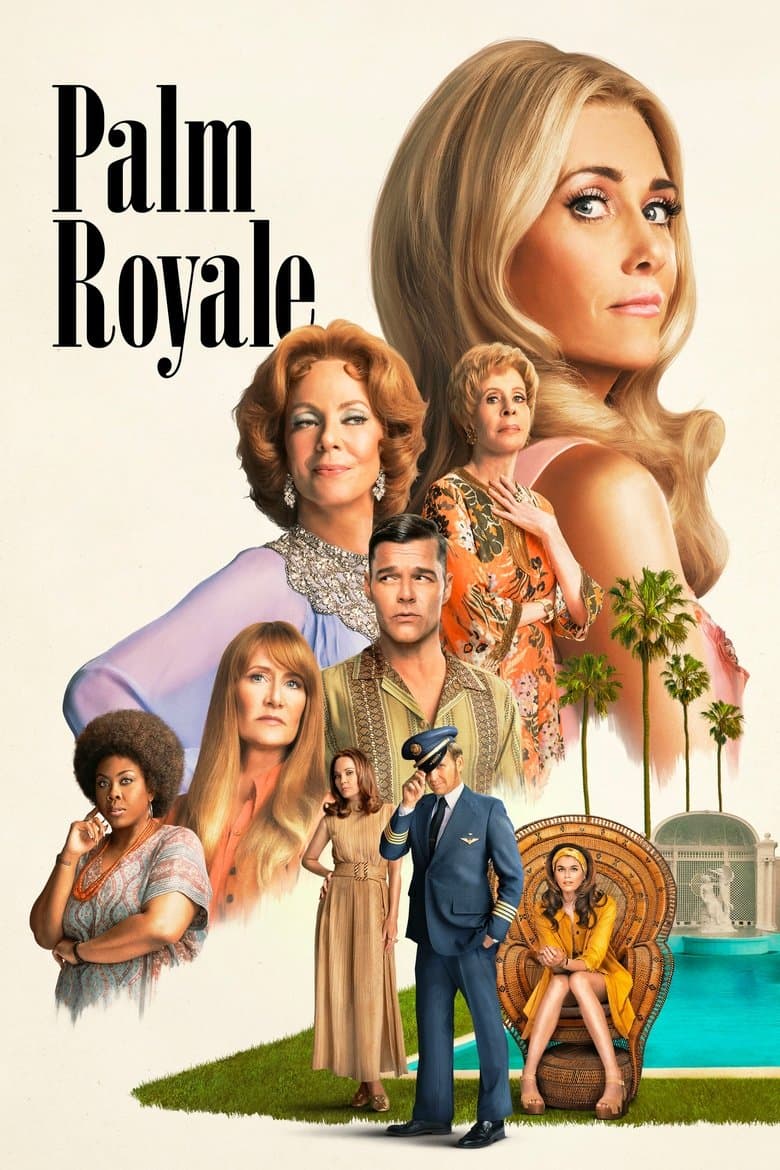
Started March 19, 2024 · Canceled · Based on 2 seasons, 20 episodes through January 13, 2026 · TV-MA
Palm Royale follows Maxine Simmons, a former beauty queen who wants a place among Palm Beach’s richest women. In 1969, she climbs fences, lies, steals, and uses family secrets to enter the Palm Royale country club. Her marriage, money problems, and hunger for status pull her into a fight with Norma, Evelyn, Dinah, and other socialites. The show mixes bright clothes and wild jokes with murder plots, affairs, family secrets, and a lot of soap-opera drama. The story gives repeated space to women’s liberation, abortion, feminist meetings, and women trying to gain power without men. Linda and Virginia lead a women’s group, help with an abortion, aid draft dodgers, and face the FBI after a plot against President Nixon. Robert is a gay bartender whose hidden love life becomes a major part of both seasons, and season two adds an openly gay community around Rock Hudson. Maxine and Evelyn end the story as powerful business partners, while the women often outsmart foolish or controlling men.
Community feedback
Was our 75% Woke rating accurate?
Breakdown
These are the editorial factors and ratings behind our score for Palm Royale.
Woke representation / casting
The show gives prominent roles to a black woman who works with feminists and later acts as an undercover FBI agent. Ricky Martin plays Robert, a gay Latino bartender who becomes a main emotional character. The black female FBI role is a strong identity-visible choice for a 1969 story because women did not become regular FBI special agents until 1972. The main Palm Royale club remains mostly white, so the pattern is noticeable but not a full representation-first design.
48%
Woke political dialogue
Linda calls women to raise the collective consciousness of the global sisterhood. Her bookstore group speaks about women of color, native women, sexuality, and life beyond the home. Characters also discuss abortion, feminism, women’s rights, and the National Organization for Women. These lines return across both seasons and help launch several plots, but the show keeps them inside a campy soap story.
55%
Identity-driven story themes
Women’s liberation shapes the show from the first episode to the ending. Dinah’s abortion, Linda’s activist group, Virginia’s work, and the women’s fight with the FBI give identity issues a continuing plot role. Season two focuses on women finding money, independence, and power without relying on husbands, while Robert’s hidden gay life and a gay community add a strong queer thread. The show often rewards women who reject old roles.
70%
Western institutional / cultural critique
Palm Royale treats marriage, wealth, and the country club as systems that keep women dependent and outsiders in their place. Linda says the rich use charity to help themselves, and the show presents the legal system as a tool that can punish ambitious women. Men often cheat, control money, threaten women, or make foolish choices while women solve the crises and take over the club. The show mocks Nixon-era power and the rich, but it does not attack Christianity or Western culture as a whole.
53%
Woke character or canon changes
Not relevant. The show is a loose adaptation with little of the book beyond the title and some names. It does not make a race, gender, or sexuality swap to an established character or real figure.
0%
Anti-woke backlash and complaints
A few small accounts called Palm Royale woke because it includes abortion, women’s-rights talk, and gay relationships. One Reddit thread repeated complaints about gay library scenes, Stonewall references, and feminist material. A Christian review site also warned about abortion, pro-choice ideas, feminism, and LGBTQ content. No boycott, review-bomb, large-account campaign, or broad news cycle was found.
22%
Creator track record context
stored context describes Abe Sylvia as a gay writer with feminist references and a strongly queer creative style. Laura Dern and Jayme Lemons often support stories about women, representation, and social issues. Writers Celeste Hughey, Juliet McDaniel, and Sharr White add stronger records tied to black women’s stories, women’s rights, or queer identity. Other creators have mixed or low activist records, so the overall context is noticeable but not extreme.
44%
Production
TV Show · 2020
New passions. New fashions. New Emily? A plucky American marketing whiz spreads her wings in life and love after landing her dream job in Paris.
TV Show · 2023
The lives of a realtor, a plumber and a former tennis star unexpectedly collide, exposing America’s obsession with true crime, murder and the slow-close toilet seat.

TV Show · 2019
A paragliding mishap drops a South Korean heiress in North Korea -- and into the life of an army officer, who decides he will help her hide.
TV Show · 2019
Burned out on life, Miles undergoes a strange procedure at a strip mall spa -- and wakes to find he's been replaced by a better version of himself.
TV Show · 2019
In a city of coaching centers known to train India’s finest collegiate minds, an earnest but unexceptional student and his friends navigate campus life.
TV Show · 2020
After being bullied and discriminated because of her ugly looks, a high school girl transforms herself into a gorgeous "goddess" and quickly rises to fame after mastering the art…
TV Show · 2019
Tony had a perfect life. But after his wife Lisa suddenly dies, Tony changes. After contemplating taking his own life, he decides instead to live long enough to punish the world…
TV Show · 2016
In his funky California beach enclave, Chip's the go-to guy for personal insights. But he isn't quite as enlightened when it comes to his own baggage.
