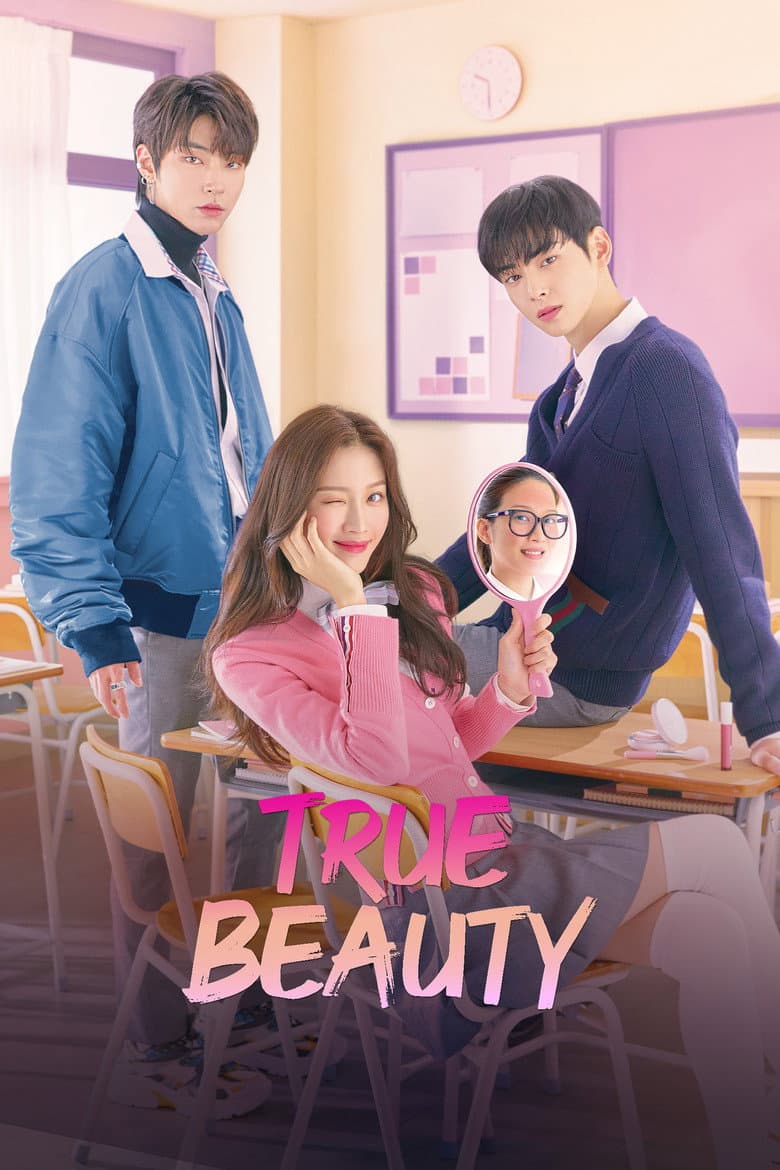
Started December 9, 2020 · Ended · Based on 1 season, 16 episodes through February 4, 2021 · TV-14 · Korean
True Beauty follows Lim Ju-gyeong, a high school student who has been bullied because classmates and family call her ugly. She moves to a new school and learns makeup from online videos, then hides her bare face behind a perfect look. She becomes popular while protecting her secret and gets caught between kind but wounded student Lee Su-ho and rebel Han Seo-jun. The show mixes bright school comedy with romance, bullying, grief, family trouble, and serious scenes about shame and mental health.
The show repeatedly focuses on beauty standards and the way people treat Ju-gyeong differently after her makeover. Makeup gives her confidence and social power, but it also keeps her afraid that friends will reject her real face. Later episodes expose the secret, show her returning to school without makeup, and move her toward a career in makeup. The main message favors self-acceptance and kindness, although the story still gives great social rewards to conventional beauty and handsome romantic heroes.
Community feedback
Was our 16% Woke rating accurate?
Breakdown
These are the editorial factors and ratings behind our score for True Beauty.
Woke representation / casting
Not present. The main roles are Korean students in a Korean school, which fits the story’s setting. The show does not present its casting as a diversity or identity campaign.
0%
Woke political dialogue
Not present. Characters talk about looks, bullying, family stress, and grief. The show does not use modern DEI, gender-politics, or activist speeches.
0%
Identity-driven story themes
The story repeatedly shows students judging people by their looks. Ju-gyeong hides her bare face with makeup because classmates and family treat her badly. Later episodes make her face the secret and attend school without makeup. The ending favors self-acceptance and kindness, but the show presents this as a personal teen story rather than a broad activist message.
32%
Western institutional / cultural critique
Not present. The show criticizes bullying and beauty pressure in a Korean school setting. It does not attack Western institutions, Christianity, capitalism, or traditional family life through activist messaging.
0%
Woke character or canon changes
Not relevant. The TV version changes some events and gives more room to side stories. No established character is changed into a different race, sex, or sexuality, and no hero role is changed for an identity message.
0%
Anti-woke backlash and complaints
Not present. Viewer and news discussion focused on the love triangle, makeup, beauty standards, adaptation choices, and pacing. No meaningful anti-woke or anti-DEI backlash appears in the reviewed coverage.
0%
Creator track record context
Not present. The cached profiles of Kim Sang-hyub, Lee Si-eun, Meow, Kim Young-kyu, and Jang Jung-do show commercial youth, romance, and melodrama work without a documented activist or DEI pattern. The director’s title-related comments focus on coming of age, personal pain, and makeup.
0%
Production
TV Show · 2019
Tony had a perfect life. But after his wife Lisa suddenly dies, Tony changes. After contemplating taking his own life, he decides instead to live long enough to punish the world…

TV Show · 2022
In disguise as her friend, Ha-ri shows up to a blind date to scare him away. But plans go awry when he turns out to be her CEO — and makes a proposal.
TV Show · 2016
After being pulled into the webtoon world created by her father, a surgical resident gets entangled in a murder mystery involving the story's hero.
TV Show · 2018
When his secretary unexpectedly quits, an arrogant executive will do anything to bring her back.
TV Show · 2021
A seemingly ordinary British couple become the focus of an extraordinary investigation when two dead bodies are discovered in the back garden of a house in Nottingham.

TV Show · 2016
Rebellious Mickey and good-natured Gus navigate the thrills and agonies of modern relationships.
TV Show · 2016
In his funky California beach enclave, Chip's the go-to guy for personal insights. But he isn't quite as enlightened when it comes to his own baggage.

TV Show · 2026
The mayor of a New England town resolves to turn it into the next tourist hot spot, despite local warnings that it's cursed.
