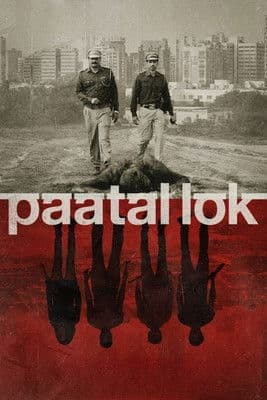
Started May 15, 2020 · Returning Series · Based on 2 seasons, 17 episodes through January 17, 2025 · TV-MA · 45 min · Hindi
Paatal Lok follows Delhi police inspector Hathiram Chaudhary, a tired and often ignored officer who keeps chasing the truth. In season one, he investigates four suspects accused of trying to kill a famous news anchor, and the case opens a hidden world of crime, media power, caste, religion, and violence. Season two moves him and his former partner Imran Ansari to Nagaland after a Naga political leader is murdered and a migrant worker disappears. The show is dark, tense, violent, and serious, but it also uses dry jokes and close looks at ordinary people.
The story puts identity and social unfairness near the center of both seasons. Season one gives major backstories to a Muslim suspect, a man trapped by caste violence, and Cheeni, a transgender woman from the Northeast, while Ansari faces religious insults inside the police force. Season two adds a gay relationship for Ansari, a woman police leader who pushes back against men, and conflicts between local Naga people, Delhi officials, rich business groups, and migrant workers. These themes often explain why characters suffer or act, although the second season spends more time on personal guilt and the crime mystery than on direct political speeches.
Community feedback
Was our 82% Woke rating accurate?
Breakdown
These are the editorial factors and ratings behind our score for Paatal Lok.
Woke representation / casting
The show puts a Muslim police officer, a transgender woman, and several Northeast characters in major roles. Season 1 makes these identity choices part of the four-suspect design, and the creator linked Ansari's casting to the low Muslim share in Delhi Police. Season 2 adds local Naga performers and a woman police leader, but those choices fit its Nagaland setting. The repeated identity focus is clear, although the cast is not built as a simple quota-style group.
44%
Woke political dialogue
Ansari's coworkers discuss how his Muslim identity affects his career and tell him to sound positive and progressive on political questions. Other characters argue about caste, religious violence, fake news, and outsider treatment. Season 2 keeps some talk about local politics, migrant workers, and the police system. Season 2 uses fewer direct political lines than season 1.
44%
Identity-driven story themes
The first season makes caste, religion, regional identity, and transgender discrimination part of the main mystery. The four suspects receive backstories that show how family, violence, and social rank shape their choices. The second season centers local Naga politics, outsider treatment, migrant hardship, drug addiction, and a gay police officer's fear of coming out. These themes recur across both seasons and often explain the crime, but the show remains a broad crime thriller.
68%
Western institutional / cultural critique
The show repeatedly presents Indian police, news media, caste hierarchy, and male power as systems that harm ordinary people. Season one links religious mob violence and fake news to wider public institutions. Season two questions closed-door development deals and shows women carrying the cost of men's crimes. The critique is modern and activist-leaning, but it is aimed at Indian institutions rather than Christianity or Western culture.
35%
Woke character or canon changes
Season 2 gives established officer Imran Ansari a newly revealed gay identity. Season 1 did not establish a same-sex relationship for Ansari, so this is a clear identity change across the series. The change drives a key conversation with Hathi Ram, but it is not the main murder plot.
28%
Anti-woke backlash and complaints
Right-wing groups called season one anti-national, Hinduphobic, and leftist because it showed religious violence, caste abuse, and police failure. The boycott hashtag trended, and news reports described a large wave of one-star ratings and complaints from BJP-linked figures. Sikh and Gorkha groups also objected to scenes and a slur, although those complaints focused more on community offense than woke politics. Season two had no comparable anti-woke campaign in the reviewed coverage.
55%
Creator track record context
Sudip Sharma's cached profile shows a repeated focus on caste, class, religion, gendered power, and institutional failure, with a score of 62/100. Anushka Sharma and Karnesh Sharma have backed several female-centered and socially pointed projects, with cached scores of 62/100 and 58/100. Nikita Grover's cached score is 55/100 because her casting work often seeks local and underused performers. The directors and most other writers have low or mixed cached scores.
58%
Production
TV Show · 2020
New Orleans judge Michael Desiato is forced to confront his own deepest convictions when his son is involved in a hit and run that embroils an organized crime family.
TV Show · 2019
Gypsy Blanchard struggles to deal with the toxic relationship with her overprotective mother, but her attempts to free herself lead to murder.
TV Show · 2020
Picking up just days after the “Power” finale, this sequel series follows Tariq navigating his new life, in which his desire to shed his father’s legacy comes up against the…
TV Show · 2021
A world-famous comedian desperately searches for a way out after a night in Philadelphia with his brother threatens to sabotage more than his success.
TV Show · 2022
Under pressure, fraying at the edges. In relentless night-time Liverpool, copper Chris is paired with a rookie. Will they save or destroy each other?
TV Show · 2018
Ray Shoesmith is a father, ex-husband, boyfriend and best friend: tough roles to juggle in the modern age. Even harder when you’re a criminal for hire.
TV Show · 2017
Covert operative Tom Keen joins forces with Susan "Scottie" Hargrave, the brilliant and cunning chief of a covert mercenary organization that solves problems that are too…
TV Show · 2019
A group of working-class friends finding unconventional ways to win at life in suburban northern England. These lads have dealt, scammed, bribed and conned their way through…
