Started February 12, 2019 · Canceled · Based on 4 seasons, 37 episodes through August 28, 2023 · TV-MA · 23 min
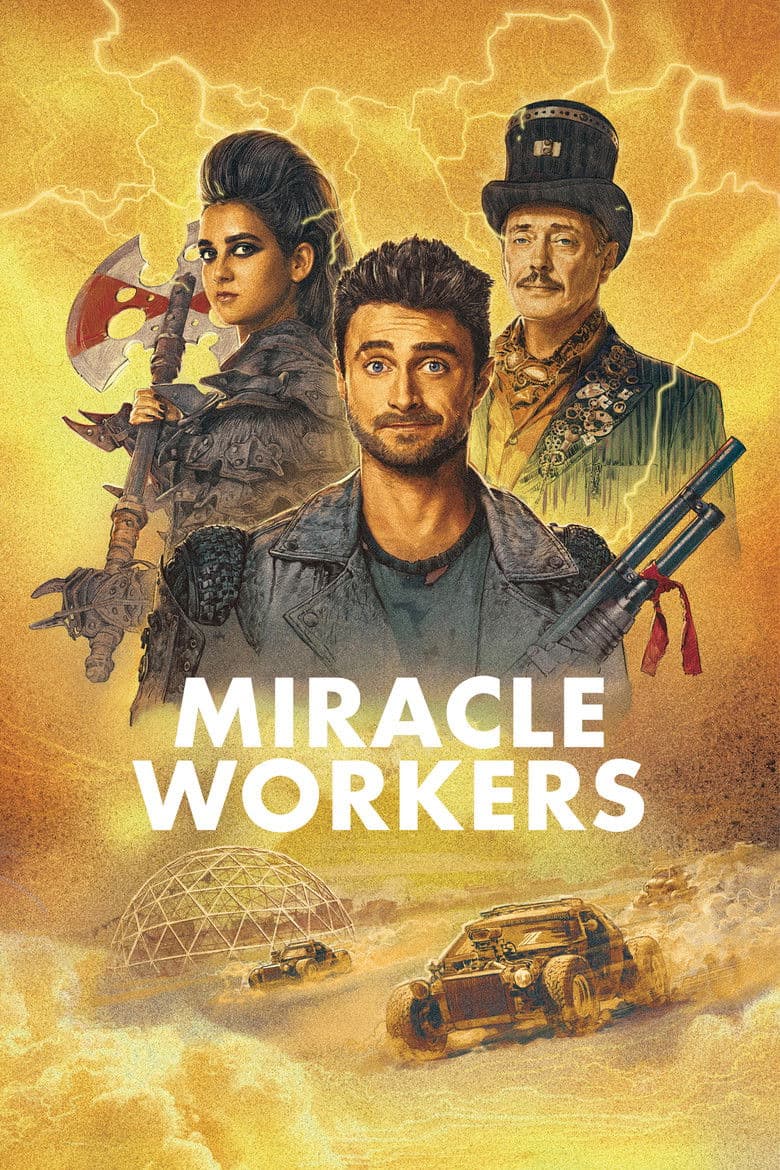
Miracle Workers is a four-season comedy anthology with the same main cast playing new people in each story. In the first season, angels Craig and Eliza try to save Earth after a careless God plans to destroy it. The later seasons follow an ambitious peasant and a gentle prince in the Middle Ages, travelers crossing the Oregon Trail, and a married warlord and road warrior trying to live in a post-nuclear suburb. The show uses silly jokes, rude humor, fantasy, and sudden dark violence to turn faith, work, love, family, and survival into comic problems.
The most visible woke elements are a repeated pattern of capable women in major roles and a diverse cast in leading roles, including a South Asian actress as the central woman in every season. The historical seasons also use stories about class, the limits placed on women, Native land, and a so-called white savior, but the show presents those points through broad comedy rather than long political speeches. The fourth season adds a brief same-sex romantic subplot between Morris and the robot Tai, while Freya's pregnancy and life as a warlord add more gender and family themes. These ideas appear across the anthology, but the show remains mainly an absurd adventure comedy about odd people trying to build better lives.
Community feedback
Was our 41% Woke rating accurate?
Breakdown
These are the editorial factors and ratings behind our score for Miracle Workers.
Woke representation / casting
Geraldine Viswanathan plays the main woman in all four seasons. Eliza, Alexandra, Prudence, and Freya are each smart, bold, or driven, and Freya is a warrior leader. Karan Soni also holds major roles in every season. The historical seasons place these South Asian actors in prominent medieval and 1844 American West roles without story reasons for their identities, which makes the repeated casting pattern more noticeable.
41%
Woke political dialogue
Season 1 uses direct jokes about God, prayer, and the end of the world. Season 2 has short political plots about royal power, income gaps, a fake doctor, and a forced marriage. Season 3 has one clear activist-style episode titled “White Savior,” where a Bureau of Indian Affairs general tries to remove Blackfeet from their land. Most of the dialogue stays silly and tied to the setting, so modern political speech is limited.
25%
Identity-driven story themes
Alexandra wants a life beyond the job forced on her, and Prudence wants freedom from a dull marriage and strict social rules. Freya is a central warlord who later faces pregnancy and the choice between violence and family life. Season 4 also gives Morris and the male robot Tai a brief sexual relationship. The show treats these ideas as jokes and character problems rather than as a main activist message.
30%
Western institutional / cultural critique
Season 1 repeatedly mocks Heaven as a broken company and shows God as lazy, foolish, and unable to care for humanity. Season 2 attacks royal rule, bad health care, inherited jobs, and class gaps through medieval jokes. Season 3 mocks patriotic pride, religious zeal, and the Bureau of Indian Affairs, while Season 4 mocks the HOA and a rich sky city that ignores poor people. These targets recur across the show, but the tone is broad comedy instead of a detailed modern attack on Western society.
30%
Woke character or canon changes
Not relevant. Each season creates new characters and settings instead of changing a known hero or canon. Historical figures such as Uncle Sam and Bill Maher appear as jokes, not as changed versions of established characters.
0%
Anti-woke backlash and complaints
Not present. Religious groups and right-leaning writers called the show blasphemous or anti-Christian, especially because of its comic version of God. Those complaints were about religious offense, not woke, DEI, or identity politics. The supplied X search found no anti-woke reaction, and broader audience discussion focused on humor and season quality.
0%
Creator track record context
Simon Rich is mainly known for absurd comedy and has little activist history. Most producers, directors, and writers have little or no public activist record. Daniel Radcliffe’s public support for transgender rights is a clearer signal, and Heather Anne Campbell has made public left-leaning statements. The people linked to the show add some context, but their politics are not the main reason the series has the themes described above.
29%
Production

TV Show · 2026
The mayor of a New England town resolves to turn it into the next tourist hot spot, despite local warnings that it's cursed.

TV Show · 2016
In his funky California beach enclave, Chip's the go-to guy for personal insights. But he isn't quite as enlightened when it comes to his own baggage.

TV Show · 2016
Rebellious Mickey and good-natured Gus navigate the thrills and agonies of modern relationships.

TV Show · 2020
New passions. New fashions. New Emily? A plucky American marketing whiz spreads her wings in life and love after landing her dream job in Paris.

TV Show · 2019
Tony had a perfect life. But after his wife Lisa suddenly dies, Tony changes. After contemplating taking his own life, he decides instead to live long enough to punish the world…

TV Show · 2020
The heartwarming and humorous adventures of a young country vet in the Yorkshire Dales in the 1930s. A remake of the 1978 series.

TV Show · 2022
In disguise as her friend, Ha-ri shows up to a blind date to scare him away. But plans go awry when he turns out to be her CEO — and makes a proposal.

TV Show · 2018
When his secretary unexpectedly quits, an arrogant executive will do anything to bring her back.
