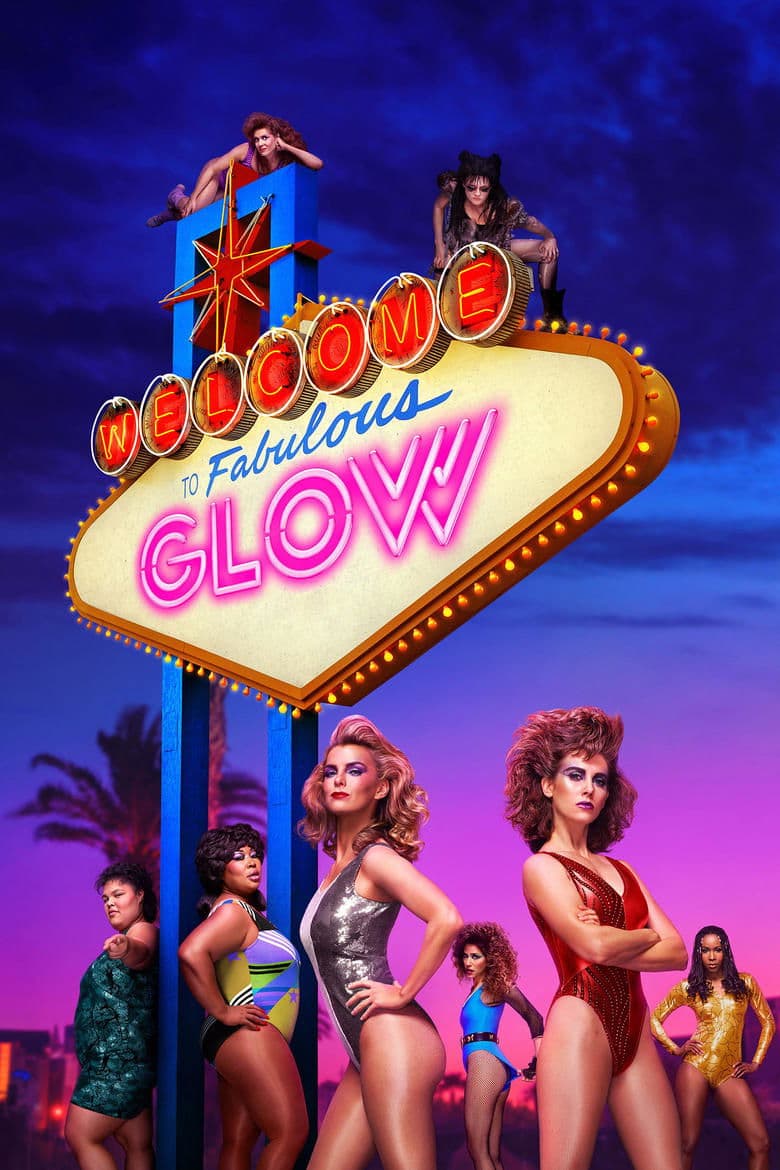
Started June 23, 2017 · Canceled · Based on 3 seasons, 30 episodes through August 9, 2019 · TV-MA
GLOW follows Ruth Wilder, a struggling actress in 1980s Los Angeles who joins a new women’s wrestling program. She trains with a large group of performers while trying to build a career and repair her broken friendship with Debbie, whose husband she slept with. The women create bold ring characters, learn dangerous moves, and fight to keep their show alive as money and producers threaten it. The tone mixes bright costumes and silly wrestling with arguments about work, love, betrayal, family, and pain.
The series gives women control of the main story and repeatedly shows them pushing back against male bosses, sexual pressure, body judgment, and old ideas about women’s work. Several major wrestlers are black, Indian-American, Cambodian-American, Latina, British, or white, and some ring characters use ethnic stereotypes as part of the period setting. Season 3 makes queer identity much more visible through Arthie and Yolanda’s relationship, Bash’s struggle with his sexuality, a drag performer, and an AIDS fund-raiser. These themes grow from side stories in the first two seasons into a larger part of the latest season, but the show still presents them through personal drama and comedy rather than long political speeches.
Community feedback
Was our 62% Woke rating accurate?
Breakdown
These are the editorial factors and ratings behind our score for GLOW.
Woke representation / casting
The ensemble gives prominent roles to Black, Indian-American, Cambodian-American, Latina, British, and white women. The mix looks deliberately varied for a small 1980s TV cast, even though Los Angeles and the real GLOW were diverse. The ring names and roles make ethnicity part of the visible design, including Welfare Queen, Fortune Cookie, Beirut, and Machu Picchu. The all-woman wrestling cast fits the premise, so the strongest signal comes from the repeated ethnic choices and Netflix’s later diverse-talent marketing.
33%
Woke political dialogue
Women repeatedly talk about sexism in acting, wrestling, and television. Ruth faces a network chief who pressures her for sex, and the show treats the abuse as part of a larger workplace problem. The wrestlers also discuss racist ring characters, homophobic jokes, and the danger of being gay during the AIDS crisis. The talks are usually tied to personal scenes and 1980s events, so the show rarely sounds like a long activist speech.
39%
Identity-driven story themes
The women build a shared career and push back against being treated as decoration. The story returns to female friendship, sexual harassment, pregnancy, motherhood, body pain, and control over work. Season 3 makes queer identity a major subplot through Arthie and Yolanda’s relationship and Bash’s struggle with his sexuality during the AIDS crisis. The show usually presents self-acceptance and honest friendship as the better path, while keeping the tone funny and personal.
56%
Western institutional / cultural critique
The show places its women inside a business run mainly by men who control money, casting, schedules, and safety. Sam is sexist and exploitative, a network chief harasses Ruth, and Debbie fights to gain power as a producer. Season 3 shows a casino turning women’s bodies and labor into a repeated product, while an AIDS fund-raiser exposes hostility toward gay performers. The story keeps these conflicts tied to the 1980s workplace and gives its men mixed motives, so the critique is recurring but not a total attack on Western institutions.
43%
Woke character or canon changes
Not relevant. The show creates fictional characters around a real wrestling idea. It does not change a known character or real person to make an identity point.
0%
Anti-woke backlash and complaints
Small right-leaning and anti-feminist posts called the show feminist garbage or said it moved toward woke ideas. Another small post praised the show for not becoming fully woke, which shows suspicion but is not a complaint that GLOW itself was propaganda. The available search found no large review-bombing push, boycott campaign, or major news fight about GLOW’s politics. The reaction is fringe and mixed.
15%
Creator track record context
Liz Flahive and Carly Mensch are linked to female-centered stories and later feminist themes. Jenji Kohan and Tara Herrmann are linked to Orange Is the New Black, which often centers race, gender, sexuality, and social issues. Sascha Rothchild has progressive-leaning work, and John Cameron Mitchell has a strong queer-focused career. Other credited writers and directors have mixed or limited public political records, so the creator signal is clear but not uniform.
57%
Production

TV Show · 2019
A paragliding mishap drops a South Korean heiress in North Korea -- and into the life of an army officer, who decides he will help her hide.
TV Show · 2024
When aristocratic Eddie inherits the family estate, he discovers that it's home to an enormous weed empire — and its proprietors aren't going anywhere.
TV Show · 2019
Burned out on life, Miles undergoes a strange procedure at a strip mall spa -- and wakes to find he's been replaced by a better version of himself.
TV Show · 2019
Tony had a perfect life. But after his wife Lisa suddenly dies, Tony changes. After contemplating taking his own life, he decides instead to live long enough to punish the world…

TV Show · 2019
In a city of coaching centers known to train India’s finest collegiate minds, an earnest but unexceptional student and his friends navigate campus life.
TV Show · 2016
Rebellious Mickey and good-natured Gus navigate the thrills and agonies of modern relationships.
TV Show · 2020
New passions. New fashions. New Emily? A plucky American marketing whiz spreads her wings in life and love after landing her dream job in Paris.
TV Show · 2020
After being bullied and discriminated because of her ugly looks, a high school girl transforms herself into a gorgeous "goddess" and quickly rises to fame after mastering the art…
